
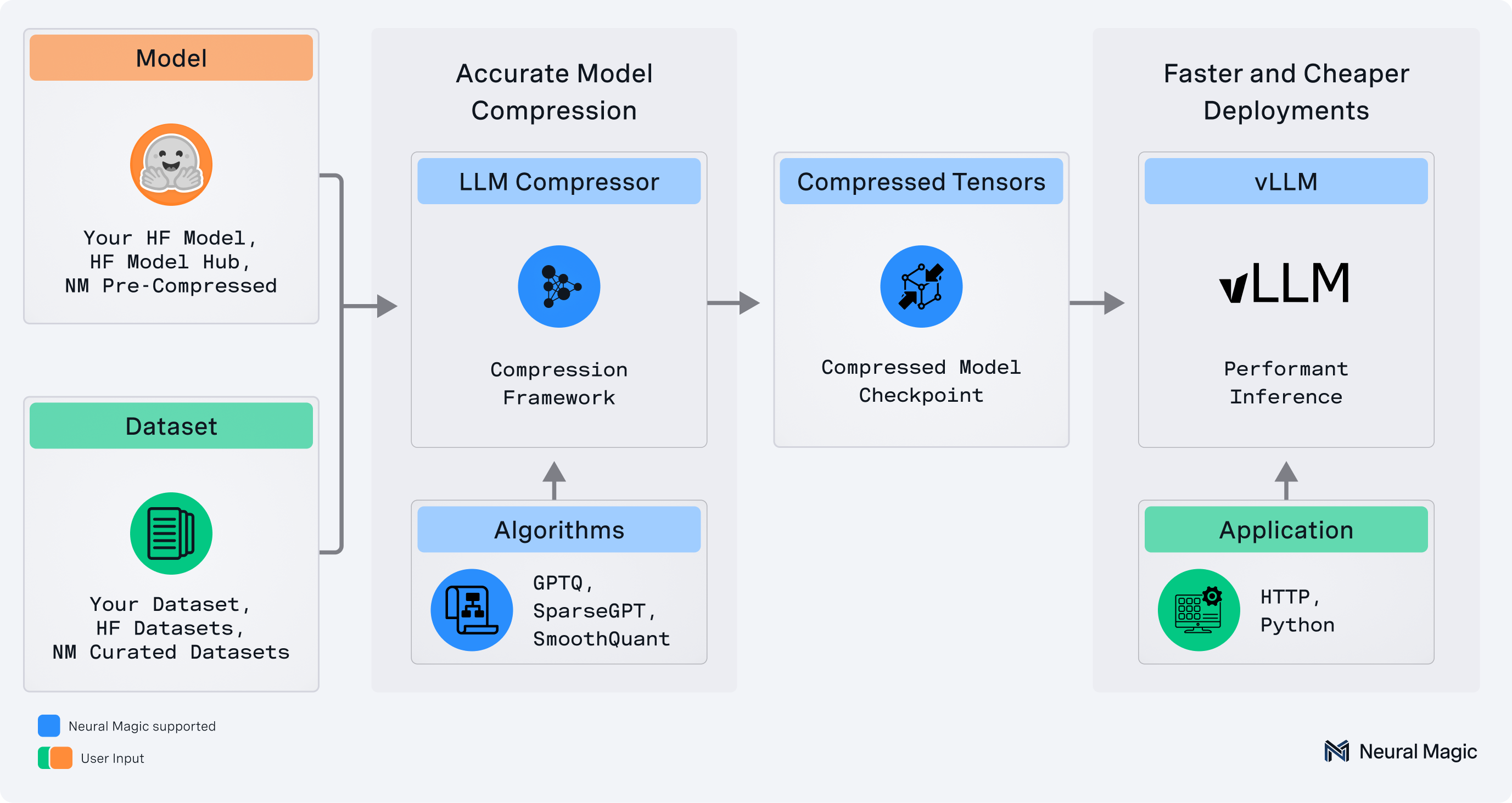
A library for compressing large language models utilizing the latest techniques and research in the field for both training aware and post training techniques. The library is designed to be flexible and easy to use on top of PyTorch and HuggingFace Transformers, allowing for quick experimentation.

Project description
 LLM Compressor


llmcompressor is an easy-to-use library for optimizing models for deployment with vllm, including:
- Comprehensive set of quantization algorithms for weight-only and activation quantization
- Seamless integration with Hugging Face models and repositories
safetensors-based file format compatible withvllm- Large model support via
accelerate
✨ Read the announcement blog here! ✨
💬 Join us on the vLLM Community Slack and share your questions, thoughts, or ideas in:
#sig-quantization#llm-compressor
🚀 What's New!
Big updates have landed in LLM Compressor! To get a more in-depth look, check out the LLM Compressor overview.
Some of the exciting new features include:
- Updated offloading and model loading support: Loading transformers models that are offloaded to disk and/or offloaded across distributed process ranks is now supported. Disk offloading allows users to load and compress very large models which normally would not fit in CPU memory. Offloading functionality is no longer supported through accelerate but through model loading utilities added to compressed-tensors. For a full summary of updated loading and offloading functionality, for both single-process and distributed flows, see the Big Models and Distributed Support guide.
- Distributed GPTQ Support: GPTQ now supports Distributed Data Parallel (DDP) functionality to significantly improve calibration runtime. An example using DDP with GPTQ can be found here.
- Updated FP4 Microscale Support: GPTQ now supports FP4 quantization schemes, including both MXFP4 and NVFP4. MXFP4 support has also been improved with updated weight scale generation. Models with weight-only quantization in the MXFP4 format can now run in vLLM as of vLLM v0.14.0. MXFP4 models with activation quantization are not yet supported in vLLM for compressed-tensors models
- New Model-Free PTQ Pathway: A new model-free PTQ pathway has been added to LLM Compressor, called
model_free_ptq. This pathway allows you to quantize your model without the requirement of Hugging Face model definition and is especially useful in cases whereoneshotmay fail. This pathway is currently supported for data-free pathways only i.e FP8 quantization and was leveraged to quantize the Mistral Large 3 model. Additional examples have been added illustrating how LLM Compressor can be used for Kimi K2 - Extended KV Cache and Attention Quantization Support: LLM Compressor now supports attention quantization. KV Cache quantization, which previously only supported per-tensor scales, has been extended to support any quantization scheme including a new
per-headquantization scheme. Support for these checkpoints is on-going in vLLM and scripts to get started have been added to the experimental folder
Supported Formats
- Activation Quantization: W8A8 (int8 and fp8)
- Mixed Precision: W4A16, W8A16, NVFP4 (W4A4 and W4A16 support)
- 2:4 Semi-structured and Unstructured Sparsity
Supported Algorithms
- Simple PTQ
- GPTQ
- AWQ
- SmoothQuant
- SparseGPT
- AutoRound
When to Use Which Optimization
Please refer to compression_schemes.md for detailed information about available optimization schemes and their use cases.
Installation
pip install llmcompressor
Get Started
End-to-End Examples
Applying quantization with llmcompressor:
- Activation quantization to
int8 - Activation quantization to
fp8 - Activation quantization to
fp4 - Activation quantization to
fp4using AutoRound - Activation quantization to
fp8and weight quantization toint4 - Weight only quantization to
fp4(NVFP4 format) - Weight only quantization to
fp4(MXFP4 format) - Weight only quantization to
int4using GPTQ - Weight only quantization to
int4using AWQ - Weight only quantization to
int4using AutoRound - KV Cache quantization to
fp8 - Attention quantization to
fp8(experimental) - Attention quantization to
nvfp4with SpinQuant (experimental) - Quantizing MoE LLMs
- Quantizing Vision-Language Models
- Quantizing Audio-Language Models
- Quantizing Models Non-uniformly
User Guides
Deep dives into advanced usage of llmcompressor:
Quick Tour
Let's quantize Qwen3-30B-A3B with FP8 weights and activations using the Round-to-Nearest algorithm.
Note that the model can be swapped for a local or remote HF-compatible checkpoint and the recipe may be changed to target different quantization algorithms or formats.
Apply Quantization
Quantization is applied by selecting an algorithm and calling the oneshot API.
from compressed_tensors.offload import dispatch_model
from transformers import AutoModelForCausalLM, AutoTokenizer

from llmcompressor import oneshot
from llmcompressor.modifiers.quantization import QuantizationModifier

MODEL_ID = "Qwen/Qwen3-30B-A3B"

# Load model.
model = AutoModelForCausalLM.from_pretrained(MODEL_ID, dtype="auto")
tokenizer = AutoTokenizer.from_pretrained(MODEL_ID)

# Configure the quantization algorithm and scheme.
# In this case, we:
#   * quantize the weights to FP8 using RTN with block_size 128
#   * quantize the activations dynamically to FP8 during inference
recipe = QuantizationModifier(
    targets="Linear",
    scheme="FP8_BLOCK",
    ignore=["lm_head", "re:.*mlp.gate$"],
)

# Apply quantization.
oneshot(model=model, recipe=recipe)

# Confirm generations of the quantized model look sane.
print("========== SAMPLE GENERATION ==============")
dispatch_model(model)
input_ids = tokenizer("Hello my name is", return_tensors="pt").input_ids.to(
    model.device
)
output = model.generate(input_ids, max_new_tokens=20)
print(tokenizer.decode(output[0]))
print("==========================================")

# Save to disk in compressed-tensors format.
SAVE_DIR = MODEL_ID.split("/")[1] + "-FP8-BLOCK"
model.save_pretrained(SAVE_DIR)
tokenizer.save_pretrained(SAVE_DIR)
Inference with vLLM
The checkpoints created by llmcompressor can be loaded and run in vllm:
Install:
pip install vllm
Run:
from vllm import LLM
model = LLM("Qwen/Qwen3-30B-A3B-FP8-BLOCK")
output = model.generate("My name is")
Questions / Contribution
- If you have any questions or requests open an issue and we will add an example or documentation.
- We appreciate contributions to the code, examples, integrations, and documentation as well as bug reports and feature requests! Learn how here.
Citation
If you find LLM Compressor useful in your research or projects, please consider citing it:
@software{llmcompressor2024,
    title={{LLM Compressor}},
    author={Red Hat AI and vLLM Project},
    year={2024},
    month={8},
    url={https://github.com/vllm-project/llm-compressor},
}
Release history Release notifications | RSS feed


Download files
Download the file for your platform. If you're not sure which to choose, learn more about installing packages.
Source Distribution
Built Distribution
Filter files by name, interpreter, ABI, and platform.
If you're not sure about the file name format, learn more about wheel file names.
Copy a direct link to the current filters
File details
Details for the file llmcompressor-0.10.0.tar.gz.
File metadata
- Download URL: llmcompressor-0.10.0.tar.gz
- Upload date:
- Size: 1.9 MB
- Tags: Source
- Uploaded using Trusted Publishing? No
- Uploaded via: twine/6.2.0 CPython/3.10.12
File hashes
| Algorithm | Hash digest | |
|---|---|---|
| SHA256 |
ad920cd99fc074a44fe5bdacbd4e78406b2f6a9c61d2c8a071f11c7f1efe447d
|
|
| MD5 |
1fbb3b3e0b5b0bbb95f1e18cb1929684
|
|
| BLAKE2b-256 |
2838ce56224dd6863ec38c9f2ce5ffaaf8e9dfa3f6c03a9faad9df4079549c1f
|
File details
Details for the file llmcompressor-0.10.0-py3-none-any.whl.
File metadata
- Download URL: llmcompressor-0.10.0-py3-none-any.whl
- Upload date:
- Size: 295.5 kB
- Tags: Python 3
- Uploaded using Trusted Publishing? No
- Uploaded via: twine/6.2.0 CPython/3.10.12
File hashes
| Algorithm | Hash digest | |
|---|---|---|
| SHA256 |
93a8ab728bada33bbf2a23f80ac912d8220943a496a9bde24df163f0db91b19e
|
|
| MD5 |
836c008c0e1b84cd5c02d75f867d6b17
|
|
| BLAKE2b-256 |
c6304a2079bd9f699fccaebdfe48049a9fa714ec5a997a7b573f612d410725ba
|






