
LLMRig
Know what your rig can run.
The open compatibility and performance intelligence layer for local AI.


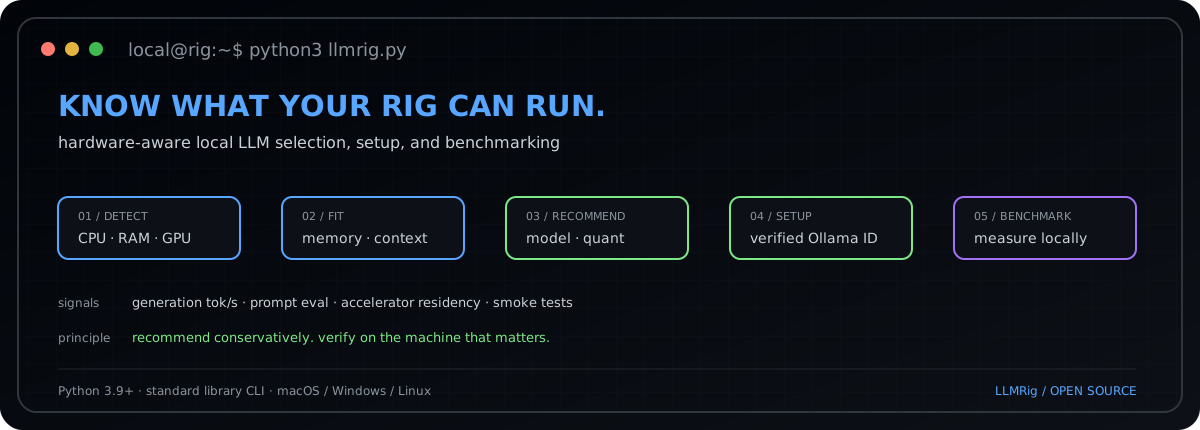
LLMRig determines viable ways to run AI models on real hardware. It keeps model, artifact, quantization, runtime, context, and measured performance separate so missing evidence does not become a confident recommendation.
Install the isolated CLI and run the safest useful first command:
pipx install llmrig
llmrig solve qwen3:0.6b
Default solve is read-only: it does not download a model, install or start a
runtime, execute inference, or write benchmark output. Measurement is an explicit
step with --verify, and only already-local candidates are eligible.
hardware
  → model and artifact resolution
  → runtime compatibility and local availability
  → read-only solve
  → optional measured verification
  → reproducible evidence
LLMRig is Qwen-first today. Curated setup uses Ollama. Local race measurement also supports llama.cpp and MLX-LM when compatible artifacts and runtimes are already present; LLMRig does not install those native runtimes or download their artifacts.
Install
pipx is recommended for the CLI:
pipx install llmrig
pipx upgrade llmrig
llmrig --version
If pipx is unavailable, use a virtual environment. This also avoids PEP 668
errors from system-managed Python installations.
python3 -m venv .venv
source .venv/bin/activate  # macOS/Linux
python -m pip install llmrig
On Windows PowerShell:
python -m venv .venv
.venv\Scripts\Activate.ps1
python -m pip install llmrig
LLMRig supports Python 3.9+ on macOS, Linux, and Windows and has no third-party
Python runtime dependencies. It can also run directly from a source checkout with
python3 llmrig.py.
Solve first
Analyze a curated model or exact owner/repository Hugging Face identifier:
llmrig solve MODEL
llmrig solve MODEL --json
llmrig solve MODEL --context 32768
llmrig solve MODEL --local-artifact llama.cpp=/path/to/model.gguf
llmrig solve MODEL --local-artifact mlx-lm=/path/to/model-directory
Hugging Face resolution reads metadata and file listings but does not download
weights. Native artifacts are inspected only at paths explicitly supplied with
--local-artifact; LLMRig does not scan arbitrary filesystem locations.
Solve reports these evidence dimensions independently:
compatible != local
local != executable
executable != measurable
measurable != measured
measured != recommended
Unknown is not false. An observed Ollama name is local evidence, not independent content attestation. A native model association is supplied by the user: LLMRig checks its local structure but does not attest its identity, weights, quality, or quantization. Private native paths stay out of public solve results.
Solve does not calculate a universal score, infer quality from throughput, or promise a winner. It recommends a planning candidate only when the available evidence supports exactly one runnable configuration with no comparable unresolved alternative. An inconclusive result is valid.
Verify explicitly
llmrig solve MODEL \
  --local-artifact llama.cpp=/path/to/model.gguf \
  --verify
solve --verify executes only compatible, already-local, executable, measurable
candidates. It requires at least two comparable configurations and reuses the
unchanged race-v2 workload, two-sample rule, 5% comparison threshold, and balanced
Pareto decision. It does not pull models, install or start runtimes, scan for
artifacts, or write passports. Fewer than two candidates makes verification
unavailable without executing inference; a competitor failure invalidates the
comparison; multiple Pareto members remain inconclusive.
Solve exit codes are:
0: analysis completed, including a completed but inconclusive verification1: an operational solve or attempted verification failure2: invalid/unresolvable input or unavailable requested verification
Minimal Python SDK
import llmrig

result = llmrig.solve("qwen3:0.6b")
print(result.plan.recommendation_status)
The stable entry point is:
llmrig.solve(
    model,
    *,
    context=None,
    local_artifacts=(),
    verify=False,
) -> llmrig.SolveResult
It prints nothing and never exits the process. local_artifacts accepts
RUNTIME=PATH strings. Invalid or unresolvable input raises SolveInputError;
operational failures raise SolveEngineError. SolveResult and SolveCandidate
are the deliberate public result contracts. _llmrig is private implementation.
Measurement commands
The measurement commands share local execution machinery but answer different questions:
| Command | Purpose | Result rule | Writes passports |
|---|---|---|---|
solve --verify |
Verify a solve candidate set | Balanced Pareto decision, or inconclusive | No |
race |
Measure at least two local configurations | Metric-specific generation, prompt, and latency results | Optional |
choose |
Explain one measured objective | generation, prompt, latency, or balanced |
No |
optimize |
Expose measured tradeoffs | Unranked noise-aware Pareto frontier | No |
bench |
Run the full Ollama benchmark | Throughput, residency data when available, and smoke tests | Optional |
Race two already-local native configurations, or combine one with an installed equivalent Ollama build:
llmrig race MODEL \
  --local-artifact llama.cpp=/path/to/model.gguf \
  --local-artifact mlx-lm=/path/to/model-directory
race never installs or downloads. At most one explicit artifact per native
runtime is accepted. A GGUF target must be a non-empty .gguf file. An MLX-LM
target must have an immediate non-empty config.json and at least one immediate
non-empty model*.safetensors file. These structural checks do not prove the
runtime can load the artifact or that differently packaged artifacts have identical
weights or quality.
Race exit 0 means at least two competitors were measured successfully, 1 means
execution failed and invalidated the comparison, and 2 means the race is
unavailable or unresolved. Results within 5% are inconclusive. There is no
composite result or model-quality claim.
Choose an explicit objective from the same measured race path:
llmrig choose MODEL --objective generation
llmrig choose MODEL --objective prompt --json
llmrig choose MODEL --objective latency
llmrig choose MODEL --objective balanced
The default balanced objective recommends only a unique measured-performance
Pareto leader. choose exit 0 means a recommendation exists, 1 means race
execution failed, and 2 means the decision is unavailable or inconclusive.
Inspect the unranked frontier directly:
llmrig optimize MODEL
llmrig optimize MODEL --json
The active dimensions are generation throughput, prompt-evaluation throughput, and normalized inference latency. A dimension is omitted globally if any successful competitor lacks two positive finite samples. Missing data is never converted to zero. The frontier measures performance only; it does not infer quality, accuracy, or reasoning.
Run the Ollama-specific full benchmark:
llmrig bench --model qwen3.8:27b-mlx --context 32768 --runs 2
llmrig bench --all-installed --context 32768 --runs 2
llmrig bench --model qwen3.8:27b-mlx --passport benchmark.passport.json
bench unloads resident Ollama models before measurement and unloads its target
afterward. It records throughput, Ollama-reported context, accelerator residency
when available, memory snapshots, and three lightweight correctness smoke tests.
Reports default to the ignored benchmarks/ directory. They are local
configuration checks, not academic quality benchmarks, and memory readings are
snapshots rather than peak measurements.
Benchmark passports
A passport is a versioned, privacy-filtered JSON record of one measured execution
configuration. Export one with bench --passport FILE or one per successfully
measured competitor with race --passport-dir DIR.
llmrig passport verify benchmark.passport.json
Verification is offline and read-only. It checks schema, SHA-256 identifiers and configuration fingerprints, aggregates, impossible states, and known privacy constraints. These hashes are deterministic identity and integrity checks—not signatures, independent attestations, benchmark certification, or proof that a claimed measurement is true. User-supplied native artifact IDs are path-independent and do not attest file contents.
Passports are exact when configuration fingerprints match.
comparable_with_warnings means the logical model and workload match but artifact,
format, quantization, runtime, runtime version, or hardware differs.
not_comparable means the logical model or workload differs. None of these labels
ranks results. A failed race exports no competitor passports.
Other commands
Inspect hardware and Ollama readiness:
llmrig doctor
llmrig doctor --json
Check three-state compatibility for a curated ID or exact Hugging Face repository:
llmrig can qwen3.8:27b-mlx
llmrig can owner/repository --json
can exits 0 for compatible, 1 for incompatible, and 2 for unknown or
unresolvable. Memory fit is a conservative planning estimate, not a prediction of
performance.
Inspect the Qwen-first catalog:
llmrig models --offline --fit
llmrig models --fit
llmrig models --refresh --fit
llmrig models --all --fit
The curated snapshot is the only layer eligible for automatic setup. Live discovery is informational and cannot establish package size, fit, runtime compatibility, or installation trust from a repository name.
Use the curated recommendation/setup workflow when desired:
llmrig recommend --category official --preference balanced
llmrig setup --model qwen3.8:27b-mlx --context 32768
setup is mutating: after confirmation it may pull a curated Ollama artifact and
run the full benchmark. Running bare llmrig starts the interactive version of that
workflow. LLMRig does not install Ollama itself.
Run offline project checks, or explicitly include live discovery:
llmrig check
llmrig check --online
Evidence and scope
LLMRig models compatibility as:
hardware × model × artifact × quantization × runtime × context × measured performance
Important boundaries:
- verified, inferred, measured, estimated, and unknown are not interchangeable
- discovery does not establish installation trust
- local does not imply executable, measurable, measured, or recommended
- benchmark evidence outranks planning heuristics
- throughput does not establish model quality
- there is no universal model/runtime score
- prediction and prediction-versus-measurement calibration are not implemented yet
Official curated entries are upstream Qwen models distributed through the selected local backend. Community reduced-refusal entries are third-party derivatives. Their behavior does not imply better reasoning, accuracy, safety, or reliability; review their provenance and licensing before use.
Development
python3 -m compileall -q llmrig.py _llmrig
python3 -m unittest discover -s tests -v
python3 llmrig.py --version
python3 llmrig.py solve --help
python3 llmrig.py check
See CONTRIBUTING.md for architecture and evidence invariants and RELEASING.md for the release sequence.
Repository layout
llmrig/
├── .github/
│   ├── ISSUE_TEMPLATE/
│   ├── dependabot.yml
│   ├── PULL_REQUEST_TEMPLATE.md
│   └── workflows/
│       ├── ci.yml
│       ├── codeql.yml
│       └── publish-to-pypi.yml
├── _llmrig/                 # private implementation package
├── assets/llmrig-terminal.svg
├── tests/
├── CHANGELOG.md
├── CITATION.cff
├── CODE_OF_CONDUCT.md
├── CONTRIBUTING.md
├── LICENSE
├── README.md
├── RELEASING.md
├── SECURITY.md
├── llmrig.py                # CLI and small public SDK facade
└── pyproject.toml
Roadmap
Future work may include broader model-family coverage, a RigGraph representation, privacy-preserving community benchmark evidence, prediction and calibration, and stable runtime adapter/plugin interfaces. These are directions, not current product claims. New functionality must preserve provenance and must not turn discovery metadata into automatic installation trust.
License and references
LLMRig is released under the MIT License.
1 maintainer

Release files for llmrig 0.7.0
For a detailed explanation of source distributions (sdists) and built distributions (wheels), please see the package formats documentation.
Source distribution (sdist)
| File | Size | Uploaded | |
|---|---|---|---|
| llmrig-0.7.0.tar.gz | 110.6 kB | Details |
Built distribution (wheel)
| File | Interpreter | ABI | Platform | Reset |
|---|---|---|---|---|
| llmrig-0.7.0-py3-none-any.whl | Python 3 | none | any | Details |
Total release size: 188.3 kB
Release files / llmrig-0.7.0.tar.gz
| Download URL | llmrig-0.7.0.tar.gz |
|---|---|
| Size | 110.6 kB |
| Tags | Source |
|
SHA-256 checksum How to use checksums |
4255311f1ed93cad51fc24522a3a710663744bcd0330674a96e1798b5ea904f5
|
|
BLAKE2b-256 checksum How to use checksums |
d26adf870574f7efb013c89c548a0a7130e8fcdc0de5b92b5290e5021bad1435
|
| Upload date | |
|
Uploaded using Trusted Publishing? What is trusted publishing? |
Yes |
| Uploaded via |
twine/7.0.0 CPython/3.13.14
|
Provenance
Provenance describes where a file came from. On PyPI, provenance is shared via attestations, which provide a verifiable record of the build or publishing details. View details, limitations and caveats.


PyPI Publish Attestation
PyPI verified that this artifact, at this checksum, originated from the publisher listed below.
Signed by GitHub Actions, verified by PyPI on Sep 7, 2026.
Transparency logRelease files / llmrig-0.7.0-py3-none-any.whl
| Download URL | llmrig-0.7.0-py3-none-any.whl |
|---|---|
| Size | 77.8 kB |
| Tags | Python 3 |
|
SHA-256 checksum How to use checksums |
3fbc24fe02317079378e6b64276e52654d495df7601ecb51eae29855599bf41a
|
|
BLAKE2b-256 checksum How to use checksums |
0c98a2d1770d24261681a411ae2b199f28554f29b6e92fdb1a7d3b738e32b2ad
|
| Upload date | |
|
Uploaded using Trusted Publishing? What is trusted publishing? |
Yes |
| Uploaded via |
twine/7.0.0 CPython/3.13.14
|
Provenance
Provenance describes where a file came from. On PyPI, provenance is shared via attestations, which provide a verifiable record of the build or publishing details. View details, limitations and caveats.
PyPI Publish Attestation
PyPI verified that this artifact, at this checksum, originated from the publisher listed below.
Signed by GitHub Actions, verified by PyPI on Sep 7, 2026.
Transparency log













