
MetaUmbra

Genome-level presence inference from metaproteomic peptides
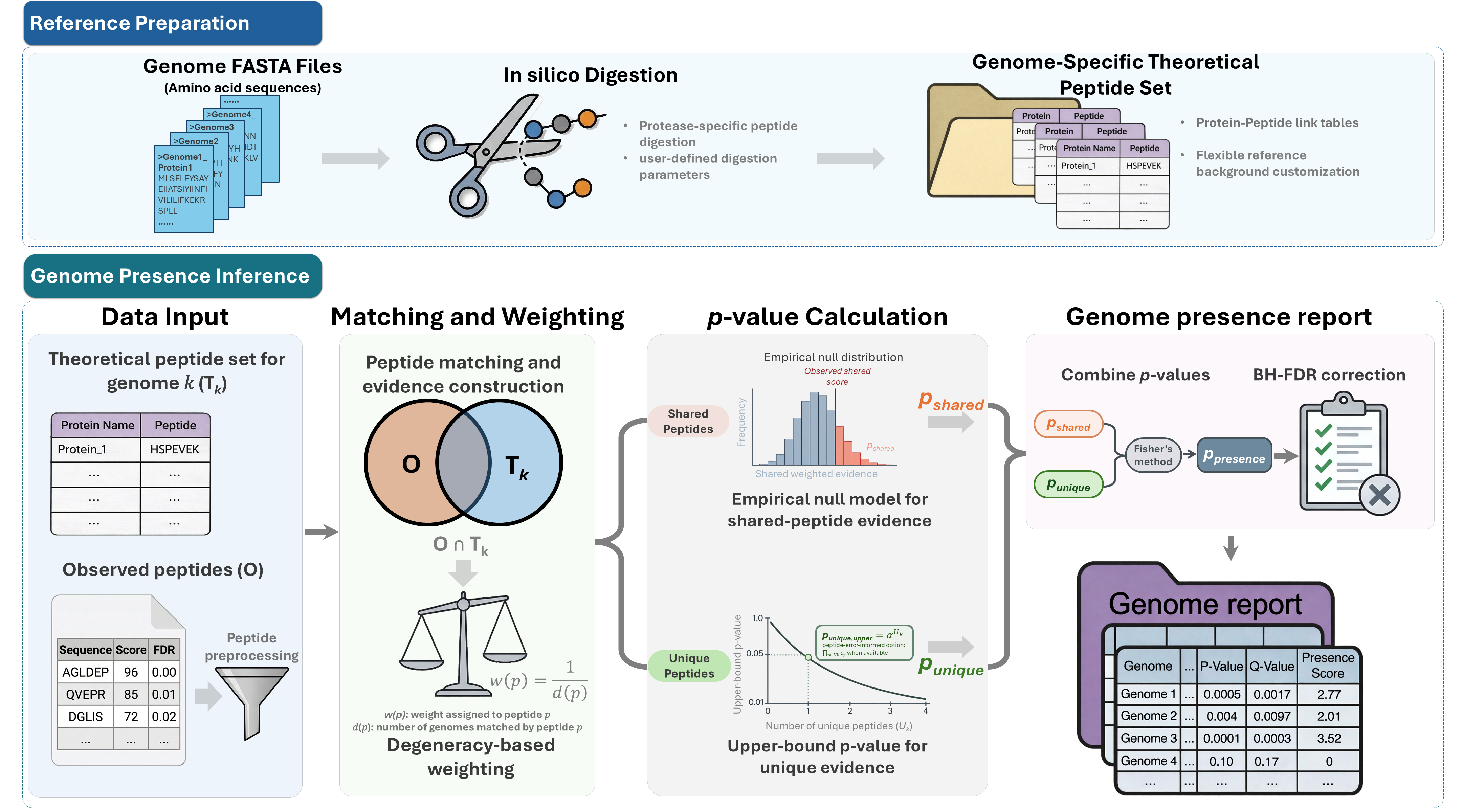
MetaUmbra performs genome-level presence inference from metaproteomic peptide lists. It combines sample-depth-aware genome-unique peptide support with weighted shared peptide evidence to identify statistically supported microbial genomes and generate interpretable presence rankings.
Main features
- Evaluate candidate genome support from metaproteomic peptide tables
- Build genome-specific theoretical peptide references from protein FASTA files
- Support user-defined genome collections, including isolate genomes, strain panels, and MAG catalogs
- Use both unique and shared peptide evidence for genome presence inference
- Calibrate genome-unique peptide counts against sample-specific weak-background genomes by default
- Score multi-sample inputs per sample or user-defined analysis unit without repeated genome digest scans
- Report genome-level p-values, BH-adjusted q-values, and presence scores
- Provide GUI, command-line, and Python workflow support
- Support peptide tables from common metaproteomics workflows such as DIA-NN and MaxQuant
Workflow overview
Installation
MetaUmbra requires Python 3.10 or newer. Installation is available via pip from PyPI.
# Install with all features (GUI, parquet support)
pip install metaumbra[all]
The default GUI extra uses PySide6. To run the GUI with PyQt5 instead, install metaumbra[gui-pyqt5].
or
# Install with core features only
pip install metaumbra
Usage
MetaUmbra can be used through either the graphical interface or the command line.
For a detailed walkthrough, including input formats, CLI examples, output interpretation, and troubleshooting, see the MetaUmbra Usage Guide.
Graphical interface
metaumbra-gui
The GUI supports FASTA digestion, peptide table loading, genome presence scoring, and result export.
Command line
MetaUmbra provides separate commands for the main workflow steps:
metaumbra digest --help
metaumbra score --help
metaumbra extract-parquet --help
A typical workflow is:
metaumbra digest ...
metaumbra score ...
Use metaumbra extract-parquet ... to convert DIA-NN parquet reports to peptide TSV files before scoring.
Input
MetaUmbra requires:
- Protein FASTA files, with one FASTA file per genome
- An observed peptide table containing peptide sequences
Optional inputs include peptide scores, peptide-level error values, decoy flags, and genome lineage annotations.
All scoring uses one analysis-unit workflow. Select --unit-mode all-samples, per-sample, or metadata; each option builds a sample-to-unit assignment and invokes the same per-unit p/q-value engine. The cohort-wide all-samples mode uses a moderately more permissive empirical-background calibration profile, recorded in the run summary, so pooled strong signals do not inflate their own null background.
The default unique-evidence mode is auto. Before observed genome significance is evaluated, it partitions candidates by theoretical peptide opportunity and checks whether at least 90% have at least 100 comparable background genomes and at least five expected observations above the configured background quantile. If structurally eligible, it uses empirical-background; otherwise the entire panel uses alpha-upper-bound. Model selection never uses pilot p-values, pilot q-values, benchmark labels, recovery, or additional-call counts. The decision variables and reason are recorded in artifacts/diagnostics/unit_empirical_background_calibration.tsv.
Peptide matching uses --peptide-normalization-policy il-equivalent by default. Isoleucine and leucine are both mapped to J before observed/theoretical deduplication, matching, degeneracy counting, and unique/shared classification. Use exact for a residue-exact sensitivity analysis. Q/K and AD/W are not collapsed. Matched-peptide and theoretical-opportunity caches record the normalization policy and reject incompatible or legacy cache schemas.
Output
The requested --output is a unified results directory.
Default output files:
unit_genome_results.tsv: one row peranalysis_unit_idxgenome_id, including q-values and threshold flags.cohort_genome_summary.tsv: recurrence across analysis units.sample_unit_mapping.tsv: the validated sample assignment.genome_selection_manifest.json: the only downstream genome-selection interface.artifacts/: run metadata, logs, caches, and optional diagnostics.
genome_selection_manifest.json uses metaumbra.genome_selection_manifest.v1 and maps every unit to sample_ids, q<=0.05 genomes, and the stricter q<=0.01 subset. Detailed scores stay in unit_genome_results.tsv.
Each scoring run records artifacts/run_parameters.json, run.log, run_status.json, and run_summary.json. Use --export-diagnostics for heavier audit tables under artifacts/diagnostics/.
In the current implementation, peptide presence within an analysis unit is defined as the union of sample-level peptide presence across samples assigned to that unit. Only genomes with at least one matched observed peptide enter that unit's BH family. Active genomes with no unique peptide remain in this family but receive pvalue_simes_closed = pvalue = 1; shared evidence can corroborate unique evidence but cannot establish presence alone. For other active genomes, the default Simes/closed-testing p-value is max(pvalue_unique, min(1, 2*min(pvalue_unique, pvalue_shared), max(pvalue_unique, pvalue_shared))). BH is then applied separately within each analysis unit. Bonferroni, calibrated/raw HMP, Fisher, and unique-only remain selectable sensitivity analyses.
Key output columns include:
| Column | Description |
|---|---|
genome_id |
Candidate genome identifier |
num_peptides_matched |
Number of observed peptides matched to the genome |
num_peptides_unique |
Number of matched peptides unique to the genome |
theoretical_unique_peptides |
Theoretical peptides unique to this genome among the analyzed genome set, included for hypergeometric-opportunity output |
expected_unique_null |
Expected observed genome-unique peptides under the selected unique-evidence null |
unique_depth_fold |
Observed unique peptides divided by expected unique peptides under the null |
has_unique_evidence |
Whether the genome has at least one observed unique peptide |
pvalue_shared |
Shared-peptide knockoff p-value |
pvalue_unique |
Unique-evidence p-value |
pvalue_simes_intersection |
Two-component Simes intersection p-value |
pvalue_simes_closed |
Unique-evidence closed-test p-value; 1 with zero observed unique peptides |
pvalue_combined_fisher |
Fisher combination retained for sensitivity comparison |
pvalue_combined_harmonic_calibrated |
Factor-2 K=2 calibrated two-component HMP sensitivity value |
pvalue_combined_harmonic |
Equal-weight HMP with the configured unique-evidence gate |
pvalue_combined_bonferroni |
Two-test Bonferroni minimum-p sensitivity value |
pvalue |
Selected genome-level p-value; by default pvalue_simes_closed |
qvalue |
BH-adjusted genome-level q-value within active genomes of the analysis unit |
presence_score |
Ranking score based on q-value |
Citation
If you use MetaUmbra, please cite:
Wu Q, Ning Z, Zhang A, Cheng K, Figeys D. MetaUmbra: Statistically Controlled Genome-Level Presence Inference from Metaproteomic Peptides.[J]. bioRxiv, 2026.04.29.721689.
A formal citation will be added after publication.
Contact
For questions or issues, please use the GitHub issue tracker or contact the corresponding author listed in the associated manuscript.
1 maintainer

Metadata
1 maintainer
Release files for metaumbra 1.5.0
For a detailed explanation of source distributions (sdists) and built distributions (wheels), please see the package formats documentation.
Source distribution (sdist)
| File | Size | Uploaded | |
|---|---|---|---|
| metaumbra-1.5.0.tar.gz | 3.6 MB | Details |
Built distribution (wheel)
| File | Interpreter | ABI | Platform | Reset |
|---|---|---|---|---|
| metaumbra-1.5.0-py3-none-any.whl | Python 3 | none | any | Details |
Total release size: 7.2 MB
Release files / metaumbra-1.5.0.tar.gz
| Download URL | metaumbra-1.5.0.tar.gz |
|---|---|
| Size | 3.6 MB |
| Tags | Source |
|
SHA-256 checksum How to use checksums |
690c89e52fb2d0702c9e75e404d6c217d46f4dbbc110cea75c1b14146e7b47d1
|
|
BLAKE2b-256 checksum How to use checksums |
4ebea71c106f4273ab399aa174e31a4a6b639b9f45346064b043429d2f4c9105
|
| Upload date | |
|
Uploaded using Trusted Publishing? What is trusted publishing? |
No |
| Uploaded via |
twine/7.0.0 CPython/3.13.14
|
Release files / metaumbra-1.5.0-py3-none-any.whl
| Download URL | metaumbra-1.5.0-py3-none-any.whl |
|---|---|
| Size | 3.6 MB |
| Tags | Python 3 |
|
SHA-256 checksum How to use checksums |
5d73983d4853d668cb86e7e6042640ca6cd75734eefdd74cc46f05cda0c2f1a8
|
|
BLAKE2b-256 checksum How to use checksums |
c3eaf74760e4b4957cf43c1385e673522a37d9f99cc71977e95c40bf33cadd0d
|
| Upload date | |
|
Uploaded using Trusted Publishing? What is trusted publishing? |
No |
| Uploaded via |
twine/7.0.0 CPython/3.13.14
|














