

napari-harpy: a spatial omics interface for napari.

Built around SpatialData and Harpy for interactive exploration, feature extraction, and object classification.
napari-harpy is a napari plugin for viewing, exploring, and analyzing
SpatialData datasets. It includes its own viewer for loading and
browsing data inside napari, alongside annotation, feature extraction, and
interactive object classification workflows.
Installation
Install from PyPI:
pip install napari-harpy
Quickstart
The quickest way to try the plugin is to create a small example SpatialData
object, write it to a temporary zarr store, read it back as an on-disk dataset,
and launch the Harpy napari interface with Interactive.
import tempfile
from pathlib import Path

from spatialdata import read_zarr

from napari_harpy import Interactive
from napari_harpy.datasets import blobs_multi_region

zarr_path = Path(tempfile.mkdtemp()) / "blobs_multi_region.zarr"

sdata = blobs_multi_region()
sdata.write(zarr_path)

sdata = read_zarr(zarr_path)
Interactive(sdata)
This opens napari with the Harpy widgets docked and the
blobs_multi_region dataset available in the shared viewer state.
Shapes triangulation uses the fast Bermuda backend by default. To use Numba
instead, launch with Interactive(sdata, triangulation_backend="numba").
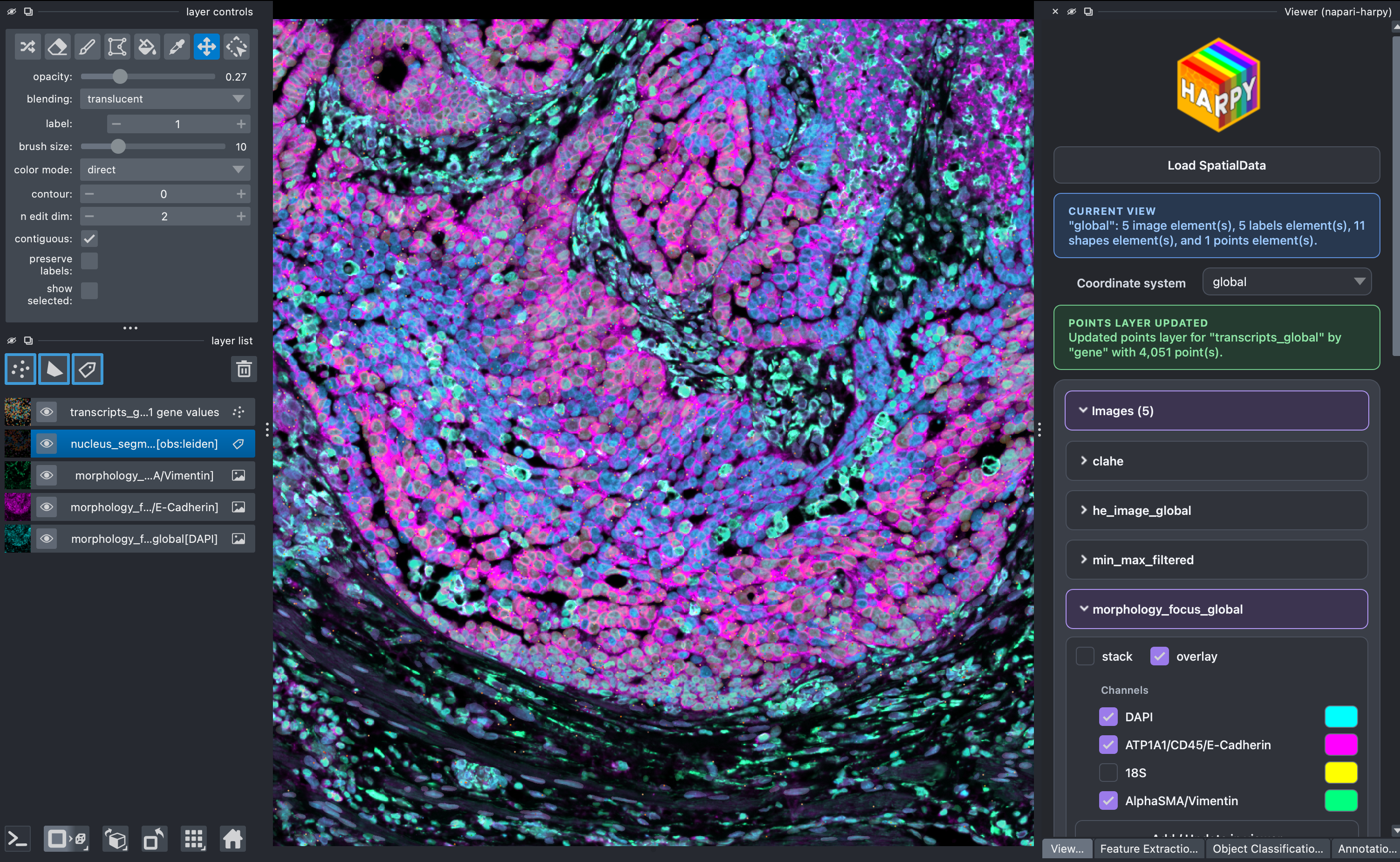
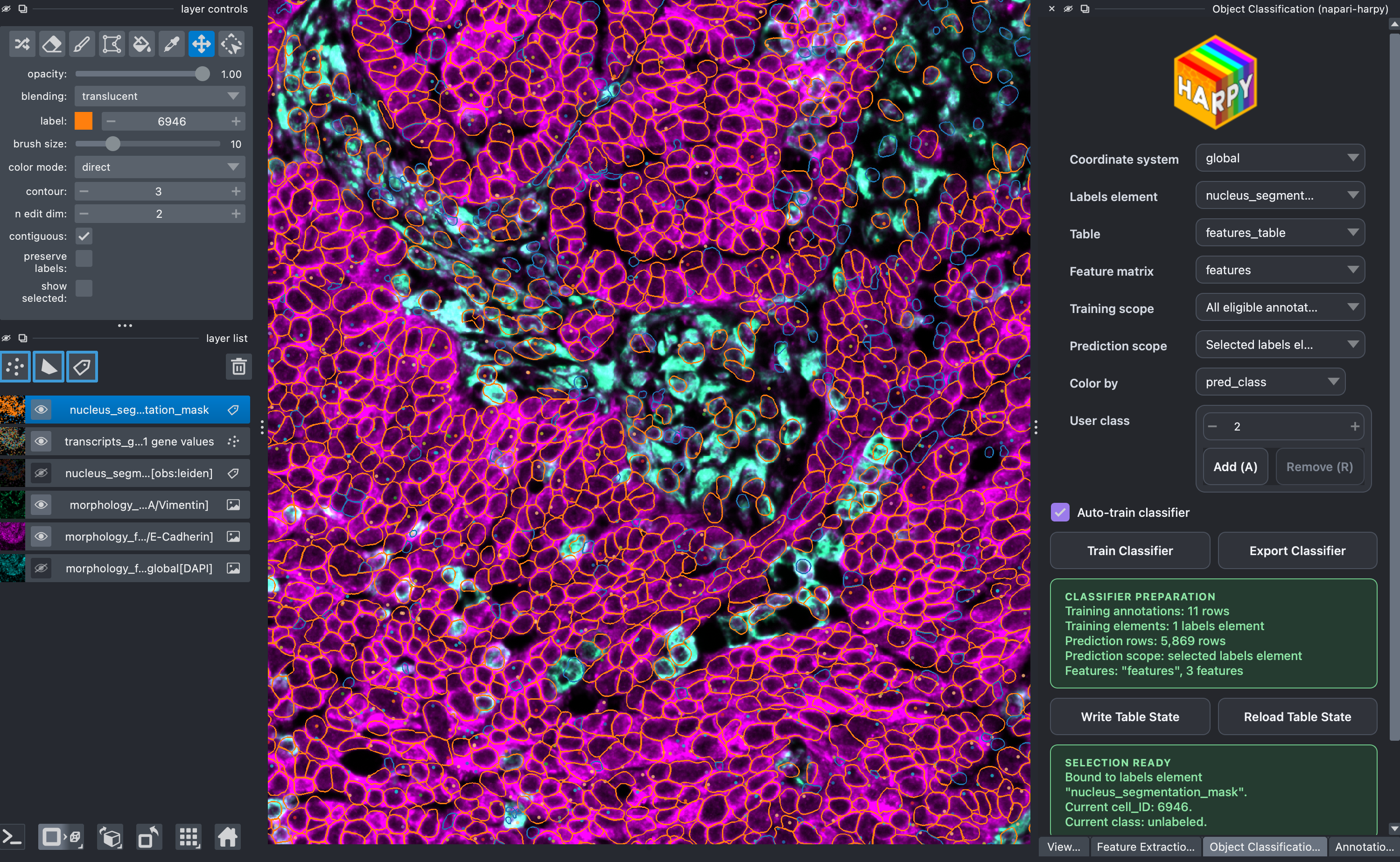
The current repository contains four working widgets:
ViewerFeature ExtractionObject ClassificationAnnotation
Today the plugin supports:
- loading and viewing
SpatialDatathrough the Harpy viewer widget - selecting a labels element, optional image, compatible coordinate system, and
linked table from the shared loaded
SpatialData - calculating intensity and morphology features through Harpy
- writing feature matrices into the selected
AnnDatatable linked to the labels element, as.obsm[feature_key], with companion metadata in.uns["feature_matrices"][feature_key] - interactive manual annotation of instances in labels elements
- interactive creation and editing of polygon shapes annotations
- background
RandomForestClassifierretraining on the selected feature matrix stored in.obsm[feature_key]of theAnnDatatable linked to the labels element - live prediction updates and labels recoloring
- explicit write-back of in-memory table state to zarr
- explicit reload of on-disk table state back into memory
- multi-sample workflows through multi-region tables and explicit labels/image/coordinate-system matching
- headless feature extraction and classifier application for scripted or batch processing
Example napari-harpy session:
Headless and Multi-Sample Workflows
For scripted or batch processing, use the public napari_harpy.headless module.
It can apply an exported classifier to an existing feature matrix, or compute
the required features before applying the classifier.
The headless APIs accept one labels element or a sequence of labels elements.
For multi-sample data, pass matching labels, image, and coordinate-system
sequences so Harpy can build or apply a shared table-level feature matrix across
the selected samples. When features need image intensities, the channel
selection is read from the exported classifier's source_channels metadata.
from spatialdata import read_zarr

from napari_harpy import headless

sdata = read_zarr("experiment.zarr")

result = headless.apply_classifier_with_feature_extraction_from_path(
    sdata,
    "classifier.harpy-classifier.joblib",
    table_name="table_multi",
    labels_name=["sample_1_labels", "sample_2_labels"],
    coordinate_system=["sample_1", "sample_2"],
    image_name=["sample_1_image", "sample_2_image"],
)
Local development
Create the development environment:
./create_env.sh
Then launch napari:
source .venv/bin/activate
napari
Open the widgets from the napari plugin menu:
Plugins -> napari-harpy -> ViewerPlugins -> napari-harpy -> Feature ExtractionPlugins -> napari-harpy -> Object ClassificationPlugins -> napari-harpy -> Annotation
Debug script
A small local debug script is available at
scripts/debug_widget.py.
It creates a temporary blobs_multi_region zarr store, loads it into napari,
and docks the Harpy widgets automatically.
This is useful for quickly reproducing widget behavior during development.
Run it with:
source .venv/bin/activate
python scripts/debug_widget.py
1 maintainer

Metadata
1 maintainer
Release files for napari-harpy 0.1.3
For a detailed explanation of source distributions (sdists) and built distributions (wheels), please see the package formats documentation.
Source distribution (sdist)
| File | Size | Uploaded | |
|---|---|---|---|
| napari_harpy-0.1.3.tar.gz | 19.9 MB | Details |
Built distribution (wheel)
| File | Interpreter | ABI | Platform | Reset |
|---|---|---|---|---|
| napari_harpy-0.1.3-py3-none-any.whl | Python 3 | none | any | Details |
Total release size: 20.6 MB
Release files / napari_harpy-0.1.3.tar.gz
| Download URL | napari_harpy-0.1.3.tar.gz |
|---|---|
| Size | 19.9 MB |
| Tags | Source |
|
SHA-256 checksum How to use checksums |
cccfb01b064460684e53eac09fe4083d676535fa081799daf4e7fcc34fef4024
|
|
BLAKE2b-256 checksum How to use checksums |
089123aa9baf0bec2aa6f15cc323a9faefc12ba92951b78301dfeaf95ec7386f
|
| Upload date | |
|
Uploaded using Trusted Publishing? What is trusted publishing? |
Yes |
| Uploaded via |
twine/7.0.0 CPython/3.13.14
|
Provenance
Provenance describes where a file came from. On PyPI, provenance is shared via attestations, which provide a verifiable record of the build or publishing details. View details, limitations and caveats.


PyPI Publish Attestation
PyPI verified that this artifact, at this checksum, originated from the publisher listed below.
Signed by GitHub Actions, verified by PyPI on Jul 31, 2026.
Transparency logRelease files / napari_harpy-0.1.3-py3-none-any.whl
| Download URL | napari_harpy-0.1.3-py3-none-any.whl |
|---|---|
| Size | 703.0 kB |
| Tags | Python 3 |
|
SHA-256 checksum How to use checksums |
636f433be7a8507f26b27aaf115c217502bda346b4c7d5de523f1a31a1326125
|
|
BLAKE2b-256 checksum How to use checksums |
e3ca72996310ef87ea5b21f53855ab0790a08f1d8afdb0d2ee8625c9f37c9986
|
| Upload date | |
|
Uploaded using Trusted Publishing? What is trusted publishing? |
Yes |
| Uploaded via |
twine/7.0.0 CPython/3.13.14
|
Provenance
Provenance describes where a file came from. On PyPI, provenance is shared via attestations, which provide a verifiable record of the build or publishing details. View details, limitations and caveats.
PyPI Publish Attestation
PyPI verified that this artifact, at this checksum, originated from the publisher listed below.
Signed by GitHub Actions, verified by PyPI on Jul 31, 2026.
Transparency log













