
OIKAN: Optimized Interpretable Kolmogorov-Arnold Networks

Project description
OIKAN: Optimized Interpretable Kolmogorov-Arnold Networks
Overview
OIKAN (Optimized Interpretable Kolmogorov-Arnold Networks) is a neuro-symbolic ML framework that combines modern neural networks with classical Kolmogorov-Arnold representation theory. It provides interpretable machine learning solutions through automatic extraction of symbolic mathematical formulas from trained models.





Important Disclaimer: OIKAN is an experimental research project. It is not intended for production use or real-world applications. This framework is designed for research purposes, experimentation, and academic exploration of neuro-symbolic machine learning concepts.
Key Features
- 🧠 Neuro-Symbolic ML: Combines neural network learning with symbolic mathematics
- 📊 Automatic Formula Extraction: Generates human-readable mathematical expressions
- 🎯 Scikit-learn Compatible: Familiar
.fit()and.predict()interface - 🔬 Research-Focused: Designed for academic exploration and experimentation
- 📈 Multi-Task: Supports both regression and classification problems
Scientific Foundation
OIKAN implements the Kolmogorov-Arnold Representation Theorem through a novel neural architecture:
-
Theorem Background: Any continuous multivariate function f(x1,...,xn) can be represented as:
f(x1,...,xn) = ∑(j=0 to 2n){ φj( ∑(i=1 to n) ψij(xi) ) }where φj and ψij are continuous single-variable functions.
-
Neural Implementation:
# Pseudo-implementation of KAN architecture
class KANLayer:
    def __init__(self, input_dim, output_dim):
        self.edges = [SymbolicEdge() for _ in range(input_dim * output_dim)]
        self.weights = initialize_weights(input_dim, output_dim)

    def forward(self, x):
        # Transform each input through basis functions
        edge_outputs = [edge(x_i) for x_i, edge in zip(x, self.edges)]
        # Combine using learned weights
        return combine_weighted_outputs(edge_outputs, self.weights)
-
Basis functions
# Edge activation contains interpretable basis functions
ADVANCED_LIB = {
      'x': (lambda x: x),          # Linear
      'x^2': (lambda x: x**2),     # Quadratic
      'sin(x)': np.sin,            # Periodic
      'tanh(x)': np.tanh          # Bounded
}
Quick Start
Installation
Method 1: Via PyPI (Recommended)
pip install -qU oikan
Method 2: Local Development
git clone https://github.com/silvermete0r/OIKAN.git
cd OIKAN
pip install -e .  # Install in development mode
Regression Example
from oikan.model import OIKANRegressor
from sklearn.model_selection import train_test_split

# Initialize model
model = OIKANRegressor()

# Fit model (sklearn-style)
model.fit(X_train, y_train, epochs=100, lr=0.01)

# Get predictions
y_pred = model.predict(X_test)

# Save interpretable formula to file with auto-generated guidelines
# The output file will contain:
# - Detailed symbolic formulas for each feature
# - Instructions for practical implementation
# - Recommendations for testing and validation
model.save_symbolic_formula("regression_formula.txt")
Example of the saved symbolic formula instructions: outputs/regression_symbolic_formula.txt
Classification Example
from oikan.model import OIKANClassifier

# Similar sklearn-style interface for classification
model = OIKANClassifier()
model.fit(X_train, y_train, epochs=100, lr=0.01)
probas = model.predict_proba(X_test)

# Save classification formulas with implementation guidelines
# The output file will contain:
# - Decision boundary formulas for each class
# - Softmax application instructions
# - Recommendations for testing and validation
model.save_symbolic_formula("classification_formula.txt")
Example of the saved symbolic formula instructions: outputs/classification_symbolic_formula.txt
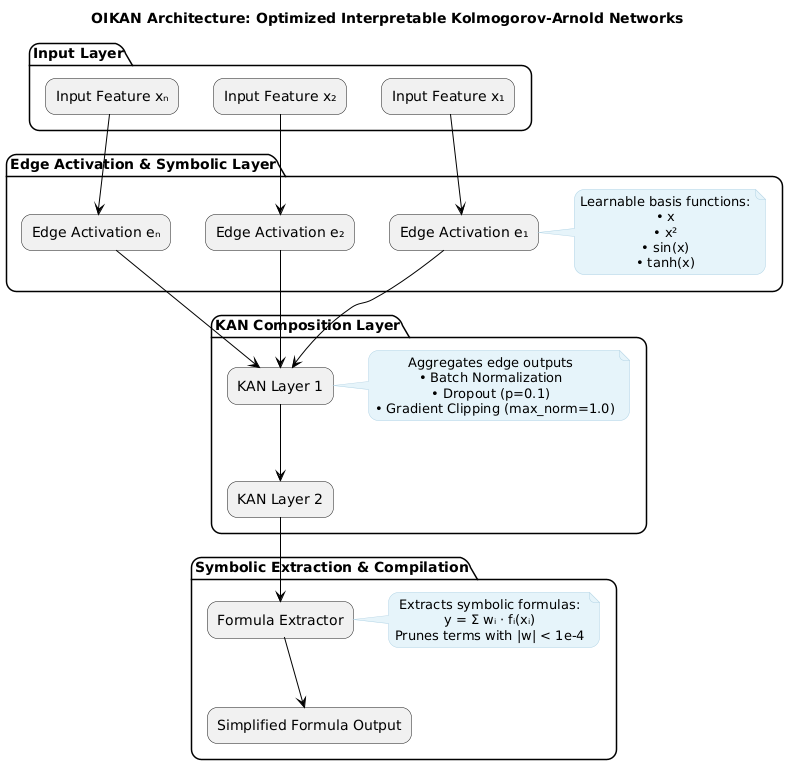
Architecture Diagram
Key Design Principles
- Interpretability First: All transformations maintain clear mathematical meaning
- Scikit-learn Compatibility: Familiar
.fit()and.predict()interface - Symbolic Formula Exporting: Export formulas as lightweight mathematical expressions
- Automatic Simplification: Remove insignificant terms (|w| < 1e-4)
Key Model Components
-
EdgeActivation Layer:
- Implements interpretable basis function transformations
- Automatically prunes insignificant terms
- Maintains mathematical transparency
-
Formula Extraction:
- Combines edge transformations with learned weights
- Applies symbolic simplification
- Generates human-readable expressions
-
Training Process:
- Gradient-based optimization of edge weights
- Automatic feature importance detection
- Complexity control through regularization
Contributing
We welcome contributions! Key areas of interest:
- Model architecture improvements
- Novel basis function implementations
- Improved symbolic extraction algorithms
- Real-world case studies and applications
- Performance optimizations
Please see CONTRIBUTING.md for guidelines.
Citation
If you use OIKAN in your research, please cite:
@software{oikan2025,
  title = {OIKAN: Optimized Interpretable Kolmogorov-Arnold Networks},
  author = {Zhalgasbayev, Arman},
  year = {2025},
  url = {https://github.com/silvermete0r/OIKAN}
}
License
This project is licensed under the MIT License - see the LICENSE file for details.
Release history Release notifications | RSS feed


Download files
Download the file for your platform. If you're not sure which to choose, learn more about installing packages.
Source Distribution
Built Distribution
Filter files by name, interpreter, ABI, and platform.
If you're not sure about the file name format, learn more about wheel file names.
Copy a direct link to the current filters
File details
Details for the file oikan-0.0.2.5.tar.gz.
File metadata
- Download URL: oikan-0.0.2.5.tar.gz
- Upload date:
- Size: 13.0 kB
- Tags: Source
- Uploaded using Trusted Publishing? No
- Uploaded via: twine/6.1.0 CPython/3.10.13
File hashes
| Algorithm | Hash digest | |
|---|---|---|
| SHA256 |
d40f7636db33e3cc97fd00e0f6704fc06264e727b0ab699ad5373d1ec013e64e
|
|
| MD5 |
374c2a70549963f02755487f961dc33e
|
|
| BLAKE2b-256 |
d657f8412455cd15ca6da586ad93d6ba9631fff63b764719d3ee457f5b5b0be8
|
File details
Details for the file oikan-0.0.2.5-py3-none-any.whl.
File metadata
- Download URL: oikan-0.0.2.5-py3-none-any.whl
- Upload date:
- Size: 11.5 kB
- Tags: Python 3
- Uploaded using Trusted Publishing? No
- Uploaded via: twine/6.1.0 CPython/3.10.13
File hashes
| Algorithm | Hash digest | |
|---|---|---|
| SHA256 |
4d6fce0fce599f1b65e91dcc086bd110590bf27f54f87418cdde9840b75db186
|
|
| MD5 |
9491fb453e5dd5d9490edb73c0bb45cd
|
|
| BLAKE2b-256 |
26c5bc5f15c5d72735b445e5a833c389b390fad190143743ce6c70347fa3d34a
|






