
OIKAN: Neuro-Symbolic ML for Scientific Discovery

Project description
OIKAN: Neuro-Symbolic ML for Scientific Discovery
Overview
OIKAN is a neuro-symbolic machine learning framework inspired by Kolmogorov-Arnold representation theorem. It combines the power of modern neural networks with techniques for extracting clear, interpretable symbolic formulas from data. OIKAN is designed to make machine learning models both accurate and Interpretable.









Important Disclaimer: OIKAN is an experimental research project. It is not intended for production use or real-world applications. This framework is designed for research purposes, experimentation, and academic exploration of neuro-symbolic machine learning concepts.
Key Features
- 🧠 Neuro-Symbolic ML: Combines neural network learning with symbolic mathematics
- 📊 Automatic Formula Extraction: Generates human-readable mathematical expressions
- 🎯 Scikit-learn Compatible: Familiar
.fit()and.predict()interface - 🔬 Research-Focused: Designed for academic exploration and experimentation
- 📈 Multi-Task: Supports both regression and classification problems
Scientific Foundation
OIKAN implements a modern interpretation of the Kolmogorov-Arnold Representation Theorem through a hybrid neural architecture:
-
Theoretical Foundation: The Kolmogorov-Arnold theorem states that any continuous n-dimensional function can be decomposed into a combination of single-variable functions:
f(x₁,...,xₙ) = ∑(j=0 to 2n){ φⱼ( ∑(i=1 to n) ψᵢⱼ(xᵢ) ) }where φⱼ and ψᵢⱼ are continuous univariate functions.
-
Neural Implementation: OIKAN uses a specialized architecture combining:
- Feature transformation layers with interpretable basis functions
- Symbolic regression for formula extraction (ElasticNet-based)
- Automatic pruning of insignificant terms
 class OIKAN:
     def __init__(self, hidden_sizes=[64, 64], activation='relu',
                 polynomial_degree=2, alpha=0.1):
         # Neural network for learning complex patterns
         self.neural_net = TabularNet(input_size, hidden_sizes, activation)
         # Data augmentation for better coverage
         self.augmented_data = self.augment_data(X, y, augmentation_factor=5)
         # Symbolic regression for interpretable formulas
         self.symbolic_regression = SymbolicRegression(alpha=alpha)
-
Basis Functions: Core set of interpretable transformations:
SYMBOLIC_FUNCTIONS = {
    'linear': 'x',           # Direct relationships
    'quadratic': 'x^2',      # Non-linear patterns
    'cubic': 'x^3',         # Higher-order relationships
    'interaction': 'x_i x_j', # Feature interactions
    'higher_order': 'x^n',    # Polynomial terms
    'trigonometric': 'sin(x)', # Trigonometric functions
    'exponential': 'exp(x)',  # Exponential growth
    'logarithmic': 'log(x)'  # Logarithmic relationships
}
-
Formula Extraction Process:
- Train neural network on raw data
- Generate augmented samples for better coverage
- Perform L1-regularized symbolic regression (alpha)
- Prune terms with coefficients below threshold
- Export human-readable mathematical expressions
Quick Start
Installation
Method 1: Via PyPI (Recommended)
pip install -qU oikan
Method 2: Local Development
git clone https://github.com/silvermete0r/OIKAN.git
cd OIKAN
pip install -e .  # Install in development mode
System Requirements
| Requirement | Details |
|---|---|
| Python | Version 3.7 or higher |
| Operating System | Platform independent (Windows/macOS/Linux) |
| Memory | Recommended minimum 4GB RAM |
| Disk Space | ~100MB for installation (including dependencies) |
| GPU | Optional (for faster training) |
| Dependencies | torch, numpy, scikit-learn, sympy, tqdm |
Regression Example
from oikan import OIKANRegressor
from sklearn.metrics import mean_squared_error

# Initialize model
model = OIKANRegressor(
    hidden_sizes=[32, 32], # Hidden layer sizes
    activation='relu', # Activation function (other options: 'tanh', 'leaky_relu', 'elu', 'swish', 'gelu')
    augmentation_factor=5, # Augmentation factor for data generation
    alpha=0.1, # L1 regularization strength (Symbolic regression)
    sigma=0.1, # Standard deviation of Gaussian noise for data augmentation
    top_k=5, # Number of top features to select (Symbolic regression)
    epochs=100, # Number of training epochs
    lr=0.001, # Learning rate
    batch_size=32, # Batch size for training
    verbose=True, # Verbose output during training
    evaluate_nn=True, # Validate neural network performance before full process
    random_state=42 # Random seed for reproducibility
)

# Fit the model
model.fit(X_train, y_train)

# Make predictions
y_pred = model.predict(X_test)

# Evaluate performance
mse = mean_squared_error(y_test, y_pred)
print("Mean Squared Error:", mse)

# Get symbolic formula
formula = model.get_formula() # default: type='original' -> returns all formula without pruning | other options: 'sympy' -> simplified formula using sympy; 'latex' -> LaTeX format
print("Symbolic Formula:", formula)

# Get feature importances
importances = model.feature_importances()
print("Feature Importances:", importances)

# Save the model (optional)
model.save("outputs/model.json")

# Load the model (optional)
loaded_model = OIKANRegressor()
loaded_model.load("outputs/model.json")
Example of the saved symbolic formula (regression model): outputs/california_housing_model.json
Classification Example
from oikan import OIKANClassifier
from sklearn.metrics import accuracy_score

# Initialize model
model = OIKANClassifier(
    hidden_sizes=[32, 32], # Hidden layer sizes
    activation='relu', # Activation function (other options: 'tanh', 'leaky_relu', 'elu', 'swish', 'gelu')
    augmentation_factor=10, # Augmentation factor for data generation
    alpha=0.1, # L1 regularization strength (Symbolic regression)
    sigma=0.1, # Standard deviation of Gaussian noise for data augmentation
    top_k=5, # Number of top features to select (Symbolic regression)
    epochs=100, # # Number of training epochs
    lr=0.001, # Learning rate
    batch_size=32, # Batch size for training
    verbose=True, # Verbose output during training
    evaluate_nn=True, # Validate neural network performance before full process
    random_state=42 # Random seed for reproducibility
)

# Fit the model
model.fit(X_train, y_train)

# Make predictions
y_pred = model.predict(X_test)

# Evaluate performance
accuracy = model.score(X_test, y_test)
print("Accuracy:", accuracy)

# Get symbolic formulas for each class
formulas = model.get_formula() # default: type='original' -> returns all formula without pruning | other options: 'sympy' -> simplified formula using sympy; 'latex' -> LaTeX format
for i, formula in enumerate(formulas):
    print(f"Class {i} Formula:", formula)

# Get feature importances
importances = model.feature_importances()
print("Feature Importances:", importances)

# Save the model (optional)
model.save("outputs/model.json")

# Load the model (optional)
loaded_model = OIKANClassifier()
loaded_model.load("outputs/model.json")
Example of the saved symbolic formula (classification model): outputs/iris_model.json
Architecture Diagram
High-Level Architecture:
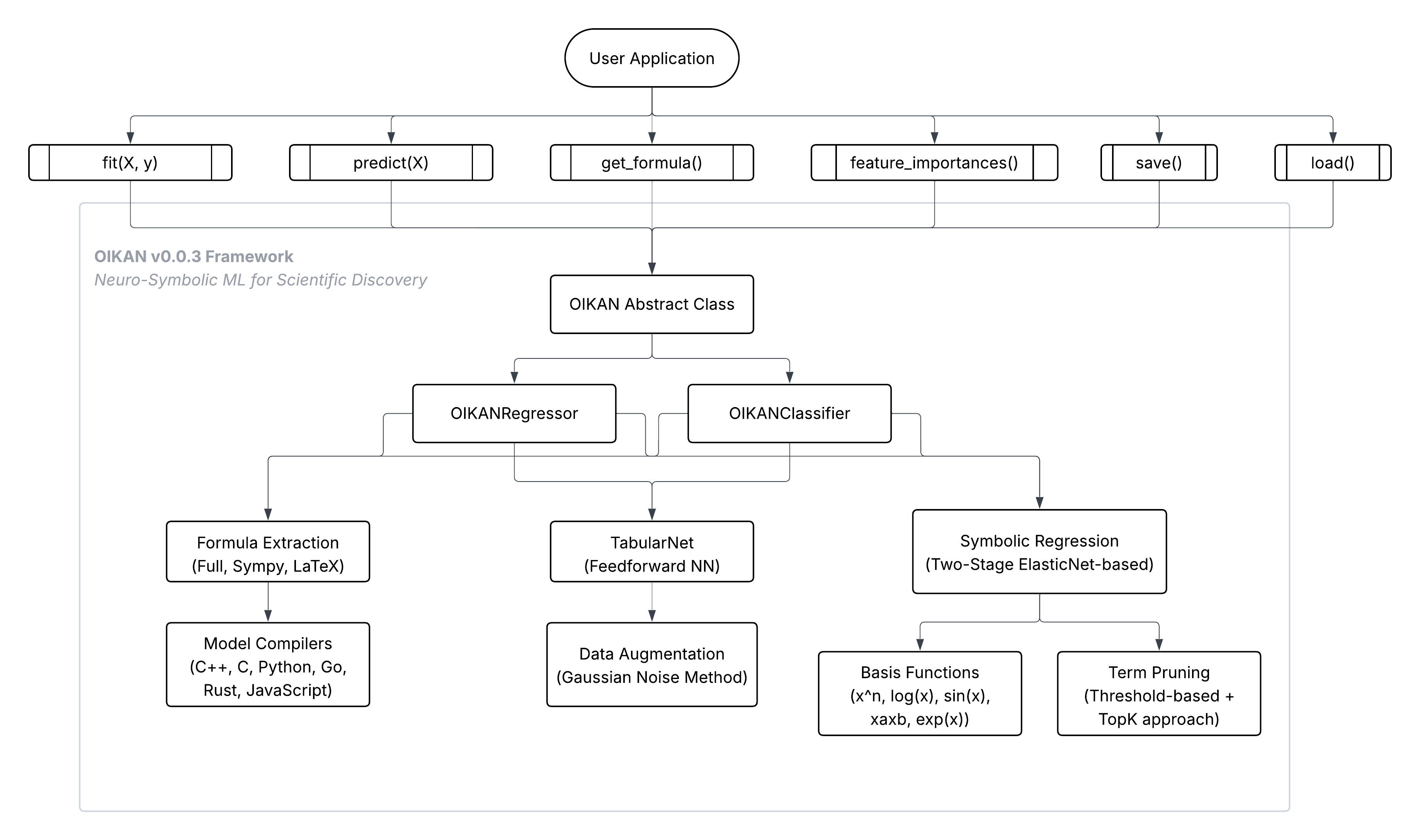
UML Diagram:
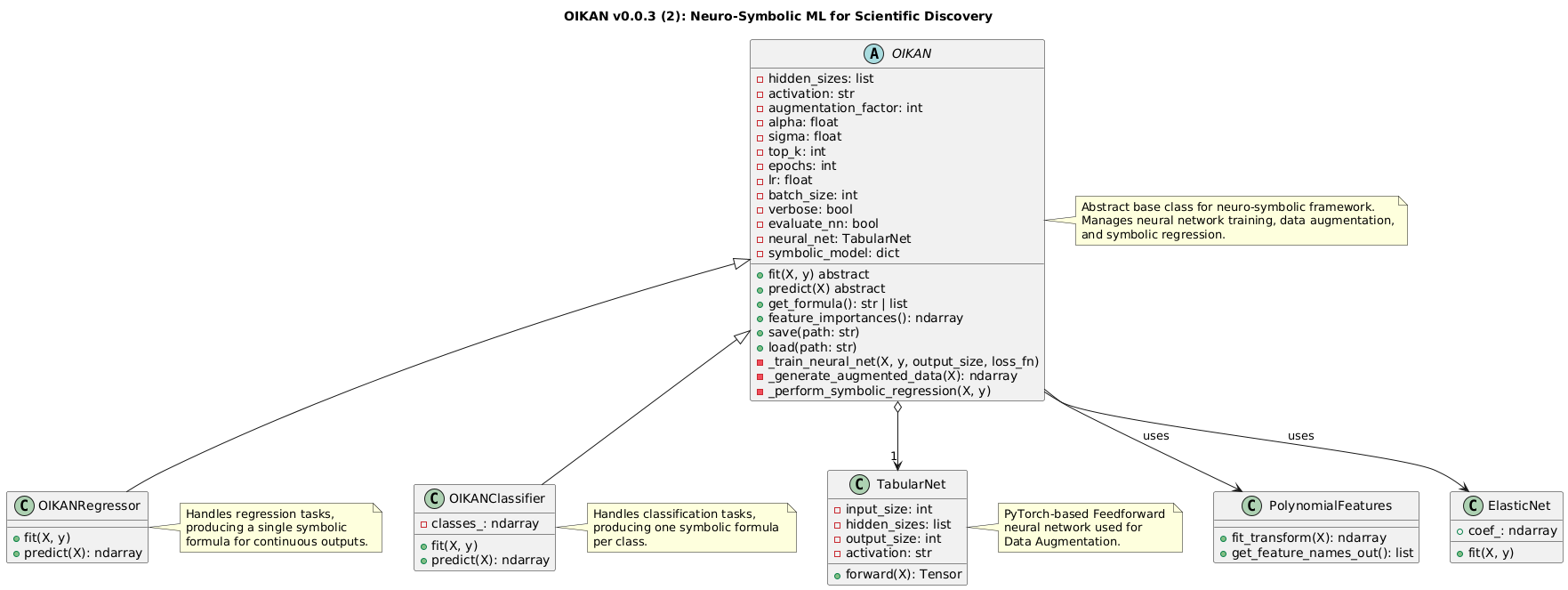
OIKAN Symbolic Model Compilers
OIKAN provides a set of symbolic model compilers to convert the symbolic formulas generated by the OIKAN model into different programming languages.
Currently, we support: Python, C++, C, JavaScript, Rust, and Go. This allows users to easily integrate the generated formulas into their applications or systems.
All compilers: model_compilers/
Example of Python Compiler
- Regression Model:
import numpy as np
import json

def predict(X, symbolic_model):
    X = np.asarray(X)
    X_transformed = evaluate_basis_functions(X, symbolic_model['basis_functions'],
                                            symbolic_model['n_features'])
    return np.dot(X_transformed, symbolic_model['coefficients'])

if __name__ == "__main__":
    with open('outputs/california_housing_model.json', 'r') as f:
        symbolic_model = json.load(f)
    X = np.random.rand(10, symbolic_model['n_features'])
    y_pred = predict(X, symbolic_model)
    print(y_pred)
- Classification Model:
import numpy as np
import json

def predict(X, symbolic_model):
    X = np.asarray(X)
    X_transformed = evaluate_basis_functions(X, symbolic_model['basis_functions'],
                                            symbolic_model['n_features'])
    logits = np.dot(X_transformed, np.array(symbolic_model['coefficients_list']).T)
    probabilities = np.exp(logits) / np.sum(np.exp(logits), axis=1, keepdims=True)
    return np.argmax(probabilities, axis=1)

if __name__ == "__main__":
    with open('outputs/iris_model.json', 'r') as f:
        symbolic_model = json.load(f)
    X = np.array([[5.1, 3.5, 1.4, 0.2],
                  [7.0, 3.2, 4.7, 1.4],
                  [6.3, 3.3, 6.0, 2.5]])
    y_pred = predict(X, symbolic_model)
    print(y_pred)
Contributing
We welcome contributions! Key areas of interest:
- Model architecture improvements
- Novel basis function implementations
- Improved symbolic extraction algorithms
- Real-world case studies and applications
- Performance optimizations
Please see CONTRIBUTING.md for guidelines.
Citation
If you use OIKAN in your research, please cite:
@software{oikan2025,
  title = {OIKAN: Neuro-Symbolic ML for Scientific Discovery},
  author = {Zhalgasbayev, Arman},
  year = {2025},
  url = {https://github.com/silvermete0r/OIKAN}
}
License
This project is licensed under the MIT License - see the LICENSE file for details.
Release history Release notifications | RSS feed


Download files
Download the file for your platform. If you're not sure which to choose, learn more about installing packages.
Source Distribution
Built Distribution
Filter files by name, interpreter, ABI, and platform.
If you're not sure about the file name format, learn more about wheel file names.
Copy a direct link to the current filters
File details
Details for the file oikan-0.0.3.7.tar.gz.
File metadata
- Download URL: oikan-0.0.3.7.tar.gz
- Upload date:
- Size: 17.6 kB
- Tags: Source
- Uploaded using Trusted Publishing? No
- Uploaded via: twine/6.1.0 CPython/3.10.13
File hashes
| Algorithm | Hash digest | |
|---|---|---|
| SHA256 |
e7298d41b93f01cd147bc9fe415a8ea25d1aac3f32c2e4bc9db22a4807982077
|
|
| MD5 |
d37d97a39b75e0e776e1d8abe53ad71d
|
|
| BLAKE2b-256 |
dda2692fd3c7eadf111649d60342e4c4fc5997471f6051f5b50e900e32077ec7
|
File details
Details for the file oikan-0.0.3.7-py3-none-any.whl.
File metadata
- Download URL: oikan-0.0.3.7-py3-none-any.whl
- Upload date:
- Size: 15.3 kB
- Tags: Python 3
- Uploaded using Trusted Publishing? No
- Uploaded via: twine/6.1.0 CPython/3.10.13
File hashes
| Algorithm | Hash digest | |
|---|---|---|
| SHA256 |
4915af900c6fcd1d7ece5e54d8797d8814daeeaf9013c5adaf65c33464276be3
|
|
| MD5 |
67c40413cdf6c79e3fed571c22b3497e
|
|
| BLAKE2b-256 |
eafc77e05fe2dc0d4f7b706366f603642dcd5bbbac2ef04d36a029a269071b92
|






