







Quiltwright -- holographic output for scientific visualization.
Eric G. Suchanek, PhD -- Flux-Frontiers
Quiltwright is the last stage of a scientific rendering pipeline -- any
pipeline that ends in a scene. It takes what you already have -- a PyVista or
VTK scene built in memory, a Blender file or an exported mesh, or a .pov
file written thirty years ago by someone who is no longer around to explain
it -- and puts it on holographic hardware in glasses-free depth. Nothing is
rewritten to get there: your scene file is never modified, the off-axis camera
is supplied per view, and each scene is rendered by the renderer it already
belongs to. Where that renderer is Blender's Cycles, the views are path-traced
on the GPU's ray-tracing cores if the hardware has them.
It is used that way by WaveRider for geometric ML manifolds and by pypdb2pov for molecular structures, but neither is a prerequisite. If you can render it, you can hang it in the air.
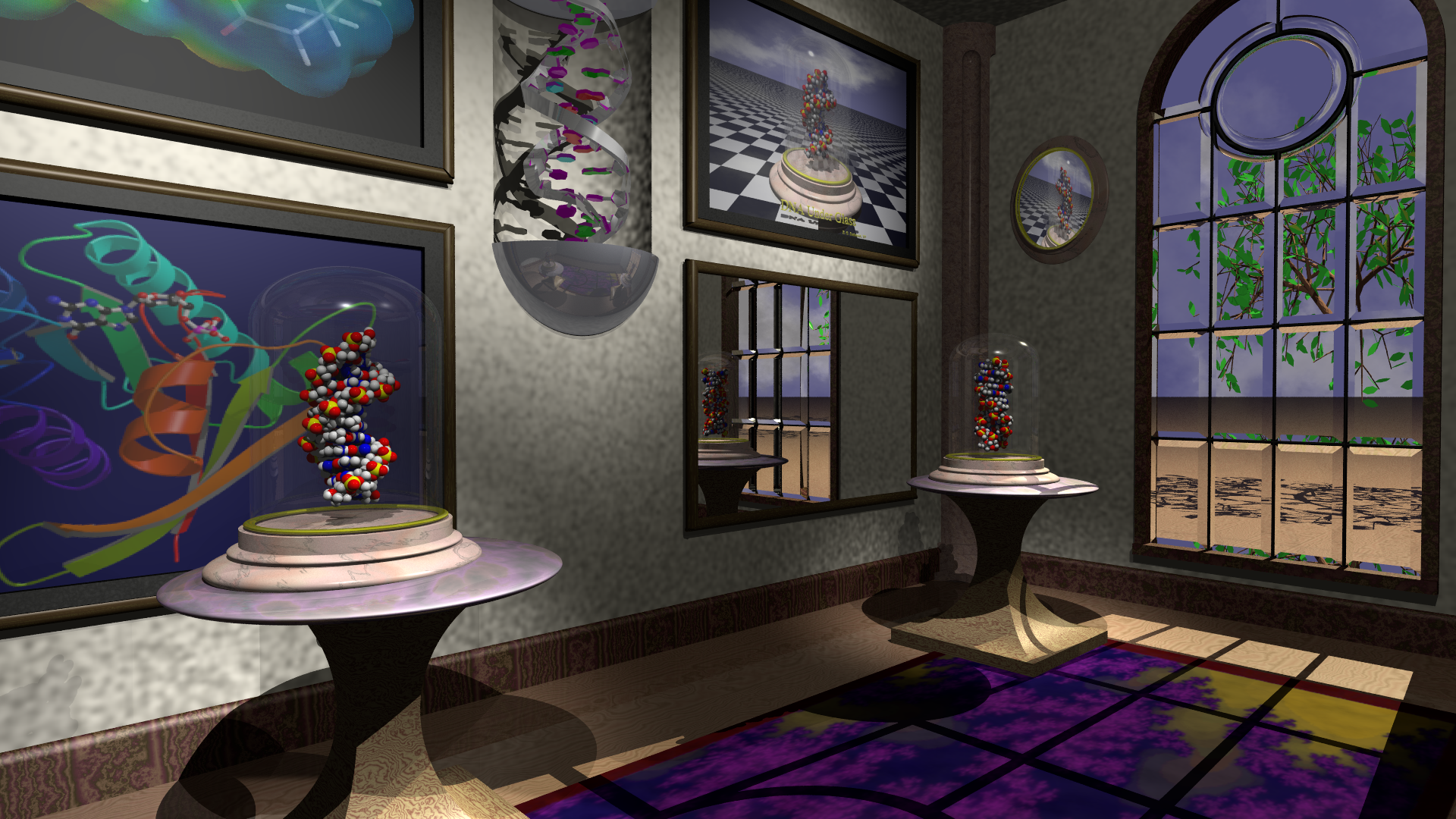
A career in structural biophysics, arranged as exhibits: B-DNA and Z-DNA under bell jars, Ras and my original DNA Under Glass on the walls. The molecular models were generated by pdb2pov in 1997; the room dates to 1995. Quiltwright ray-traces it into a 48-view light-field quilt for Looking Glass light-field panels, or into 2-D video for Hololuminescent displays. A third output -- a 23-view sweep for LitiHolo's desktop hologram printer -- is in development. About the image
Latest news
v0.11.0 (2026-08-31). quiltwright dynamic packs a set of stills into a
macOS Dynamic Desktop HEIC, writing the same appearance/solar/time-of-day
metadata Apple ships in The Lake.heic -- so a woven Looking Glass quilt, or
an ordinary 2-D still, can drive the Mac's light/dark wallpaper cycle.
POV-Ray scenes get there without touching clock: new lighting= and
sun= arguments on render_pov_quilt/render_pov_views add a Dynamic
Desktop-aware key light and an explicit parallel sun, and bj_holo_2026.pov
is now framed and lit for the desktop -- the normal plate by day, a fog
night after dark. Underneath, HasLens replaces a private protocol so
depth_budget accepts any lens-shaped camera, and the PyVista, POV-Ray, and
Cycles backends share their duplicated helpers through a new
quiltwright.runtime module.
Full history: CHANGELOG.md and releases.
What it's for
     scene sources                  quiltwright                  outputs

  PyVista / VTK  -----+        +------------------+        +-->  LFD  light-field panels
   (WaveRider, TVB)   |        |  off-axis views  |        |          multi-view quilts
                      +------->|  depth budget    |------->+-->  HLD  hololuminescent
  POV-Ray  -----------+        |  quilt assembly  |        |          2-D video
   (pypdb2pov, PyMOL) |        |  view sweeps     |        +-->  LitiHolo  hogel sweeps
                      |        +------------------+                       (in development)
  Blender / meshes ---+
   (.blend, glTF, USD, OBJ)
Three backends share one assembler:
| Backend | Call | Input |
|---|---|---|
| PyVista / VTK | render_quilt() |
In-memory plotter |
| POV-Ray | render_pov_quilt() |
.pov on disk; original never modified |
| Cycles | render_cycles_quilt() |
.blend and mesh files; GPU ray tracing where available |
render_cycles_quilt_from_plotter() takes the same PyVista plotter
render_quilt() does and path-traces it instead. WaveRider, The Virtual
Brain, PyVista example datasets, quiltwright.povgen, and a
plain .pov file on disk all feed the same path.
Two display technologies. Light-field displays (LFD -- Portrait, Go,
16"/27"/32"/65") consume quilts: N views tiled into one image.
quiltwright.lfd targets those. Hololuminescent displays (HLD --
16"/27"/86") play ordinary 2-D video behind a fixed holographic optic and
need dark-field styling rather than parallax; that is quiltwright.hld.
A third output is in development: render_pov_views() plus LITIHOLO_SWEEP
write a 23-view single-row sweep for LitiHolo's desktop hologram printer. Nothing
has yet passed through a printer's software;
docs/lfd.md
records what remains open.
Off-axis, not toe-in
Each view must use an off-axis (asymmetric-frustum) projection: the camera slides sideways while continuing to face the same direction, with the image plane sheared back onto the original view axis.
The intuitive alternative is to swivel each camera to keep the subject centered. This "toe-in" approach introduces vertical parallax and keystone distortion, so the display cannot fuse the views: you get ghosting instead of depth. It is the single most common way light-field renders go wrong, and it produces output that looks perfectly plausible in any individual frame.
Install
pip install quiltwright                 # core: quilt geometry + Bridge control
pip install "quiltwright[viz]"          # + PyVista/VTK rendering backend
pip install "quiltwright[video]"        # + a bundled ffmpeg for video encoding
pip install "quiltwright[molecules]"    # + PDB and mmCIF, via pypdb2pov
Requires Python 3.12 or 3.13. Core depends only on numpy, pillow, and click.
POV-Ray, Blender, PyMOL, ffmpeg, and Looking Glass Bridge are external binaries, not pip dependencies. Poetry groups, from-source install, and the rest of the stack are in the installation guide.
Quick start
import pyvista as pv
from quiltwright import QUILT_PRESETS, render_quilt, save_quilt

p = pv.Plotter(off_screen=True)
p.add_mesh(pv.ParametricTorus())
spec = QUILT_PRESETS["portrait"]
save_quilt(render_quilt(p, spec), "torus", spec)   # -> torus_qs8x6a0.75.png
POV-Ray, Cycles, casting to Bridge, and hologram-printer sweeps: docs/usage.md. Shell targets and the CLI: docs/shell.md.
Driving it from the shell
The Makefile covers the bundled 1993-99 scenes. The quiltwright CLI covers
hardware (cast, weave, wallpaper, dynamic, bridge) and arbitrary input (mesh,
cartoon, probe). Worked exhibits stay in scripts/. Full tour:
docs/shell.md.
make gallery                    # every reference still -> gallery/
make quilts                     # every bundled quilt, measured budgets dialled in
make preview-museum             # quarter-size, for iterating on composition

quiltwright cast renders/quilts/bell-jar-holo_qs8x6a1.77778.png
quiltwright bridge status       # is Bridge actually able to draw?
quiltwright weave ... && quiltwright wallpaper ...   # the no-Bridge path
quiltwright cartoon 2omf.cif.gz ompf_cartoon.inc     # molecular ribbon, via PyMOL
quiltwright mesh model.glb                           # any mesh file, camera auto-framed
quiltwright probe scene.pov --eye 0 35 -95 --aim 0 18 0   # measure its depth range

python scripts/make_exhibit.py 7AHL --quilt          # fetch -> convert -> render
RENDER_THREADS defaults to ncpu - 2. When the glass stays black, run
quiltwright bridge status first -- Bridge keeps answering HTTP after crashing
internally.
The depth budget
Whether a hologram fuses comes down to adjacent-view disparity: how far a feature moves between neighboring views. Roughly 4-5 px is the practical ceiling; past ~8 px, hard edges ghost. The arithmetic API is in docs/usage.md; the results worth knowing before you frame a shot -- each derived in docs/povray.md:
- Content at the focal plane has zero disparity -- it is welded to the glass.
- The focal plane belongs at the harmonic mean of the measured depth range, not the midpoint; near content is the expensive side.
- A narrower field of view increases disparity. The widely repeated "~14 degree FOV" advice is specific to object-centric scenes; applied to an interior it makes ghosting worse.
- Interiors have a fourth trap no arithmetic warns about: the camera sweep can run through a wall. Measure sweep clearance.
- The depths themselves are measured, not guessed --
quiltwright probesweeps an opaque plane along the view axis and reports where content actually begins and ends.
Supported devices
QUILT_PRESETS carries the official quilt settings for Portrait, Go, and the
16"/27"/32"/65" panels in both orientations. The 16" Gen3 Landscape entry is
verified against what Bridge reports for real hardware -- see
docs/usage.md.
Documentation
| Document | Contents |
|---|---|
| docs/install.md | Installing the full stack: package extras, POV-Ray, ffmpeg, Bridge, pypdb2pov |
| docs/usage.md | Library recipes: PyVista, POV-Ray, Cycles, casting to Bridge, printer sweeps, depth budget |
| docs/shell.md | Driving it from the shell: every make target, the parallelism model, run reports, and what each CLI command is for |
| docs/cli.md | Flag-by-flag reference for every quiltwright command |
| docs/architecture.md | The module map, the off-axis invariant shared by all three backends, and why the geometry core stays free of VTK |
| docs/lfd.md | Light-field output, Bridge/Studio setup, device presets, the PyVista path, view sweeps for hologram printers |
| docs/pyvista-datasets.md | PyVista dataset ideas for holograms: topography, the Allen mouse brain atlas, other strong-depth candidates |
| docs/tvb-data.md | Brain geometry from The Virtual Brain: cortical surfaces, connectomes, parcellations, downloaded on demand |
| docs/povray.md | The POV-Ray backend: off-axis camera derivation, depth budget, sweep clearance, a worked case study |
| docs/cycles.md | The Blender Cycles backend: hardware ray tracing (Metal/OptiX/HIP), mesh and .blend scenes, one process per sweep |
| docs/mesh-import.md | Any 3D object file (glTF/GLB, OBJ, FBX, USD, …) to a quilt in one command, with the camera auto-framed from the mesh's bounds |
| docs/povgen.md | Writing POV-Ray scenes from analytic primitives, so a scene composed in Python can be ray-traced rather than rasterized |
| docs/pov-workflow.md | The procedure: taking an archive scene from "won't parse" to a quilt that fuses, step by step |
| docs/pdb2pov.md | Rendering molecular structures as holograms with pypdb2pov, from the shell or in-process |
| docs/hld.md | Hololuminescent Displays, which play ordinary 2-D video rather than quilts |
| docs/about-the-image.md | The museum scene: what is on display, and the thirty-year pipeline behind it |
| docs/gallery.md | Every image in gallery/, which scene made it, and the aspect each must be rendered at |
Testing
poetry install --with viz,dev    # or: pip install -e ".[viz]" && pip install pytest
pytest
Tests skip when their backend is absent. Headless CI: xvfb-run -a pytest.
Layered install and skip conditions are in the
installation guide.
The pipelines this serves
- WaveRider -- manifold-aware
geometric ML. Its voxel and manifold visualizer builds the PyVista scenes
that
render_quilt()sweeps. - pypdb2pov -- PDB and mmCIF to POV-Ray. Reads mmCIF and compressed input, ships the atom textures inside the package, and imports, so a conversion and a quilt render fit in one script. Scenes are byte-identical to pdb2pov, the 1993 C original.
- proteusPy -- protein disulfide bond analysis and rendering.
Citation
If you use Quiltwright in your work, please cite it. Citation metadata is in CITATION.cff; GitHub's "Cite this repository" button generates BibTeX/APA from it, and the DOI badge above resolves to the archived release on Zenodo.
@software{suchanek_quiltwright,
  author  = {Suchanek, Eric G.},
  title   = {Quiltwright: Holographic Output for Looking Glass Displays},
  url     = {https://github.com/Flux-Frontiers/quiltwright},
  doi     = {10.5281/zenodo.22180300},
  version = {0.11.0},
  year    = {2026}
}
License
BSD 3-Clause. See LICENSE.
1 maintainer

Download files
Download the file for your platform. If you're not sure which to choose, learn more about installing packages.
Source Distribution
Built Distribution
Filter files by name, interpreter, ABI, and platform.
If you're not sure about the file name format, learn more about wheel file names.
Copy a direct link to the current filters
File details
Details for the file quiltwright-0.11.0.tar.gz.
File metadata
- Download URL: quiltwright-0.11.0.tar.gz
- Upload date:
- Size: 147.4 kB
- Tags: Source
- Uploaded using Trusted Publishing? Yes
- Uploaded via:
twine/7.0.0 CPython/3.13.14
File hashes
| Algorithm | Hash digest | |
|---|---|---|
| SHA256 |
5964a94c03d1392a44188b7f3b16166f50232abc124680767916787557b5c868
|
|
| MD5 |
2f0d5b9cbcdd24eea3cf429b793bb807
|
|
| BLAKE2b-256 |
854c12ac1671482bdbb0d21951b540f3bdb35841ac149fccc0ceff70b705fd2d
|
Provenance
The following attestation bundles were made for quiltwright-0.11.0.tar.gz:
Publisher:
release.yml on Flux-Frontiers/quiltwright
-
Statement:
-
Statement type:
https://in-toto.io/Statement/v1 -
Predicate type:
https://docs.pypi.org/attestations/publish/v1 -
Subject name:
quiltwright-0.11.0.tar.gz -
Subject digest:
5964a94c03d1392a44188b7f3b16166f50232abc124680767916787557b5c868 - Sigstore transparency entry: 2671045445
- Sigstore integration time:
-
Permalink:
Flux-Frontiers/quiltwright@9c6c3cf4acbc0d5879db6b75161e29bc8bb89e88 -
Branch / Tag:
refs/tags/v0.11.0 - Owner: https://github.com/Flux-Frontiers
-
Access:
public
-
Token Issuer:
https://token.actions.githubusercontent.com -
Runner Environment:
github-hosted -
Publication workflow:
release.yml@9c6c3cf4acbc0d5879db6b75161e29bc8bb89e88 -
Trigger Event:
push
-
Statement type:
File details
Details for the file quiltwright-0.11.0-py3-none-any.whl.
File metadata
- Download URL: quiltwright-0.11.0-py3-none-any.whl
- Upload date:
- Size: 158.8 kB
- Tags: Python 3
- Uploaded using Trusted Publishing? Yes
- Uploaded via:
twine/7.0.0 CPython/3.13.14
File hashes
| Algorithm | Hash digest | |
|---|---|---|
| SHA256 |
31c120c89aff3bc7cd2fb60e8d032a50c3168617019c8ea8b7e2c178fa5c4c26
|
|
| MD5 |
511ee3c4c11852d5114981a88a12ebb0
|
|
| BLAKE2b-256 |
51747e8a0542d551817971d1729a74d62f926d2e10ea8ea18b31ff5df61ace47
|
Provenance
The following attestation bundles were made for quiltwright-0.11.0-py3-none-any.whl:
Publisher:
release.yml on Flux-Frontiers/quiltwright
-
Statement:
-
Statement type:
https://in-toto.io/Statement/v1 -
Predicate type:
https://docs.pypi.org/attestations/publish/v1 -
Subject name:
quiltwright-0.11.0-py3-none-any.whl -
Subject digest:
31c120c89aff3bc7cd2fb60e8d032a50c3168617019c8ea8b7e2c178fa5c4c26 - Sigstore transparency entry: 2671045484
- Sigstore integration time:
-
Permalink:
Flux-Frontiers/quiltwright@9c6c3cf4acbc0d5879db6b75161e29bc8bb89e88 -
Branch / Tag:
refs/tags/v0.11.0 - Owner: https://github.com/Flux-Frontiers
-
Access:
public
-
Token Issuer:
https://token.actions.githubusercontent.com -
Runner Environment:
github-hosted -
Publication workflow:
release.yml@9c6c3cf4acbc0d5879db6b75161e29bc8bb89e88 -
Trigger Event:
push
-
Statement type:














