

RAGWire
Build production-ready RAG pipelines with document ingestion, metadata-aware retrieval, hybrid search, and Qdrant storage in a few lines of Python.







Table of Contents
- Why RAGWire?
- Try It In 60 Seconds
- Best For
- Supported Stack
- Project Status
- Features
- Architecture
- Installation
- Quick Start
- Configuration
- Embedding Providers
- Examples
- Production Notes
- Security & Privacy
- How RAGWire Fits
- Component Usage
- Package Structure
- Troubleshooting
- Contributing
Why RAGWire?
RAGWire gives you the building blocks for document-heavy RAG systems without forcing you into a full application framework. It keeps ingestion, metadata extraction, vector storage, and retrieval configurable, inspectable, and easy to wire into your own apps or agents.
- Ingest PDFs, DOCX, XLSX, PPTX, Markdown, and text files
- Extract structured metadata with your chosen LLM
- Store dense and optional sparse vectors in Qdrant
- Retrieve with metadata filters, MMR, hybrid search, or cross-encoder reranking
- Answer questions with citations, and measure whether retrieval is any good
- Swap LLM and embedding providers through YAML config
- Re-run ingestion safely with SHA256 deduplication
Try It In 60 Seconds
pip install ragwire
Start Qdrant locally:
docker run -p 6333:6333 qdrant/qdrant
from ragwire import RAGWire

rag = RAGWire("config.yaml")

rag.ingest_directory("data/", recursive=True)

answer = rag.query("What was Apple's revenue in 2025?")
print(answer.formatted())
Example output:
Apple reported total net sales of $416.2 billion for fiscal 2025 [1], an
increase of 8% year over year [1].

Sources:
  [1] Apple_10k_2025.pdf
If the documents do not answer the question, query() says so rather than falling back on the model's own knowledge. To work with the underlying chunks instead:
results = rag.retrieve("What was Apple's revenue in 2025?", top_k=5)
for doc in results:
    print(doc.page_content[:300])
    print(doc.metadata)
Apple reported total net sales of ...
{'company_name': 'apple inc.', 'doc_type': '10-k', 'fiscal_year': 2025, 'file_name': 'Apple_10k_2025.pdf'}
Best For
- Financial document QA and SEC filing analysis
- Internal knowledge bases over PDFs and office documents
- Research document search with metadata filters
- Agentic RAG systems that need filter context
- Giving Claude Desktop, Claude Code or Cursor access to your own documents over MCP
- Scheduled pipelines that must stay in step with a folder or an S3 bucket
- Hybrid retrieval applications using Qdrant
Supported Stack
| Layer | Supported |
|---|---|
| Document loading | PDF, DOCX, XLSX, PPTX, TXT, MD via MarkItDown |
| Vector database | Qdrant |
| Embeddings | Ollama, OpenAI, OpenRouter, HuggingFace, Google, FastEmbed |
| LLM metadata extraction | Ollama, OpenAI, OpenRouter, Gemini, Groq, Anthropic |
| Retrieval | Similarity, MMR, hybrid dense+sparse search, cross-encoder reranking |
| Reranking | Local cross-encoder (sentence-transformers), Cohere Rerank |
| Answer generation | Cited answers with refusal, sync and async |
| Sources | Local folders, S3 and S3-compatible stores, custom connectors |
| Agent integration | MCP server for Claude Desktop, Claude Code, Cursor |
| Evaluation | recall@k, MRR, hit rate, precision, config sweeps |
| Configuration | YAML + environment variables |
Project Status
RAGWire is in beta and designed for developers building production-style RAG systems. The core ingestion, metadata extraction, Qdrant storage, and retrieval workflows are usable today; APIs may evolve as the toolkit matures.
Features
Ingestion
- Document Loading: PDF, DOCX, XLSX, PPTX and more via MarkItDown
- LLM Metadata Extraction: extracts company, doc type, fiscal period using your LLM; fully customisable via YAML
- Smart Text Splitting: markdown-aware, recursive, and page-wise chunking strategies; page-wise keeps one chunk per PDF page or PPTX slide and stamps
page_numberon every chunk - SHA256 Deduplication: at both file and chunk level
- Directory Ingestion: ingest an entire folder with one call, with optional recursive scan
- Source Sync:
rag.sync()reconciles against local folders and S3, including deletions that plain ingestion never sees
Retrieval and answers
- Multiple Embedding Providers: Ollama, OpenAI, OpenRouter, HuggingFace, Google, FastEmbed
- Qdrant Vector Store: dense, sparse, and hybrid search
- Advanced Retrieval: similarity, MMR, and hybrid search with metadata filtering
- Reranking: optional cross-encoder second stage, local and API-key-free by default
- Grounded Answers:
rag.query()returns cited answers and refuses when the documents come up short, withaquery()for async callers
Operating it
- Evaluation: recall@k, MRR and config sweeps against your own golden set, so tuning is measured rather than guessed
- MCP Server:
ragwire mcp serveexposes a collection to Claude Desktop, Claude Code and Cursor - CLI:
ragwire ingest,sync,evalandmcp serve - Env Var Substitution: use
${VAR}inconfig.yamlfor secrets
Architecture
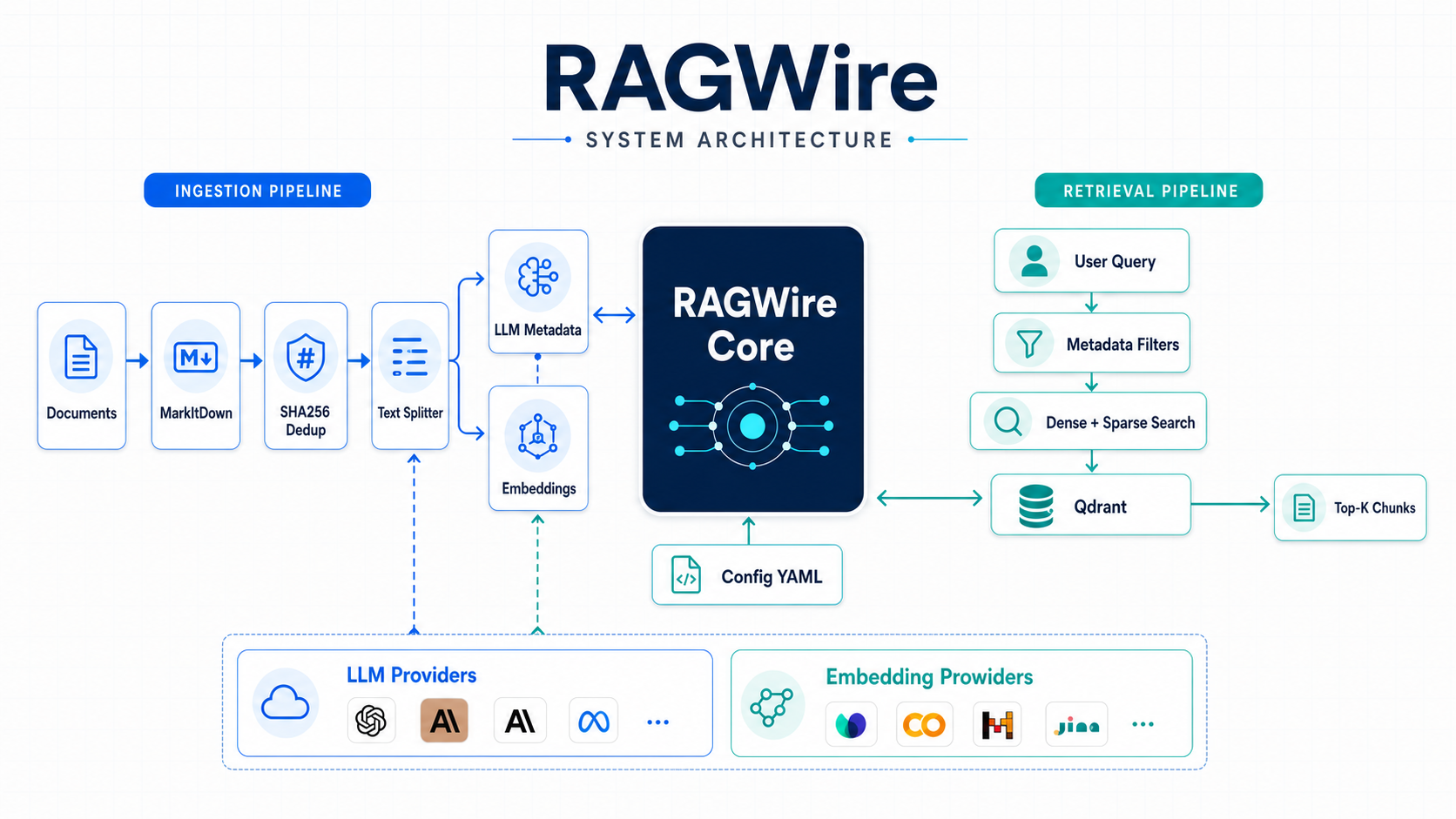
RAGWire is coordinated by the RAGWire core and configured through YAML. Documents move through conversion, deduplication, chunking, metadata extraction, embeddings, and Qdrant storage. Queries can use explicit or LLM-extracted metadata filters before dense, sparse, or hybrid retrieval returns the most relevant chunks.
Document Ingestion Flow
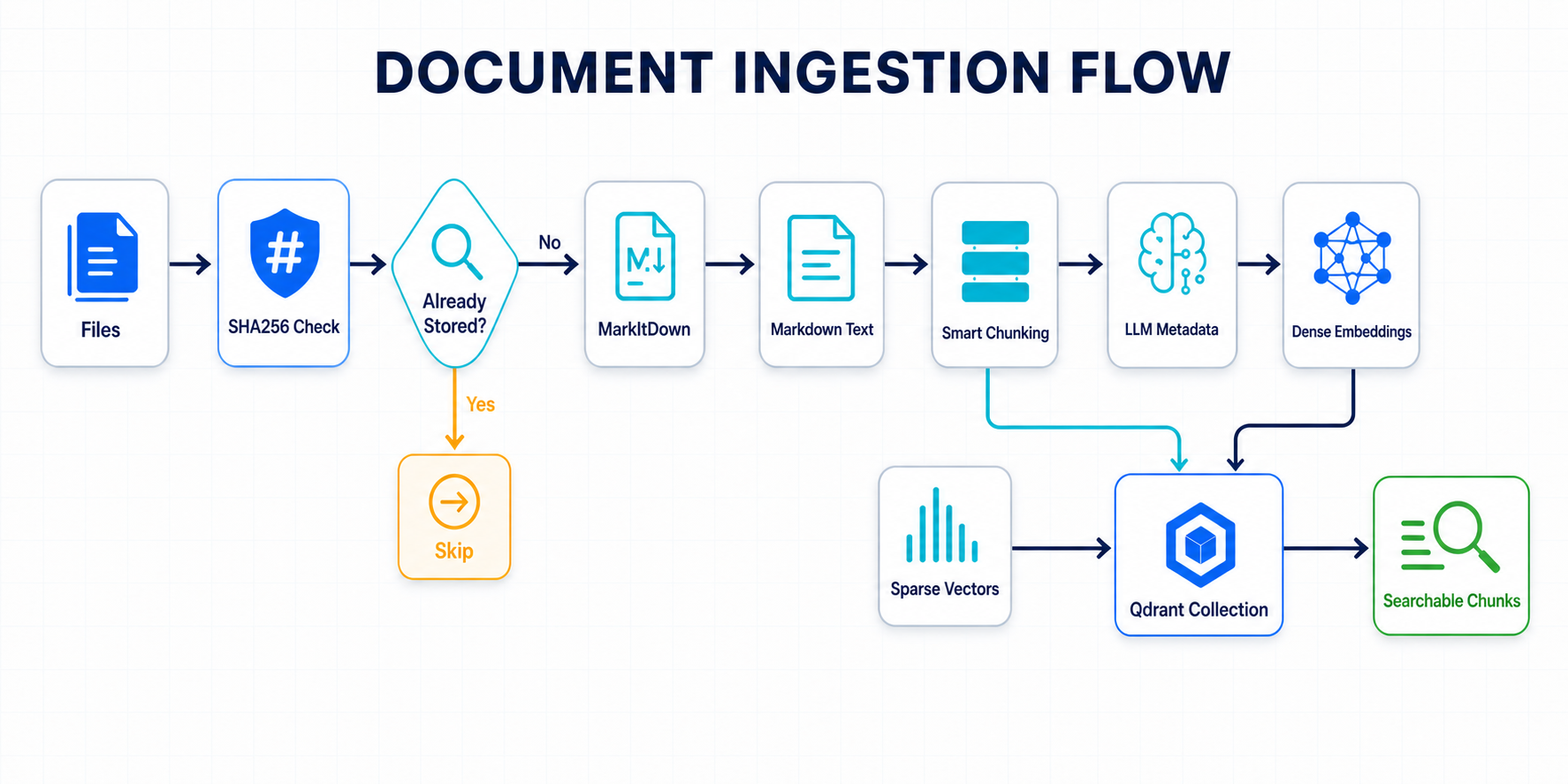
The ingestion path is safe to re-run: SHA256 file hashes skip previously stored documents. New files are converted to Markdown, split into overlapping chunks, enriched with structured LLM metadata, embedded, and stored in Qdrant with dense and optional sparse vectors.
Installation
pip install ragwire

# With Ollama support (local, no API key)
pip install "ragwire[ollama]"

# With OpenRouter support (LLM + embeddings; requires Python >= 3.10)
pip install "ragwire[openrouter]"

# Optional capabilities
pip install "ragwire[rerank]"   # local cross-encoder reranking, no API key
pip install "ragwire[cohere]"   # hosted reranking
pip install "ragwire[mcp]"      # MCP server for Claude Desktop / Code / Cursor
pip install "ragwire[s3]"       # S3 source connector for rag.sync()

# Everything
pip install "ragwire[all]"
Nothing above is needed for the core install. Reranking, MCP and S3 are opt-in, and evaluation needs no extra package at all.
Quick Start
from ragwire import RAGWire

rag = RAGWire("config.yaml")

# Ingest files. SHA256 deduplication makes this safe to re-run.
stats = rag.ingest_documents(["data/Apple_10k_2025.pdf", "data/Microsoft_10k_2025.pdf"])
print(f"Processed: {stats['processed']}, Skipped: {stats['skipped']}, Chunks: {stats['chunks_created']}")

# Or ingest an entire directory
stats = rag.ingest_directory("data/", recursive=True)

# Basic retrieval returns a list of LangChain Document objects
results = rag.retrieve("What is the total revenue?", top_k=5)
for doc in results:
    print(doc.page_content[:300])
    print(doc.metadata["company_name"])   # str, lowercased, e.g. "apple"
    print(doc.metadata["fiscal_year"])    # int, e.g. 2025
    print(doc.metadata["file_name"])      # str, e.g. "Apple_10k_2025.pdf"

# Retrieval with explicit metadata filters
results = rag.retrieve(
    "What is the net income?",
    filters={"company_name": "apple", "fiscal_year": 2025}  # pass year as int
)

# A list gives OR logic within a field, matching any of the listed values
results = rag.retrieve("Compare revenue trends", filters={"fiscal_year": [2023, 2024, 2025]})

# Agent-controlled filtering (recommended for AI agents)
filters = rag.extract_filters("Apple's revenue in 2025")
# → {"company_name": "apple", "fiscal_year": 2025} or None
results = rag.retrieve("Apple's revenue in 2025", filters=filters)
Grounded Answers
retrieve() returns chunks. query() returns an answer with the sources it came from, and refuses rather than falling back on the model's own knowledge.
answer = rag.query("What was Apple's net income in fiscal 2025?")

print(answer.text)          # "Apple reported net income of $93.7 billion [1]."
print(answer.sources)       # ["Apple_10k_2025.pdf"]
print(answer.confidence)    # fraction of sentences carrying a citation

# An Answer is falsy when the documents did not support one
if not answer:
    print("Not in the collection")

# Async, for anything serving concurrent users
answer = await rag.aquery("What was net income?")
Keeping the Collection Current
Ingestion only ever adds, so a file deleted at the source keeps answering queries forever. sync() reconciles instead.
sources:
  - type: local
    path: "./documents"
    recursive: true
stats = rag.sync(dry_run=True)   # see what would change
stats = rag.sync()               # ingest new, replace changed, delete gone
Command Line
ragwire ingest ./documents --recursive
ragwire sync --dry-run
ragwire eval golden.yaml --compare-rerank
ragwire mcp serve --config config.yaml    # expose the collection to Claude Desktop
Query & Retrieval Flow
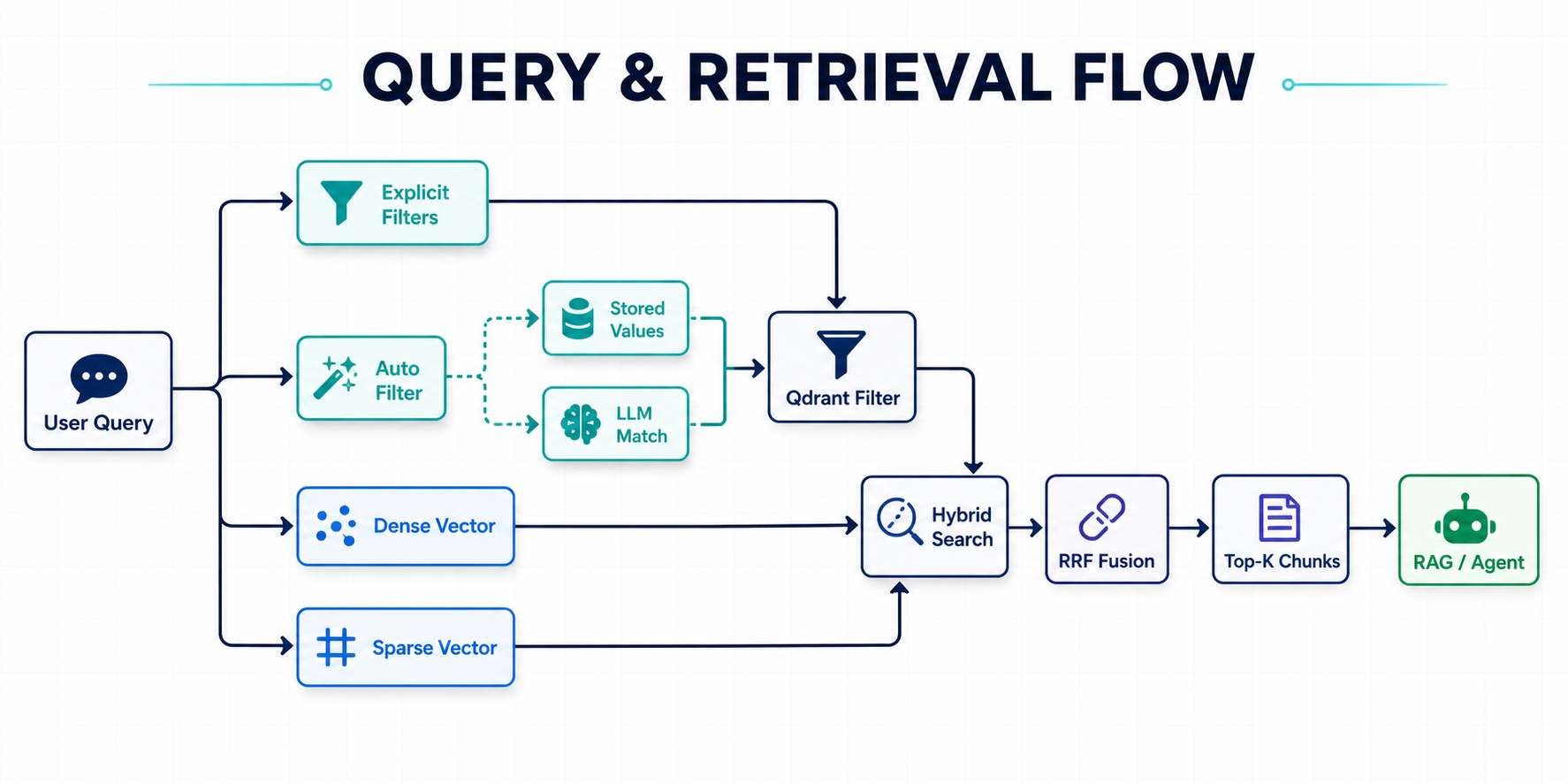
At query time, callers can pass filters directly or enable LLM-assisted filter extraction grounded in values already stored in Qdrant. The query is then resolved through similarity, MMR, or dense-plus-sparse hybrid search and returned as top-ranked LangChain Document chunks for a RAG application or agent.
Configuration
Create a minimal config.yaml:
embeddings:
  provider: "ollama"
  model: "qwen3-embedding:0.6b"
  base_url: "http://localhost:11434"

llm:
  provider: "ollama"
  model: "qwen3.5:9b"
  num_ctx: 16384

vectorstore:
  url: "http://localhost:6333"
  collection_name: "rag_documents"
  use_sparse: true

retriever:
  search_type: "hybrid"
  top_k: 5
Copy config.example.yaml to config.yaml for the full template. Secrets can be injected via environment variables:
vectorstore:
  url: "https://your-cluster.qdrant.io"
  api_key: "${QDRANT_API_KEY}"

llm:
  provider: "openai"
  model: "gpt-5.4-nano"
  api_key: "${OPENAI_API_KEY}"
Full example:
embeddings:
  provider: "ollama"
  model: "qwen3-embedding:0.6b"
  base_url: "http://localhost:11434"

llm:
  provider: "ollama"
  model: "qwen3.5:9b"
  num_ctx: 16384

vectorstore:
  url: "http://localhost:6333"
  collection_name: "my_docs"
  use_sparse: true

retriever:
  search_type: "hybrid"
  top_k: 5
  auto_filter: false   # set true to enable LLM-based filter extraction from every query
Optional blocks
Each of these is entirely optional. Omit it and the feature is off.
retriever:
  top_k: 5
  rerank:                              # needs: pip install "ragwire[rerank]"
    provider: "cross_encoder"          # or "cohere"
    model: "BAAI/bge-reranker-base"
    fetch_k: 25                        # candidates scored, default max(4 * top_k, 20)

generation:                            # controls rag.query() only
  max_context_chars: 12000             # budget for the source block sent to the LLM

sources:                               # used by rag.sync()
  - type: local
    path: "./documents"
    recursive: true
  - type: s3                           # needs: pip install "ragwire[s3]"
    bucket: "my-filings"
    prefix: "2026/"
See the API reference for every key.
Embedding Providers
# Ollama (local)
embeddings:
  provider: "ollama"
  model: "qwen3-embedding:0.6b"

# OpenAI
embeddings:
  provider: "openai"
  model: "text-embedding-3-small"

# OpenRouter (free-tier models available)
embeddings:
  provider: "openrouter"
  model: "nvidia/llama-nemotron-embed-vl-1b-v2:free"
  api_key: "${OPENROUTER_API_KEY}"

# HuggingFace (local)
embeddings:
  provider: "huggingface"
  model_name: "sentence-transformers/all-MiniLM-L6-v2"

# Google
embeddings:
  provider: "google"
  model: "models/embedding-001"
Examples
Start with the basic examples, then move into app and agent tutorials:
| Example | Path |
|---|---|
| Basic ingestion and retrieval | examples/basic_usage.py |
| Custom metadata extraction | examples/custom_metadata_usage.py |
| RAG agent helper | examples/rag_agent.py |
| Golden set for evaluation | examples/golden.example.yaml |
| Tutorial series overview | examples/tutorials/00_series_overview.md |
| FastAPI production app | examples/tutorials/15_fastapi_production_app.md |
| LangGraph RAG pipeline | examples/tutorials/05_langgraph_rag_pipeline.md |
| Chainlit RAG chatbot | examples/tutorials/03_chainlit_rag_chatbot.md |
Production Notes
- Use Qdrant Cloud or a persistent local Qdrant volume for real projects.
- Keep
force_recreate: falseafter initial setup to avoid accidental collection resets. - Store API keys in environment variables and reference them as
${VAR}in YAML. - Tune
chunk_size,chunk_overlap,top_k, andsearch_typefor your document type. - Use metadata filters for high-precision retrieval over multi-company, multi-year, or multi-domain collections.
- Enable
use_sparse: truewithfastembedwhen keyword matching matters alongside semantic search. - Measure before you tune. Write twenty real questions into a golden set and run
ragwire eval golden.yaml. Chunk size andtop_kadvice, including the advice above, is a guess until it is checked against your own corpus. - Turn on reranking, then prove it helped.
ragwire eval golden.yaml --compare-rerankruns both ways. Unchanged recall with improved MRR is the expected shape: reranking reorders the candidate pool rather than widening it. - Prefer
sync()over repeatedingest_directory()for anything scheduled. Ingestion only ever adds, so a document deleted at the source keeps answering queries forever. Runragwire sync --dry-runthe first time. - Log
answer.confidenceandanswer.refusedin user-facing apps. A run of refusals usually means a retrieval or filtering problem, not a generation one.
Security & Privacy
RAGWire can run with local Ollama models for teams that do not want document text sent to hosted LLM providers. If you configure hosted LLM or embedding providers, the relevant document text or query text is sent to those providers for metadata extraction, embeddings, answer generation, or filter extraction. Keep secrets out of source control by using environment variables in config.yaml.
A fully local setup is possible end to end: Ollama for the LLM and embeddings, cross_encoder for reranking, and a local or self-hosted Qdrant. Reranking in particular defaults to a local model precisely so that turning it on does not push document text to a third party.
rag.query() sends retrieved chunk text to whichever LLM you configured. The MCP server exposes your collection to whatever client you connect it to, so treat that connection with the same care as any other data access.
How RAGWire Fits
RAGWire is a composable Python toolkit, not a hosted RAG platform and not a full application framework. Use it when you want direct control over document ingestion, metadata design, Qdrant storage, and retrieval behavior while still avoiding boilerplate.
Component Usage
from ragwire import (
    MarkItDownLoader,
    get_splitter,
    get_markdown_splitter,
    get_embedding,
    QdrantStore,
    MetadataExtractor,
    hybrid_search,
    mmr_search,
)

# Load a document
loader = MarkItDownLoader()
result = loader.load("document.pdf")

# Split text
splitter = get_markdown_splitter(chunk_size=10000, chunk_overlap=2000)
chunks = splitter.split_text(result["text_content"])

# Or one chunk per page (set splitter.strategy: "page" to use this in the pipeline).
# Pages come from the format itself: PDF pages, PPTX slides, "<!-- pagebreak -->"
# markers in text files, or markdown/HTML headings.
from ragwire import PageLoader, PageSplitter

loader = PageLoader()
result = loader.load("report.pdf")
pages = PageSplitter().split(
    result["text_content"], pages=result["pages"], file_type=result["file_type"]
)
# each page: {"text", "page_number", "page_label", "page_total"}

# Embeddings
embedding = get_embedding({"provider": "ollama", "model": "qwen3-embedding:0.6b"})

# Vector store
store = QdrantStore(config={"url": "http://localhost:6333"}, embedding=embedding)
store.set_collection("my_collection")
vectorstore = store.get_store()
The newer subsystems are composable in the same way. Each takes what it needs and holds no hidden dependency on RAGWire:
from ragwire.eval import GoldenSet, evaluate, sweep
from ragwire.generation import AnswerGenerator
from ragwire.mcp import search_documents, get_filter_context
from ragwire.retriever import get_reranker
from ragwire.sources import LocalSource, REGISTRY, Source

# Answer from documents you selected yourself
generator = AnswerGenerator(rag.llm, max_context_chars=20000)
answer = generator.generate("What was net income?", my_documents)

# Rerank a candidate list from anywhere
reranker = get_reranker({"provider": "cross_encoder"})
best = reranker.rerank("net income", candidates, top_n=5)

# Agent-ready text without running an MCP server
context = get_filter_context(rag, "apple revenue")
Package Structure
ragwire/
├── core/          # Config loader + RAGWire orchestrator
├── loaders/       # MarkItDown converter + page-aware loader (pypdf, python-pptx)
├── processing/    # Text splitters + SHA256 hashing
├── metadata/      # Pydantic schema + LLM extractor
├── embeddings/    # Multi-provider embedding factory
├── vectorstores/  # Qdrant wrapper with hybrid search
├── retriever/     # Similarity, MMR, hybrid retrieval and reranking
├── generation/    # Grounded answers with citations
├── eval/          # Golden sets, recall@k, MRR, config sweeps
├── sources/       # Local and S3 connectors for rag.sync()
├── mcp/           # MCP server and tools
├── cli.py         # The ragwire command
└── utils/         # Logging
Troubleshooting
| Error | Fix |
|---|---|
| Qdrant connection refused | docker run -p 6333:6333 qdrant/qdrant |
markitdown[pdf] missing |
pip install "markitdown[pdf]" |
| Ollama model not found | ollama pull <model-name> |
fastembed missing |
pip install fastembed (needed for hybrid search) |
| Embedding dimension mismatch | Set force_recreate: true in config once, then back to false |
Contributing
Contributions are welcome. Please open an issue for bugs, feature requests, provider integrations, or documentation improvements before larger changes.
License
MIT © 2026 KGP Talkie Private Limited
Links



- 🌐 Website: kgptalkie.com
- 📖 Docs: laxmimerit.github.io/RAGWire
- 💻 GitHub: github.com/laxmimerit/ragwire
- 📧 Email: udemy@kgptalkie.com
1 maintainer

Download files
Download the file for your platform. If you're not sure which to choose, learn more about installing packages.
Source Distribution
Built Distribution
Filter files by name, interpreter, ABI, and platform.
If you're not sure about the file name format, learn more about wheel file names.
Copy a direct link to the current filters
File details
Details for the file ragwire-1.6.0.tar.gz.
File metadata
- Download URL: ragwire-1.6.0.tar.gz
- Upload date:
- Size: 3.7 MB
- Tags: Source
- Uploaded using Trusted Publishing? Yes
- Uploaded via:
twine/7.0.0 CPython/3.13.14
File hashes
| Algorithm | Hash digest | |
|---|---|---|
| SHA256 |
8bea5da599597ed744d9e34d9bfd1831c3c4124196458b735f75db5d076ca4dc
|
|
| MD5 |
7afa2aaee5708fa449f07243ca0d925f
|
|
| BLAKE2b-256 |
1985dc7010b2c7d3d1491abc0f9d642fbefe75b9bb657151e56c91ba59c6c483
|
Provenance
The following attestation bundles were made for ragwire-1.6.0.tar.gz:
Publisher:
publish.yml on laxmimerit/RAGWire
-
Statement:
-
Statement type:
https://in-toto.io/Statement/v1 -
Predicate type:
https://docs.pypi.org/attestations/publish/v1 -
Subject name:
ragwire-1.6.0.tar.gz -
Subject digest:
8bea5da599597ed744d9e34d9bfd1831c3c4124196458b735f75db5d076ca4dc - Sigstore transparency entry: 2465280320
- Sigstore integration time:
-
Permalink:
laxmimerit/RAGWire@2003a4dd274b497ce8dae3799421a253e21942c4 -
Branch / Tag:
refs/tags/v1.6.0 - Owner: https://github.com/laxmimerit
-
Access:
public
-
Token Issuer:
https://token.actions.githubusercontent.com -
Runner Environment:
github-hosted -
Publication workflow:
publish.yml@2003a4dd274b497ce8dae3799421a253e21942c4 -
Trigger Event:
push
-
Statement type:
File details
Details for the file ragwire-1.6.0-py3-none-any.whl.
File metadata
- Download URL: ragwire-1.6.0-py3-none-any.whl
- Upload date:
- Size: 3.7 MB
- Tags: Python 3
- Uploaded using Trusted Publishing? Yes
- Uploaded via:
twine/7.0.0 CPython/3.13.14
File hashes
| Algorithm | Hash digest | |
|---|---|---|
| SHA256 |
effdf94fbc6a9fc43a1536ba290e03a7ac027a94462236ff2c404018188877f6
|
|
| MD5 |
20f6103e4e6001a4acf159b128b8aa07
|
|
| BLAKE2b-256 |
fdaa1d2caae2a350da7c1f471272819782432d46355652a6492c04a303e2f900
|
Provenance
The following attestation bundles were made for ragwire-1.6.0-py3-none-any.whl:
Publisher:
publish.yml on laxmimerit/RAGWire
-
Statement:
-
Statement type:
https://in-toto.io/Statement/v1 -
Predicate type:
https://docs.pypi.org/attestations/publish/v1 -
Subject name:
ragwire-1.6.0-py3-none-any.whl -
Subject digest:
effdf94fbc6a9fc43a1536ba290e03a7ac027a94462236ff2c404018188877f6 - Sigstore transparency entry: 2465280369
- Sigstore integration time:
-
Permalink:
laxmimerit/RAGWire@2003a4dd274b497ce8dae3799421a253e21942c4 -
Branch / Tag:
refs/tags/v1.6.0 - Owner: https://github.com/laxmimerit
-
Access:
public
-
Token Issuer:
https://token.actions.githubusercontent.com -
Runner Environment:
github-hosted -
Publication workflow:
publish.yml@2003a4dd274b497ce8dae3799421a253e21942c4 -
Trigger Event:
push
-
Statement type:














