
Stormlog
Memory and performance profiling for ML training and inference
| Documentation | Usage guide | Inference profiling | Terminal UI | PyPI |




About
Stormlog measures what a model does to the hardware it runs on, and keeps the evidence. It works the same way for a training job's memory and for an inference server's latency: capture once, save an artifact, then analyze, compare and diagnose it from the CLI, Python or a terminal UI.
Training and memory
- Track allocated, reserved and device memory over time for PyTorch (CUDA, ROCm, Apple MPS and CPU), TensorFlow, JAX, and MLX on Apple Silicon.
- Catch growth before it becomes an OOM: alert thresholds, growth and gap analysis, and an OOM flight recorder that keeps the moments before a crash.
- Reconstruct long captures by session, and compare ranks of a distributed run to find the one that diverged.
- Write diagnose bundles with a fixed exit-code and report contract for CI and release gates, and log to W&B or MLflow.
Inference serving
- Profile any OpenAI-compatible endpoint: time to first token, time per output token, end-to-end latency, throughput, failures and tokens, under closed-loop, fixed-rate, Poisson, burst or replayed traffic.
- Judge each run against an SLO with goodput, and compare a baseline with a
candidate over repeated runs (
stormlog infer compare), so a change is shown to help instead of assumed to. - Explain slow windows (
stormlog infer diagnose): queue saturation, KV preemption, prefix-cache loss, client admission and workload changes, each finding citing the records behind it. - Go deeper on vLLM: its Prometheus metrics, an execution hook that records scheduler steps, and GPU profiler traces joined to the requests they served.
- Watch a live server and capture its incidents (
stormlog infer watch), and export Prometheus metrics and OTLP spans.
Supported runtimes
| Area | Supported |
|---|---|
| Training memory | PyTorch (CUDA, ROCm, MPS, CPU), TensorFlow, JAX, MLX on Apple Silicon |
| Inference serving | vLLM (metrics, execution hook, profiler traces), any OpenAI-compatible server, MLX-LM, oMLX, MLX-Audio |
| Interfaces | Python API, gpumemprof / tfmemprof / jaxmemprof / mlxmemprof, stormlog infer, stormlog query, terminal UI |
| Python | 3.10 to 3.15 |
Getting started
pip install stormlog                 # core, inference profiling and the CLIs
pip install "stormlog[tui,torch]"    # terminal UI with PyTorch
Other extras: torch, tf, jax, mlx (Apple Silicon), viz,
infer-tokenizers, infer-otlp, wandb, mlflow, and all. The
examples/ package and the scenario scripts are source-checkout only: clone
the repository and pip install -e . to run them.
Training memory
gpumemprof info                      # tfmemprof info, jaxmemprof info, mlxmemprof info
gpumemprof track --duration 30 --interval 0.5 --output track.json --format json
gpumemprof analyze track.json --format txt --output analysis.txt
gpumemprof diagnose --duration 0 --output diag/
stormlog                             # the terminal UI
import torch
from stormlog import GPUMemoryProfiler  # CUDA or ROCm; MemoryTracker also covers MPS

profiler = GPUMemoryProfiler()
model = torch.nn.Linear(1024, 128).to(profiler.device)


def train_step() -> torch.Tensor:
    return model(torch.randn(64, 1024, device=profiler.device)).sum()


profiler.profile_function(train_step)
print(f"Peak: {profiler.get_summary()['peak_memory_usage'] / 1024**2:.1f} MB")
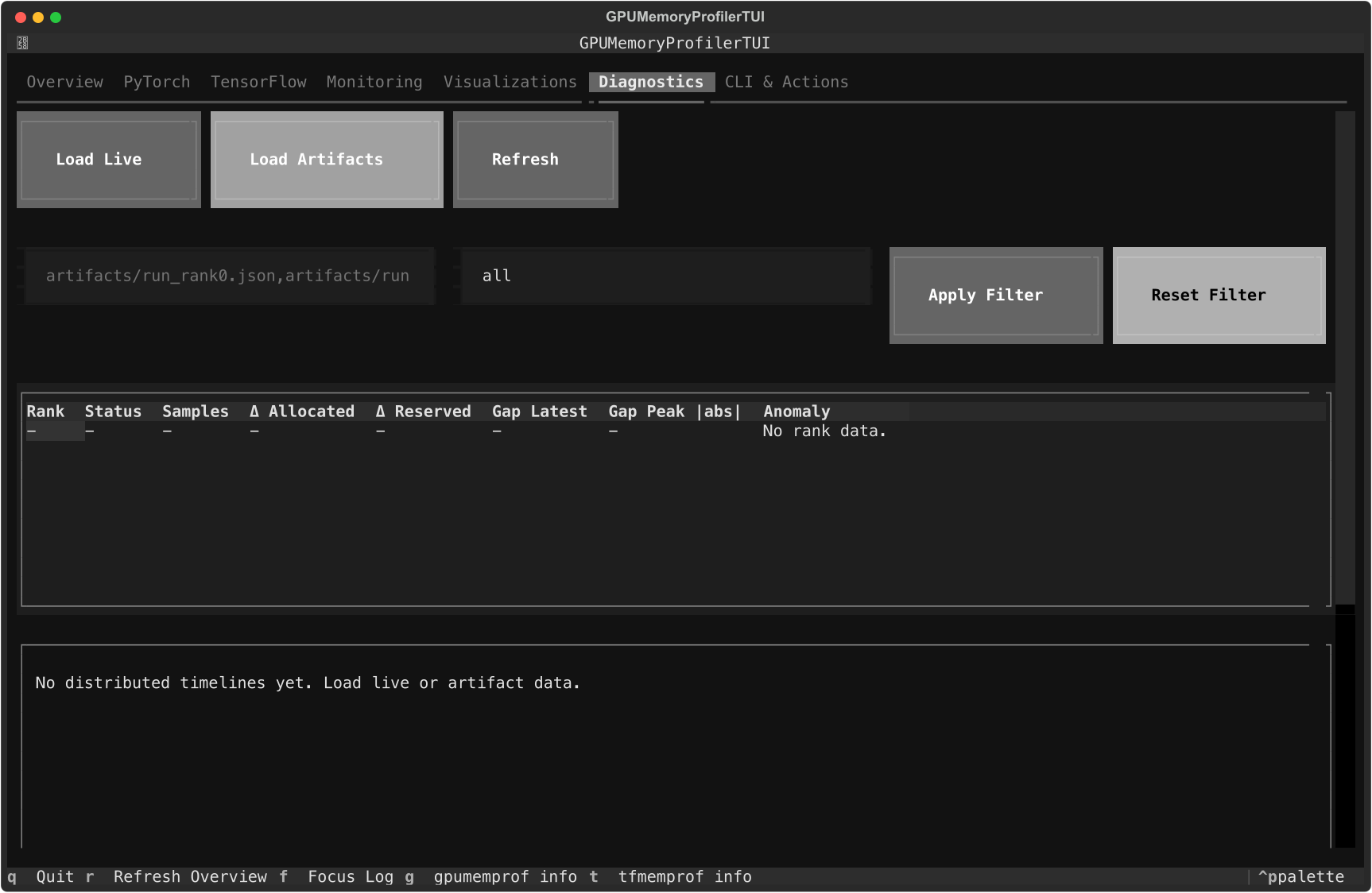
The terminal UI after ResNet-18 trained on CIFAR-10 for six epochs on an NVIDIA L4 (87.8% test accuracy): the memory timeline with its markers, and the first anomaly attributed to epoch 1 / train.
Inference
stormlog infer profile \
  --base-url http://localhost:8000/v1 --model Qwen/Qwen2.5-7B-Instruct \
  --concurrency 1,8,32 --duration 60 --slo ttft:500 --vllm-metrics \
  --output run.jsonl
stormlog infer analyze run.jsonl     # latency, throughput, goodput per case
stormlog infer diagnose run.jsonl    # why slow windows were slow
stormlog infer compare --baseline base-*.jsonl --candidate cand-*.jsonl \
  --gate 'client.e2e.p95=non-inferiority:0.05'
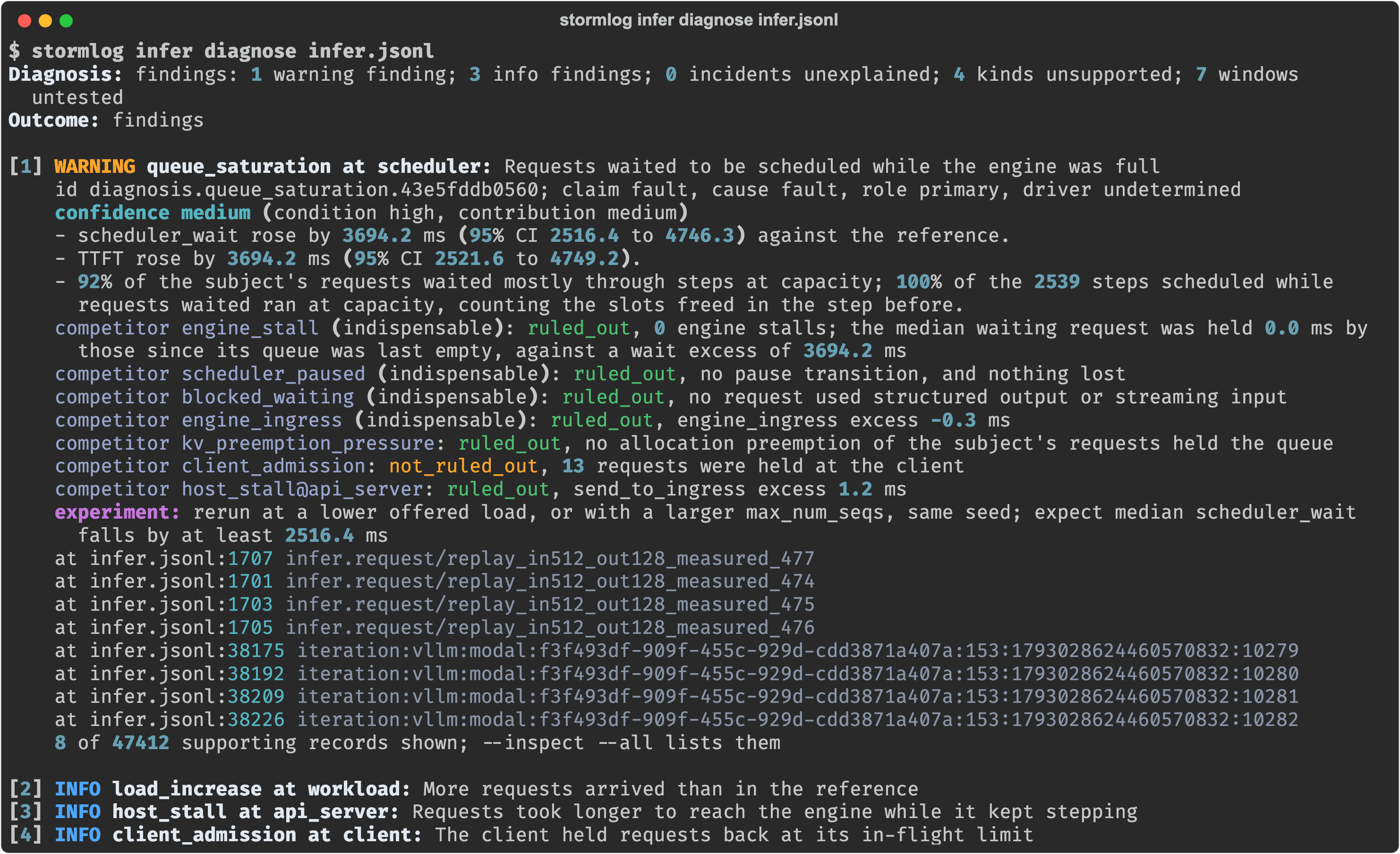
An excerpt of stormlog infer diagnose on vLLM 0.30.0 serving Qwen3-0.6B on an NVIDIA L4, overloaded for 12 seconds.
Documentation
- Installation and usage guide
- CLI reference and Python API
- Inference profiling, SLOs and goodput, comparing runs and diagnosis
- vLLM execution hook, incident capture and Prometheus and OTLP export
- Terminal UI, MLX on Apple Silicon and CPU-only machines
- Production cookbook: always-on tracking, incident playbooks, and CI and release qualification
- Report and exit-code contract
Contributing
Contributions are welcome. See the contributing guide and the code of conduct.
License


Release files for stormlog 0.4.3
For a detailed explanation of source distributions (sdists) and built distributions (wheels), please see the package formats documentation.
Source distribution (sdist)
| File | Size | Uploaded | Provenance | Actions |
|---|---|---|---|---|
| stormlog-0.4.3.tar.gz | 4.0 MB | With provenance | Details for stormlog-0.4.3.tar.gz |
Built distribution (wheel)
| File | Interpreter | ABI | Platform | Actions Reset |
|---|---|---|---|---|
| stormlog-0.4.3-py3-none-any.whl | Python 3 | none | any | Details for stormlog-0.4.3-py3-none-any.whl |
Total release size: 5.2 MB
Release files / stormlog-0.4.3.tar.gz
| Download URL | stormlog-0.4.3.tar.gz |
|---|---|
| Size | 4.0 MB |
| Tags | Source |
|
SHA-256 checksum How to use checksums |
63406a53bd98c066e35988f01af772e6e2e0fcd449606a79fbfcde5fa1915a34
|
|
BLAKE2b-256 checksum How to use checksums |
a45255a6f3e2622a0fa399557e059ab972525b9e37bf84d674e29dab3e041e32
|
| Upload date | |
|
Uploaded using Trusted Publishing? What is trusted publishing? |
Yes |
| Uploaded via |
twine/7.0.0 CPython/3.13.14
|
Provenance
Provenance describes where a file came from. On PyPI, provenance is shared via attestations, which provide a verifiable record of the build or publishing details. View details, limitations and caveats.


PyPI Publish Attestation
PyPI verified that this artifact, at this checksum, originated from the publisher listed below.
Signed by GitHub Actions, verified by PyPI on Oct 27, 2026.
Transparency logRelease files / stormlog-0.4.3-py3-none-any.whl
| Download URL | stormlog-0.4.3-py3-none-any.whl |
|---|---|
| Size | 1.2 MB |
| Tags | Python 3 |
|
SHA-256 checksum How to use checksums |
9d54afd63ccd00fe68063fea91de862ec35f12a218b1ce8b67b137a53a0523c5
|
|
BLAKE2b-256 checksum How to use checksums |
a715f02a0d4c12021d74fca47091765f91ef2a4f77307378d5740313e378b406
|
| Upload date | |
|
Uploaded using Trusted Publishing? What is trusted publishing? |
Yes |
| Uploaded via |
twine/7.0.0 CPython/3.13.14
|
Provenance
Provenance describes where a file came from. On PyPI, provenance is shared via attestations, which provide a verifiable record of the build or publishing details. View details, limitations and caveats.
PyPI Publish Attestation
PyPI verified that this artifact, at this checksum, originated from the publisher listed below.
Signed by GitHub Actions, verified by PyPI on Oct 27, 2026.
Transparency logSecurity for stormlog 0.4.3
Provenance
Provenance describes where a file came from. On PyPI, provenance is shared via attestations, which provide a verifiable record of the build or publishing details. View details, limitations and caveats.
Full provenance
Both files in this release have been uploaded with provenance metadata.
Attestation for stormlog-0.4.3.tar.gz
PyPI Publish Attestation
PyPI verified that this artifact, at this checksum, originated from the publisher listed below.
Signed by GitHub Actions, verified by PyPI on Oct 27, 2026.
Transparency logA note on package security
PyPI is a repository for distributing packages, not a service for auditing them. While third-party security researchers and our staff do their best to detect and remove malicious packages, PyPI cannot guarantee the quality, security or suitability of any given package.
To learn more about protecting yourself from malicious actors, visit our package security documentation.














