
A network substrate for Python agents
Verified details
These details have been verified by PyPIProject links
GitHub Statistics
Maintainers

Project description
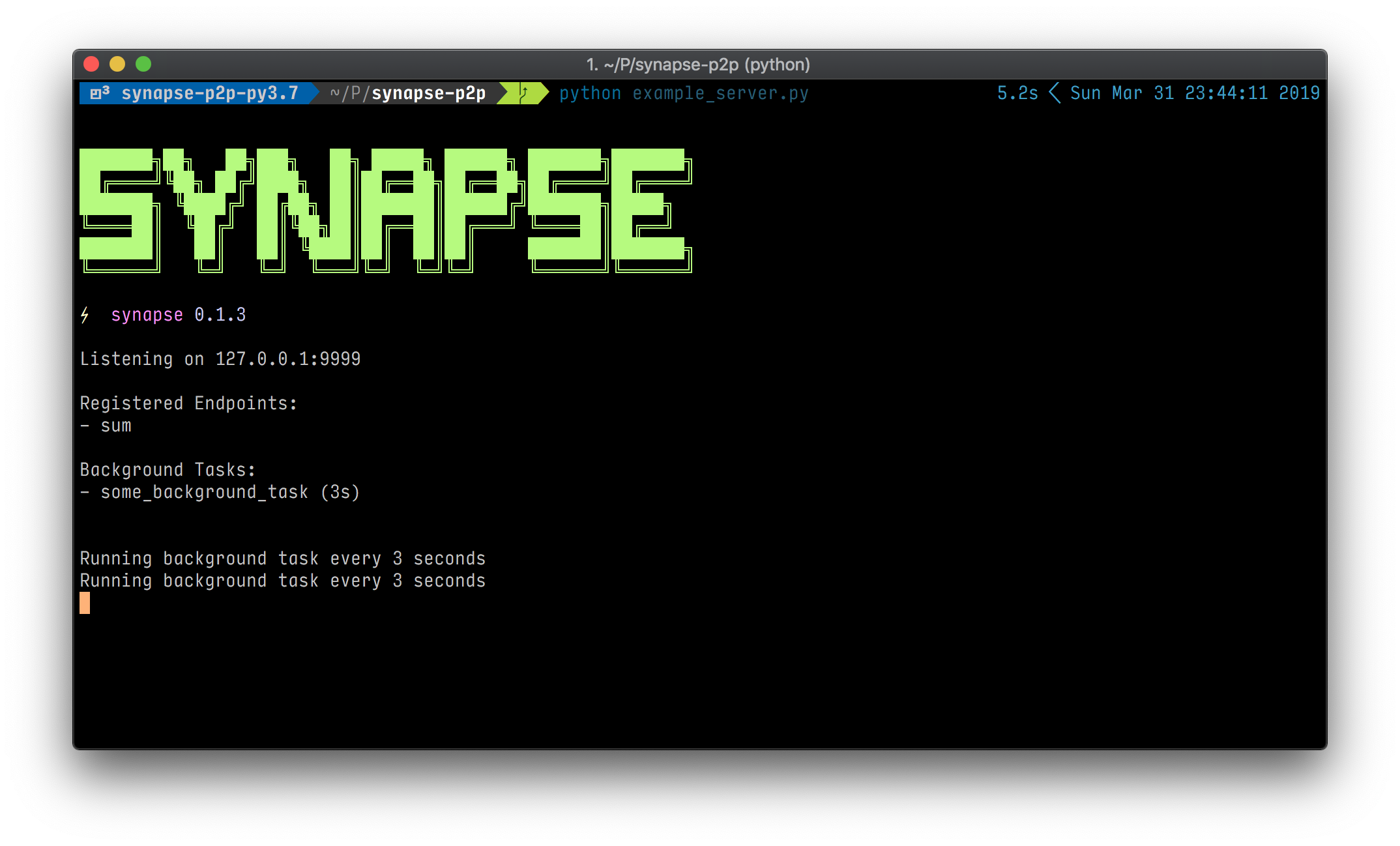
Synapse P2P
A network substrate for Python agents.
Synapse P2P is a tiny async RPC, discovery, and capability-publishing layer for building agent-to-agent networks, local agent swarms, distributed tools, peer-to-peer services, and lightweight service meshes.
It is designed to be useful to both humans and LLM agents:
- Humans get a simple Python API.
- Agents get discoverable methods, published capabilities, structured request/response messages, and machine-readable metadata.
@app.endpoint("sum")
async def sum_endpoint(a: int, b: int) -> int:
    return a + b
result = await Client("127.0.0.1", 9999).call("sum", 1, 2)
Why Synapse?
LLM agents need a way to find each other, ask what each other can do, and delegate work over a small, predictable protocol.
Synapse provides the substrate for that:
- RPC: call remote Python functions over TCP.
- Discovery: inspect published methods and agent capabilities.
- Agent identity: expose role, description, and capabilities.
- Delegation: send tasks to another agent through
_agent.ask. - Structured protocol: MsgPack request/response envelopes with request IDs and errors.
Think of it as a minimal network layer for agentic systems — not a framework that decides how agents think, but a substrate they can use to connect.
Features
- Async TCP RPC built on
asyncio - MsgPack serialization for compact binary messages
- Length-prefixed framing for reliable message boundaries over TCP
- Decorator-based endpoints with
@app.endpoint(...) - Built-in async client with request/response handling
- Structured responses and errors via
RPCResponseandRPCError - Positional and keyword arguments for remote calls
- Request IDs for correlation and future persistent-connection support
- Published method discovery via
_synapse.methods - Agent metadata discovery via
_agent.infoand_agent.capabilities - Agent task delegation via
_agent.ask - Periodic background tasks with
@app.background(...) - Serializer abstraction for custom protocols later
- P2P-oriented primitives such as node identity and XOR-distance helpers
Installation
pip install synapse-p2p
For development with uv:
uv sync --group dev
uv run pytest
uv run ruff check .
uv run pyrefly check
Quickstart: RPC server and client
Create a server:
from synapse_p2p import Server

app = Server(address="127.0.0.1", port=9999)  # or Server() for defaults


@app.endpoint("sum", description="Add two numbers")
async def sum_endpoint(a: int, b: int) -> int:
    return a + b


if __name__ == "__main__":
    app.run()
Call it from a client:
import asyncio

from synapse_p2p import Client


async def main() -> None:
    client = Client("127.0.0.1", 9999)
    result = await client.call("sum", 1, 2)
    print(result)


asyncio.run(main())
Output:
3
Quickstart: agent node
An AgentNode is a Synapse server that publishes agent metadata and accepts delegated work.
from synapse_p2p import AgentNode

agent = AgentNode(
    name="Reviewer",
    role="reviewer",
    description="Reviews Python code and suggests tests.",
    capabilities=["python", "code-review", "pytest"],
)


@agent.task_handler
async def handle_task(task: str, context: dict):
    return {
        "status": "done",
        "result": f"Reviewed task: {task}",
        "context_keys": list(context),
    }


agent.run()
Another agent or client can inspect it:
info = await client.call("_agent.info")
capabilities = await client.call("_agent.capabilities")
And delegate work:
result = await client.call(
    "_agent.ask",
    "Review this pull request",
    context={"files": ["server.py", "client.py"]},
)
Built-in discovery endpoints
Synapse reserves _synapse.* for substrate-level metadata.
_synapse.ping
Health check:
await client.call("_synapse.ping")
# "pong"
_synapse.methods
Returns published RPC methods:
await client.call("_synapse.methods")
Example response:
[
    {
        "name": "sum",
        "publish": True,
        "description": "Add two numbers",
    }
]
Endpoints are published by default:
@app.endpoint("image.resize", description="Resize an image")
async def resize_image(...):
    ...
Private endpoints can opt out:
@app.endpoint("admin.restart", publish=False)
async def restart():
    ...
Built-in agent endpoints
Synapse reserves _agent.* for agent-level metadata and task delegation.
_agent.info
Returns agent identity:
{
    "name": "Reviewer",
    "role": "reviewer",
    "description": "Reviews Python code and suggests tests.",
    "capabilities": ["python", "code-review", "pytest"],
}
_agent.capabilities
Returns machine-readable capability descriptors:
[
    {
        "name": "code-review",
        "description": "Review Python code for correctness and maintainability.",
        "input_schema": {},
        "output_schema": {},
    }
]
Capabilities can be strings or explicit descriptors:
from synapse_p2p import AgentCapability, AgentNode

agent = AgentNode(
    name="Researcher",
    role="researcher",
    capabilities=[
        AgentCapability(
            name="web-research",
            description="Find and summarize evidence from the web.",
            input_schema={"query": "string"},
            output_schema={"summary": "string", "sources": "array"},
        )
    ],
)
_agent.ask
Delegates a task to the agent's registered task handler:
await client.call(
    "_agent.ask",
    "Find bugs in this module",
    context={"code": "..."},
)
The task handler receives:
async def handle_task(task: str, context: dict):
    ...
Patterns for LLM agents
1. Discover a peer
info = await client.call("_agent.info")
methods = await client.call("_synapse.methods")
capabilities = await client.call("_agent.capabilities")
2. Select a peer by capability
if "code-review" in info["capabilities"]:
    result = await client.call("_agent.ask", "Review this diff", context={"diff": diff})
3. Publish tools as RPC methods
@app.endpoint("filesystem.search", description="Search files by regex")
async def search_files(pattern: str) -> list[str]:
    ...
4. Hide dangerous tools
@app.endpoint("shell.exec", publish=False)
async def shell_exec(command: str) -> str:
    ...
Private methods are still callable if known, but they are not advertised by _synapse.methods.
Server lifecycle
Use app.run() for simple scripts. In larger async applications or tests, use start() and stop():
server = await app.start()
try:
    ...
finally:
    await app.stop()
Background tasks
Synapse can run recurring async background jobs alongside your RPC server:
@app.background(5)
async def heartbeat():
    print("still alive")
The task above runs roughly every five seconds. Exceptions are logged and do not stop future runs.
Structured protocol
Synapse sends length-prefixed MsgPack messages over TCP.
A request looks like:
RPCRequest(
    id="request-id",
    endpoint="sum",
    args=[1, 2],
    kwargs={},
)
A successful response looks like:
RPCResponse(
    id="request-id",
    ok=True,
    result=3,
)
An error response looks like:
RPCResponse(
    id="request-id",
    ok=False,
    error=RPCError(code="bad_request", message="Unregistered endpoint called: nope"),
)
Low-level access
Most users should use Client, but lower-level message types are exported if you want to build custom transports or tooling:
from synapse_p2p import RPCError, RPCRequest, RPCResponse, RemoteProcedureCall
from synapse_p2p.framing import read_frame, write_frame
from synapse_p2p.serializers import MessagePackRPCSerializer
RemoteProcedureCall is kept as a backwards-compatible alias for RPCRequest.
Project status
Synapse is intentionally small and evolving. The current focus is a clean async RPC and agent substrate. Future work may include:
- Peer discovery and bootstrap peer exchange
- Agent-to-agent network discovery
- Long-running jobs for agent tasks
- Persistent connections and streaming events
- Routing tables / Kademlia-style node lookup
- Handshakes and node capabilities
- Authenticated or encrypted messages
- Broadcast and gossip primitives
Keywords
Python agent substrate, agent-to-agent networking, LLM agent RPC, multi-agent systems, agent discovery, capability discovery, Python RPC, asyncio RPC, peer-to-peer Python, P2P networking, MsgPack RPC, TCP RPC, async microservices, distributed agents, distributed workers, service-to-service communication.
Project details
Verified details
These details have been verified by PyPIProject links
GitHub Statistics
Maintainers
Release history Release notifications | RSS feed


Download files
Download the file for your platform. If you're not sure which to choose, learn more about installing packages.
Source Distribution
Built Distribution
Filter files by name, interpreter, ABI, and platform.
If you're not sure about the file name format, learn more about wheel file names.
Copy a direct link to the current filters
File details
Details for the file synapse_p2p-1.3.0.tar.gz.
File metadata
- Download URL: synapse_p2p-1.3.0.tar.gz
- Upload date:
- Size: 42.7 kB
- Tags: Source
- Uploaded using Trusted Publishing? Yes
- Uploaded via: uv/0.11.15 {"installer":{"name":"uv","version":"0.11.15","subcommand":["publish"]},"python":null,"implementation":{"name":null,"version":null},"distro":{"name":"Ubuntu","version":"24.04","id":"noble","libc":null},"system":{"name":null,"release":null},"cpu":null,"openssl_version":null,"setuptools_version":null,"rustc_version":null,"ci":true}
File hashes
| Algorithm | Hash digest | |
|---|---|---|
| SHA256 |
f4d7a1c38d0229620b82b465acf8d0dbaa5b41a89e860ec90e7ac9d309a1ca4f
|
|
| MD5 |
98a94eaa0da22c7f022500c0ac0af428
|
|
| BLAKE2b-256 |
703d9d4de6f9371e5de102614fb535ca71e895749fd2d7900b86b54a92dbe5c8
|
File details
Details for the file synapse_p2p-1.3.0-py3-none-any.whl.
File metadata
- Download URL: synapse_p2p-1.3.0-py3-none-any.whl
- Upload date:
- Size: 19.0 kB
- Tags: Python 3
- Uploaded using Trusted Publishing? Yes
- Uploaded via: uv/0.11.15 {"installer":{"name":"uv","version":"0.11.15","subcommand":["publish"]},"python":null,"implementation":{"name":null,"version":null},"distro":{"name":"Ubuntu","version":"24.04","id":"noble","libc":null},"system":{"name":null,"release":null},"cpu":null,"openssl_version":null,"setuptools_version":null,"rustc_version":null,"ci":true}
File hashes
| Algorithm | Hash digest | |
|---|---|---|
| SHA256 |
5c266dbf557ab60e1a8d21d817f7d618b117d1da18b6d2c075c36f637d2c6b4c
|
|
| MD5 |
32d006f000df3fbdfa29bd478a740218
|
|
| BLAKE2b-256 |
7bf29cf86fe0b6616124ad6d6a8b4315ada79e59d81b565377eeddf63ddb886d
|






