
A language-agnostic network substrate for agent-to-agent collaboration
Verified details
These details have been verified by PyPIProject links
GitHub Statistics
Maintainers

Project description

Build agent swarms that discover each other, share abilities, join conversations, expose custom endpoints, and wake up on schedules like sunrise... across any network.





Synapse is a lightweight peer-to-peer substrate for agent infrastructure. Give each process a `Node` and Synapse gives that node a name, peers, capabilities, RPC endpoints, shared conversations, agent cards, heartbeats, and periodic tasks.
from synapse_p2p import Node, solar

node = Node(
    name="garden-node",
    swarm="garden.example.com",
    capabilities=["sensors", "watering"],
    mdns=True,
)


@node.periodic(solar("sunrise", latitude=51.5, longitude=-0.1, tz="Europe/London"))
async def morning_check() -> None:
    await node.broadcast("garden.status")


node.run()
A node can wrap an LLM agent, a script, a service, a sensor, or a tool. Synapse is not the agent brain. It is the swarm layer agents stand on.
What makes it fun:
- Swarms are teams—nodes find teammates by swarm name.
- Nodes have names and abilities—advertise
code-review,weather,memory,watering, anything. - Shared conversations—broadcast once; many nodes can wade in, reply, leave, and come back later.
- Custom endpoints—expose any async function as swarm-callable RPC.
- Agent cards—publish metadata so peers can understand what you are.
- Periodic tasks—start work every minute, every weekday, or literally at sunrise.
🧭 Table of contents
- Install
- The mental model
- Why it feels different
- What can you build?
- Synapse vs A2A
- Quickstart: RPC
- Swarms and discovery
- Capabilities
- Ask: delegate work
- Broadcast: shared conversations
- Periodic tasks
- Artifacts and agent cards
- Heartbeats
- CLI
- Examples
- Protocol details
- What Synapse is not
📦 Install
Using uv or pip:
uv add synapse-p2p
pip install synapse-p2p
Then:
sn --help
🧠 The mental model
Synapse uses these words carefully:
| Word | Meaning |
|---|---|
| Node | A running Synapse participant. You create one with Node(...). |
| Peer | Another node this node knows about. |
| Swarm | Nodes with the same swarm name. |
| Agent | Your higher-level logic: an LLM loop, workflow, script, or automation. |
| Capability | A short advertised skill like code-review, web-research, or watering. |
| Endpoint | An async function peers can call over RPC. |
Use node for Synapse networking. Use agent for the logic you put behind a node.
Synapse gives nodes:
- a name and swarm identity
- peer discovery over mDNS or seeds
- advertised capabilities / abilities
- custom async RPC endpoints
- direct task delegation
- shared broadcast conversations
- agent cards and other advertised metadata
- periodic tasks on interval, cron, or solar time
- heartbeats and offline detection
- a simple MsgPack-over-TCP protocol
✨ Why it feels different
Most agent frameworks start with one agent loop. Synapse starts with the swarm.
planner-node ── broadcasts "who can review this?"
      │
      ├── security-node replies now
      ├── tests-node replies now
      └── docs-node replies later using the same conversation nonce
A node can join a swarm, advertise what it can do, expose custom endpoints, publish an agent card, and participate in conversations without a central coordinator.
Periodic tasks make nodes feel alive:
@node.periodic(solar("sunrise", latitude=51.5, longitude=-0.1, tz="Europe/London"))
async def wake_up() -> None:
    await node.broadcast("daily.start")
🛠️ What can you build?
- Research swarms — a planner node broadcasts a question; specialist nodes wade into the same conversation.
- Code-review teams — nodes advertise
security,tests, ordocs; a coordinator delegates to the right peer. - Local-first automations — laptop, server, and Raspberry Pi nodes discover each other with mDNS.
- Sunrise agents — a node starts work at sunrise, sunset, or civil twilight.
- Internal agent APIs — put an LLM agent behind a custom endpoint so other nodes can discover and call it.
- Self-describing tools — publish an agent card with name, role, abilities, input modes, and output modes.
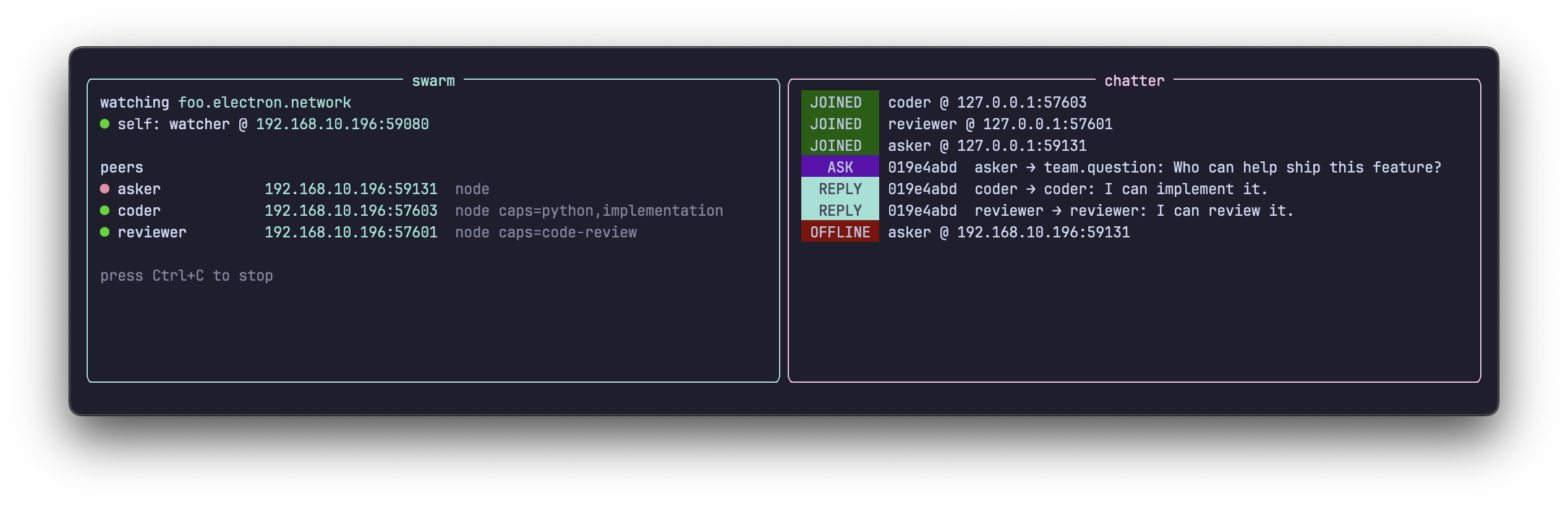
- Live dashboards — watch joins, heartbeats, messages, replies, and offline events with
sn watch.
Synapse handles the substrate. You bring the behavior.
⚖️ Synapse vs A2A
A2A is a full agent interoperability protocol. Synapse is much smaller: a peer-to-peer substrate for nodes that need to find each other and talk.
Use A2A when you need a formal cross-vendor agent protocol with task lifecycle, message parts, artifacts, streaming, push notifications, and enterprise-style integration points.
Use Synapse when you want to build a swarm quickly:
| A2A | Synapse |
|---|---|
| Agent protocol | Swarm substrate |
| HTTP / JSON-RPC oriented | Length-prefixed MsgPack over TCP |
| Formal task lifecycle | Simple RPC, ask, and broadcast |
| Agent cards are central | Agent cards are optional artifacts |
| More concepts to implement | One main primitive: Node |
| Best for interoperability | Best for local-first swarms and fast experimentation |
Synapse is intentionally less bloated:
- no required task state machine
- no required message/part/artifact object model
- no server/client role ceremony inside a swarm
- no central coordinator
- no hosted registry requirement
- no opinion about how agents think
The core idea is simple: start nodes, advertise abilities, call endpoints, broadcast into shared conversations, and run periodic jobs.
⚡ Quickstart: RPC
Create a node with an endpoint:
from synapse_p2p import Node

node = Node(name="calculator", port=9999)


@node.endpoint("sum", description="Add two numbers")
async def sum(a: int, b: int) -> int:
    return a + b


node.run()
Call it:
import asyncio

from synapse_p2p import Client


async def main() -> None:
    result = await Client("127.0.0.1", 9999).call("sum", 1, 2)
    print(result)


asyncio.run(main())
🐝 Swarms and discovery
A swarm is a group of nodes with the same swarm name. Nodes only join and heartbeat peers in their own swarm.
node = Node(
    name="coder",
    swarm="foo.electron.network",
    capabilities=["python", "tests"],
)
Use a domain-style swarm name to avoid collisions.
📡 Local discovery with mDNS
Use mDNS for zero-config discovery on a LAN:
node = Node(
    name="reviewer",
    swarm="foo.electron.network",
    capabilities=["code-review"],
    mdns=True,
)

await node.start()
await node.join()
Any node on the same LAN with the same swarm and mdns=True can discover it.
🌍 Remote discovery with seeds
Use seeds when nodes are not on the same LAN:
node = Node(
    name="planner",
    swarm="foo.electron.network",
    seeds=["bootstrap.foo.electron.network:9999"],
)

await node.start()
await node.join()
A seed is just another Synapse node. It is a first contact point, not a coordinator. Once joined, nodes exchange known peers and can talk directly.
🎯 Capabilities
Capabilities tell peers what a node can do.
node = Node(capabilities=["python", "code-review"])
Use structured capabilities when you want descriptions and schemas:
from synapse_p2p import Capability, Node

node = Node(
    name="researcher",
    capabilities=[
        Capability(
            name="web-research",
            description="Find and summarize sources.",
            input_schema={"query": "string"},
            output_schema={"summary": "string", "sources": "array"},
        )
    ],
)
Inspect a peer:
info = await client.call("_node.info")
capabilities = await client.call("_node.capabilities")
methods = await client.call("_synapse.methods")
🤝 Ask: delegate work
Use @node.ask for the default task handler on a node. Synapse provides the transport; your agent code decides whether and how to answer.
from synapse_p2p import Node

node = Node(name="reviewer", capabilities=["code-review"])


@node.ask
async def handle(task: str, context: dict):
    return {"status": "done", "task": task}
There are two ways to use it.
Direct ask
Call one known peer directly with _node.ask:
from synapse_p2p import Client

result = await Client.from_peer(peer).call(
    "_node.ask",
    "Review this diff",
    context={"diff": diff},
)
Swarm ask
Broadcast to the built-in synapse.ask endpoint when you want any interested node to wade in:
broadcast = await node.broadcast(
    "synapse.ask",
    "Review this diff",
    context={"diff": diff},
)
A node with an @node.ask handler will ACK the conversation, run the handler, and reply with the result. Nodes without a handler fail quietly from the caller's point of view, just like any other broadcast recipient that cannot help.
The CLI wraps this flow:
sn ask foo.electron.network "Review this diff" --context url=https://github.com/org/repo/pull/1
💬 Broadcast: shared conversations
Use broadcast when you do not know which node should answer.
broadcast = await node.broadcast("team.question", "Who can review this diff?")
Every receiver gets the same conversation nonce. Any node can reply:
from synapse_p2p import Broadcast


@node.endpoint("team.question")
async def answer(question: str, broadcast: Broadcast) -> dict:
    await node.reply(broadcast, {"answer": "I can help"})
    return {"accepted": True}
The origin node can read all replies:
for reply in node.replies(broadcast):
    print(reply.peer.name, reply.result)
Synapse also keeps a lightweight conversation event log. A broadcast creates a message event whose conversation_id is the broadcast nonce. Nodes may opt into the conversation with ack or other events; Synapse does not decide who should answer.
@node.endpoint("team.question")
async def answer(question: str, broadcast: Broadcast) -> dict:
    # ACK means "I saw this and am choosing to wade in".
    # It does not mean Synapse assigned this node the work.
    await node.ack(broadcast, {"seen": True})
    await node.reply(broadcast, {"answer": "I can help"})
    return {"accepted": True}
Listen for conversation events:
from synapse_p2p import ConversationEvent


@node.on("conversation.ack")
async def on_ack(event: ConversationEvent) -> None:
    print(event.peer.name, "acked", event.conversation_id)


for event in node.conversation(broadcast):
    print(event.kind, event.peer.name, event.payload)
Built-in conversation event kinds are intentionally small conventions:
message— a broadcast or conversation message was seenack— a node chose to acknowledge / enter the conversationreply— a node replied with a result
Higher-level agent frameworks can layer routing, claiming, status, artifacts, or task semantics on top by emitting their own event kinds with node.emit_conversation_event(...).
Why this is useful:
- one broadcast creates one shared conversation
- every node sees the same nonce
- nodes can wade in or stay silent
- ACK is opt-in, not automatic assignment
- replies and events group without a central coordinator
- UUIDv7 nonces keep conversations roughly time-ordered when the runtime supports them
🌅 Periodic tasks
Nodes can wake up on a schedule: every few seconds, every weekday morning, or when the sun rises.
from synapse_p2p import Node, cron, every, solar

node = Node(name="worker")


@node.periodic(every(seconds=30))
async def refresh_cache() -> None:
    print("refreshing cache")


@node.periodic(cron("0 9 * * mon-fri", tz="Europe/London"))
async def weekday_digest() -> None:
    print("weekday digest")


@node.periodic(solar("sunrise", latitude=51.5, longitude=-0.1, tz="Europe/London"))
async def sunrise_job() -> None:
    print("the sun is up; time to work")


node.run()
A number is shorthand for seconds:
@node.periodic(30)  # equivalent to every(seconds=30)
async def refresh_cache() -> None:
    ...
Built-in schedules:
every(seconds=..., minutes=..., hours=..., days=...)cron("*/15 * * * *", tz="UTC")solar("sunrise", latitude=..., longitude=..., tz="UTC")
Solar events include sunrise, sunset, solar_noon, civil_twilight_begin, civil_twilight_end, nautical_twilight_begin, nautical_twilight_end, astronomical_twilight_begin, and astronomical_twilight_end.
Notes:
- periodic handlers must be
async def - the first run starts immediately when the node starts
- later runs follow the schedule
- exceptions are logged and do not stop future runs
- long-running tasks can overlap if the next scheduled time arrives first
🪪 Artifacts and agent cards
Nodes can advertise small metadata documents that peers can fetch over RPC.
node.artifact(
    "agent-card",
    {
        "name": node.name,
        "description": "Reviews Python PRs and returns concise feedback.",
        "capabilities": ["code-review", "pytest"],
        "input_modes": ["text", "git-diff", "url"],
        "output_modes": ["text/markdown", "text/x-diff"],
    },
    mime_type="application/vnd.synapse.agent-card+json",
    description="Self-description for peers that understand agent cards.",
)
Fetch artifacts from a peer:
from synapse_p2p import Client

client = Client.from_peer(peer)

artifacts = await client.call("_synapse.artifacts")
agent_card = await client.call("_synapse.artifact.get", "agent-card")
Synapse does not interpret artifacts. It serves bytes/JSON plus a MIME type. Your application decides what the artifact means.
💓 Heartbeats
Nodes heartbeat known peers and mark stale peers offline.
from synapse_p2p import Node, Peer

node = Node(name="planner", heartbeat_interval=5, peer_timeout=20)


@node.on("peer.joined")
async def joined(peer: Peer) -> None:
    print(f"joined: {peer.name}")


@node.on("peer.offline")
async def offline(peer: Peer) -> None:
    print(f"offline: {peer.name}")
Offline means “not seen within peer_timeout.”
🖥️ CLI
The CLI is sn.
sn --help
👀 Watch a swarm
sn watch foo.electron.network
Useful options:
sn watch foo.electron.network --show-heartbeats
sn watch foo.electron.network --seed 192.168.1.25:9000 --no-mdns
sn watch foo.electron.network --team backend
sn watch foo.electron.network --no-capabilities
🙋 Ask from the terminal
sn ask broadcasts to the built-in synapse.ask endpoint. Nodes with a @node.ask handler can opt in with ACK and reply with their result.
sn ask foo.electron.network "Review this diff"
sn ask foo.electron.network "Review this diff" --context url=https://github.com/org/repo/pull/1
sn ask foo.electron.network "Who can help?" --forever
Example output:
ask: 019e4ab0-1d0d-709a-...
waiting for ACKs and replies... press Ctrl+C to stop
✓ reviewer acked
- reviewer: LGTM after fixing tests
📣 Broadcast from the terminal
sn broadcast foo.electron.network "Who can review this diff?"
sn broadcast foo.electron.network "Who can help?" --forever
sn broadcast foo.electron.network "Ship status?" --discover 2 --timeout 10
📋 List local swarms
sn list-swarms
sn list-swarms --seconds 5
📚 Examples
See examples/.
# two nodes, one delegates to the other
python examples/isolated_agents/agent_alpha.py
python examples/isolated_agents/agent_beta.py
python examples/isolated_agents/ask_alpha.py

# local zero-config mDNS swarm
python examples/local_mdns_swarm/reviewer.py
python examples/local_mdns_swarm/coder.py
python examples/local_mdns_swarm/ask.py

# Pydantic AI team that replies over mDNS
python examples/pydantic_ai_team/reviewer.py
python examples/pydantic_ai_team/coder.py
python examples/pydantic_ai_team/product.py
python examples/pydantic_ai_team/ask.py

# interval, cron, sunrise, and civil twilight jobs
python examples/periodic_tasks.py
The Pydantic AI example uses TestModel by default, so it runs without API keys. Set PYDANTIC_AI_MODEL, for example openai:gpt-5.2, to use a real model.
🔌 Protocol details
Built-in endpoints:
| Endpoint | Purpose |
|---|---|
_synapse.ping |
health check |
_synapse.info |
node identity and swarm metadata |
_synapse.methods |
published RPC methods |
_synapse.peers |
known peers |
_synapse.join |
join through a seed |
_synapse.heartbeat |
update peer liveness |
_synapse.broadcast.reply |
reply to a broadcast nonce |
_synapse.conversation.event |
gossip a shared conversation event |
_synapse.artifacts |
list advertised artifacts |
_synapse.artifact.get |
fetch one advertised artifact |
_node.info |
name, role, description, capabilities |
_node.capabilities |
machine-readable capabilities |
_node.ask |
delegate directly to the node ask handler |
synapse.ask |
swarm-facing ask endpoint used by sn ask |
Wire format:
- 4-byte unsigned big-endian payload length
- MsgPack payload bytes
Request:
{
    "type": "request",
    "id": "request-id",
    "endpoint": "sum",
    "args": [1, 2],
    "kwargs": {},
}
Response:
{
    "type": "response",
    "id": "request-id",
    "ok": True,
    "result": 3,
    "error": None,
}
Useful low-level exports:
from synapse_p2p import (
    AdvertisedArtifact,
    Broadcast,
    BroadcastReply,
    Capability,
    Client,
    ConversationEvent,
    Node,
    Peer,
    RPCError,
    RPCRequest,
    RPCResponse,
    ServedArtifact,
)
Enable logs when debugging:
from loguru import logger

logger.enable("synapse_p2p")
🚫 What Synapse is not
Synapse does not implement planning, memory, consensus, auth policy, NAT traversal, hosted registries, or UX.
Those belong above Synapse.
Synapse is the substrate:
nodes + discovery + capabilities + conversations + artifacts + heartbeats + schedules + a tiny protocol
🔎 Keywords
swarm substrate, agent substrate, node discovery, local mDNS discovery, agent-to-agent networking, LLM agent RPC, multi-agent systems, capability discovery, language-agnostic RPC, Python RPC, asyncio RPC, peer-to-peer Python, P2P networking, MsgPack RPC, TCP RPC, distributed agents.
Project details
Verified details
These details have been verified by PyPIProject links
GitHub Statistics
Maintainers
Release history Release notifications | RSS feed


Download files
Download the file for your platform. If you're not sure which to choose, learn more about installing packages.
Source Distribution
Built Distribution
Filter files by name, interpreter, ABI, and platform.
If you're not sure about the file name format, learn more about wheel file names.
Copy a direct link to the current filters
File details
Details for the file synapse_p2p-2.3.0.tar.gz.
File metadata
- Download URL: synapse_p2p-2.3.0.tar.gz
- Upload date:
- Size: 284.6 kB
- Tags: Source
- Uploaded using Trusted Publishing? Yes
- Uploaded via: uv/0.11.16 {"installer":{"name":"uv","version":"0.11.16","subcommand":["publish"]},"python":null,"implementation":{"name":null,"version":null},"distro":{"name":"Ubuntu","version":"24.04","id":"noble","libc":null},"system":{"name":null,"release":null},"cpu":null,"openssl_version":null,"setuptools_version":null,"rustc_version":null,"ci":true}
File hashes
| Algorithm | Hash digest | |
|---|---|---|
| SHA256 |
ddab119ed3f5a1333ccaff6b8907ad33584b2dc510f3290c58a39254bae71dc4
|
|
| MD5 |
48434f757a3146e29f4dd866a691a46f
|
|
| BLAKE2b-256 |
5f7c784dfe24b49d96c9f24b77eb08655fdbe5f4c20d9bd54251cf965c494ead
|
File details
Details for the file synapse_p2p-2.3.0-py3-none-any.whl.
File metadata
- Download URL: synapse_p2p-2.3.0-py3-none-any.whl
- Upload date:
- Size: 51.3 kB
- Tags: Python 3
- Uploaded using Trusted Publishing? Yes
- Uploaded via: uv/0.11.16 {"installer":{"name":"uv","version":"0.11.16","subcommand":["publish"]},"python":null,"implementation":{"name":null,"version":null},"distro":{"name":"Ubuntu","version":"24.04","id":"noble","libc":null},"system":{"name":null,"release":null},"cpu":null,"openssl_version":null,"setuptools_version":null,"rustc_version":null,"ci":true}
File hashes
| Algorithm | Hash digest | |
|---|---|---|
| SHA256 |
4da799f9083f7fe5f089c461041f08d61dd175adf7f8c7c91c0f9bd13e8e1a0c
|
|
| MD5 |
e147c0b12582ceeefe68efbb81079f1d
|
|
| BLAKE2b-256 |
b87869c19fad16c2741c0b13a87f60aa8bf275f33b02c3661d2557111a47e98f
|






