
A language-agnostic network substrate for agent-to-agent collaboration
Verified details
These details have been verified by PyPIProject links
GitHub Statistics
Maintainers

Project description

Build agent swarms that discover each other, share abilities, join conversations, and wake up on schedules like sunrise... across any network.





Synapse is a small peer-to-peer substrate for agent infrastructure. Give each process a Node and it gets a name, peers, capabilities, RPC endpoints, shared conversations, and periodic tasks.
Synapse is not the agent brain. It's the swarm layer agents stand on. A node can wrap an LLM agent, a script, a service, or a sensor, and it doesn't matter what model (if any) is behind it.
from synapse_p2p import Node, solar

node = Node(
    name="garden-node",
    swarm="garden.example.com",
    capabilities=["sensors", "watering"],
    mdns=True,
)


@node.periodic(solar("sunrise", latitude=51.5, longitude=-0.1, tz="Europe/London"))
async def morning_check() -> None:
    await node.broadcast("garden.status")


node.run()
Install
uv add synapse-p2p     # or: pip install synapse-p2p
sn --help              # the CLI
The mental model
| Word | Meaning |
|---|---|
| Node | A running Synapse participant. You create one with Node(...). |
| Swarm | Nodes with the same swarm name. They find and heartbeat each other. |
| Capability | A short advertised skill like code-review or watering. |
| Endpoint | An async function peers can call over RPC. |
| Conversation | A shared, gossiped event log that any node can wade into. |
| Agent | Your higher-level logic: an LLM loop, workflow, script, or automation. |
Discovery
On the same LAN, mDNS needs zero config:
node = Node(name="reviewer", swarm="foo.electron.network", mdns=True)
await node.start()
await node.join()
Across networks, use a seed. A seed is just another Synapse node: a first contact point, not a coordinator. Once joined, nodes exchange known peers and talk directly.
node = Node(name="planner", swarm="foo.electron.network", seeds=["bootstrap.foo.electron.network:9999"])
RPC
Any async function can be an endpoint:
node = Node(name="calculator", port=9999)


@node.endpoint("sum", description="Add two numbers")
async def sum(a: int, b: int) -> int:
    return a + b
from synapse_p2p import Client

result = await Client("127.0.0.1", 9999).call("sum", 1, 2)  # 3
Peers are self-describing: _node.info, _node.capabilities, and _synapse.methods tell you what a node is and what it can do. Nodes can also publish agent cards and other metadata with node.artifact(...).
Ask: delegate work
Give a node a default task handler:
node = Node(name="reviewer", capabilities=["code-review"])


@node.ask
async def handle(task: str, context: dict):
    return await my_agent.run(task, context)
Ask one known peer directly:
result = await Client.from_peer(peer).call("_node.ask", "Review this diff", context={"diff": diff})
Or ask the whole swarm when you don't know who should answer:
broadcast = await node.broadcast("synapse.ask", "Review this diff", context={"diff": diff})
Nodes that opt in will ACK the conversation, run their handler in the background, and reply when they're done. The RPC itself returns immediately, so a handler that spends ten minutes inside an LLM doesn't hold a socket open. Read whatever came back:
for reply in node.replies(broadcast):
    print(reply.peer.name, reply.result)
The same flow from the terminal:
sn ask foo.electron.network "Review this diff"
Conversations
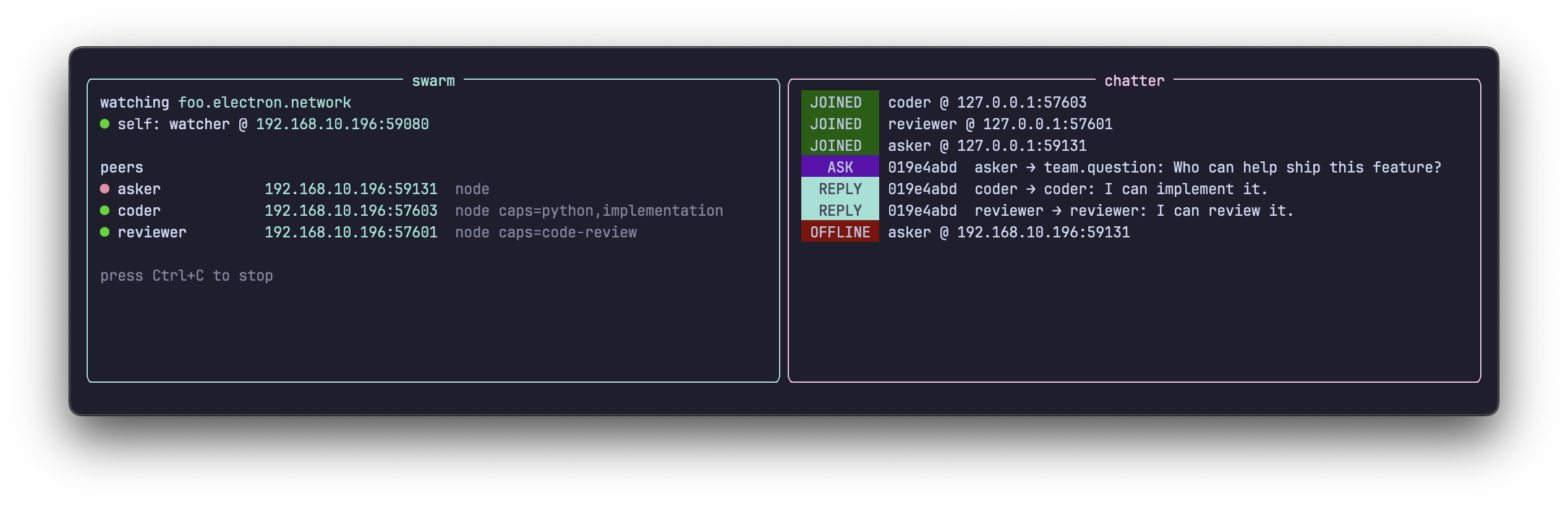
A broadcast creates a shared conversation. Every receiver gets the same nonce, and any node can reply, ACK, or ignore it. Synapse never decides who should answer.
broadcast = await node.broadcast("team.question", "Who can review this diff?")
@node.endpoint("team.question")
async def answer(question: str, broadcast: Broadcast) -> dict:
    await node.ack(broadcast, {"seen": True})
    await node.reply(broadcast, {"answer": "I can help"})
    return {"accepted": True}
Watch events live, or read the log after the fact:
@node.on("conversation.reply")
async def on_reply(event: ConversationEvent) -> None:
    print(event.peer.name, event.payload)


for event in node.conversation(broadcast):
    print(event.kind, event.peer.name, event.payload)
The built-in event kinds are small conventions: message, ack, and reply. Emit your own with node.emit_conversation_event(...).
Conversation history
The event log is in-memory by default. Swap in SQLite if it should survive restarts:
from synapse_p2p import Node, SqliteConversationLog

node = Node(name="architect", conversation_log=SqliteConversationLog("conversations.db"))
A node that joined late (or rebooted) can pull a conversation it missed from any peer:
await node.sync_conversation(peer, conversation_id)
Long conversations compact themselves. Past conversation_max_events, older events get folded into a single summary event; the opening message and the most recent events are kept as-is. The default summarizer is a plain digest, but you probably want your model to do it:
node = Node(name="architect", conversation_max_events=100, conversation_keep_recent=25)


@node.summarizer
async def summarize(events: list[ConversationEvent]) -> str:
    return await my_llm_summarize(events)
Compaction is local. Each node compresses its own copy of the shared log, and gossip can't resurrect compacted events. There's also node.compact_conversation(...) if you'd rather do it by hand.
Teams
synapse_p2p.teams is an optional task layer built on conversation events. A Team offers work, Workers claim tasks that match their capabilities, and the team grants each task to the first claimant. Exactly one worker runs each task.
from synapse_p2p.teams import Assignment, Team, Worker

# architect process (say, Claude)
team = Team(node)
task = await team.offer("implement the parser", spec={"file": "parser.py"}, requires=["python"])
result = await team.wait(task, timeout=600)

# coder process (say, GPT)
worker = Worker(coder_node)


@worker.task
async def implement(assignment: Assignment) -> dict:
    await assignment.progress("starting")
    return {"diff": await my_agent.run(assignment.title, assignment.spec)}
Each task is one conversation: task.offer, task.claim, task.grant, task.progress, then task.done or task.failed. Every peer can watch it, late joiners can sync it, and long threads compact like anything else. See examples/coding_team for an architect on one model reviewing work from coders on another.
Periodic tasks
from synapse_p2p import cron, every, solar


@node.periodic(every(seconds=30))
async def refresh_cache() -> None: ...


@node.periodic(cron("0 9 * * mon-fri", tz="Europe/London"))
async def weekday_digest() -> None: ...


@node.periodic(solar("sunrise", latitude=51.5, longitude=-0.1, tz="Europe/London"))
async def sunrise_job() -> None: ...
Handlers must be async def. A bare number means seconds. The first run fires at startup, and exceptions are logged without killing the schedule. Solar events go from sunrise all the way to astronomical_twilight_end.
Heartbeats
Nodes heartbeat known peers and mark stale ones offline. Tune with heartbeat_interval and peer_timeout.
@node.on("peer.joined")
async def joined(peer: Peer) -> None: ...


@node.on("peer.offline")
async def offline(peer: Peer) -> None: ...
CLI
sn watch foo.electron.network        # live view of joins, heartbeats, conversations
sn ask foo.electron.network "Who can help?"
sn broadcast foo.electron.network "Ship status?"
sn list-swarms
Examples
| Example | What it demonstrates |
|---|---|
basic_rpc |
The smallest node/client pair. |
isolated_agents |
Delegation through a known seed. |
bootstrap_team_trio |
Bootstrap discovery, ask handlers, agent cards. |
local_mdns_swarm |
Zero-config discovery, ACKs and replies in one conversation. |
pydantic_ai_team |
Pydantic AI agents behind nodes. |
periodic_tasks |
Interval, cron, and solar jobs. |
stock_trading_team |
Analyst/news/trader swarm with a paper exchange. |
coding_team |
An architect and coders on different models, via the teams layer. |
Each folder has a README with exact run commands.
What Synapse is not
Synapse does not implement planning, memory, consensus, auth policy, NAT traversal, hosted registries, or UX. Those belong above Synapse.
Two exceptions are on the roadmap because they belong in the substrate itself: node identity with signed gossip for untrusted networks, and a relay mode so seeds can bridge peers that can't dial each other.
nodes + discovery + capabilities + conversations + artifacts + heartbeats + schedules + a tiny protocol
Protocol details
Wire format: a 4-byte unsigned big-endian length header, then a MsgPack payload. Frames up to 4 MiB are accepted by default (Node(max_upload_size=...), Client(max_download_size=...)), which is plenty for diffs and documents.
# request
{"type": "request", "id": "request-id", "endpoint": "sum", "args": [1, 2], "kwargs": {}}
# response
{"type": "response", "id": "request-id", "ok": True, "result": 3, "error": None}
Built-in endpoints:
| Endpoint | Purpose |
|---|---|
_synapse.ping |
health check |
_synapse.info |
node identity and swarm metadata |
_synapse.methods |
published RPC methods |
_synapse.peers |
known peers |
_synapse.join |
join through a seed |
_synapse.heartbeat |
update peer liveness |
_synapse.broadcast.reply |
reply to a broadcast nonce |
_synapse.conversation.event |
gossip a shared conversation event |
_synapse.conversation.sync |
serve a conversation's events to a late joiner |
_synapse.conversation.list |
list locally known conversation ids |
_synapse.artifacts |
list advertised artifacts |
_synapse.artifact.get |
fetch one advertised artifact |
_node.info |
name, role, description, capabilities |
_node.capabilities |
machine-readable capabilities |
_node.ask |
delegate directly to the node ask handler |
synapse.ask |
swarm-facing ask endpoint used by sn ask |
Debug logging:
from loguru import logger

logger.enable("synapse_p2p")
Synapse vs A2A
A2A is a full agent interoperability protocol. Synapse is much smaller. Use A2A when you need a formal cross-vendor protocol with task lifecycles, message parts, and enterprise integration points. Use Synapse when you want to build a swarm quickly.
| A2A | Synapse |
|---|---|
| Agent protocol | Swarm substrate |
| HTTP / JSON-RPC oriented | Length-prefixed MsgPack over TCP |
| Formal task lifecycle | Simple RPC, ask, and broadcast |
| Agent cards are central | Agent cards are optional artifacts |
| More concepts to implement | One main primitive: Node |
| Best for interoperability | Best for local-first swarms and fast experimentation |
No required task state machine, no server/client ceremony inside a swarm, no hosted registry, no opinion about how agents think.
Project details
Verified details
These details have been verified by PyPIProject links
GitHub Statistics
Maintainers
Release history Release notifications | RSS feed


Download files
Download the file for your platform. If you're not sure which to choose, learn more about installing packages.
Source Distribution
Built Distribution
Filter files by name, interpreter, ABI, and platform.
If you're not sure about the file name format, learn more about wheel file names.
Copy a direct link to the current filters
File details
Details for the file synapse_p2p-2.4.0.tar.gz.
File metadata
- Download URL: synapse_p2p-2.4.0.tar.gz
- Upload date:
- Size: 304.6 kB
- Tags: Source
- Uploaded using Trusted Publishing? Yes
- Uploaded via: uv/0.11.26 {"installer":{"name":"uv","version":"0.11.26","subcommand":["publish"]},"python":null,"implementation":{"name":null,"version":null},"distro":{"name":"Ubuntu","version":"24.04","id":"noble","libc":null},"system":{"name":null,"release":null},"cpu":null,"openssl_version":null,"setuptools_version":null,"rustc_version":null,"ci":true}
File hashes
| Algorithm | Hash digest | |
|---|---|---|
| SHA256 |
c5eaedc72d049bbb6212af672c0c7e1814c95ebd676afcaead8a3d5868eab079
|
|
| MD5 |
e09c62799a8a26936bf238ee7e6a5748
|
|
| BLAKE2b-256 |
c9f8faecdb3ec9727c8876ee168eb26acbafd421317929ab010a9beb82e88259
|
File details
Details for the file synapse_p2p-2.4.0-py3-none-any.whl.
File metadata
- Download URL: synapse_p2p-2.4.0-py3-none-any.whl
- Upload date:
- Size: 60.0 kB
- Tags: Python 3
- Uploaded using Trusted Publishing? Yes
- Uploaded via: uv/0.11.26 {"installer":{"name":"uv","version":"0.11.26","subcommand":["publish"]},"python":null,"implementation":{"name":null,"version":null},"distro":{"name":"Ubuntu","version":"24.04","id":"noble","libc":null},"system":{"name":null,"release":null},"cpu":null,"openssl_version":null,"setuptools_version":null,"rustc_version":null,"ci":true}
File hashes
| Algorithm | Hash digest | |
|---|---|---|
| SHA256 |
bd9767dce11bfd25dee14979d0fa19e2c6146c250881df1458f5f57f8b671592
|
|
| MD5 |
26cbb237c7cebfd1f03c1e8a48e2b1d2
|
|
| BLAKE2b-256 |
3fc584176394026b6ea600de8d79be22dd04ab85ef3ff25889bf960d3e288806
|






