
A language-agnostic network substrate for agent-to-agent collaboration
Verified details
These details have been verified by PyPIProject links
GitHub Statistics
Maintainers

Project description

A p2p swarm substrate for nodes that find each other, talk to each other, and work together.




from synapse_p2p import Node

node = Node(
    name="reviewer",
    swarm="foo.electron.network",
    capabilities=["code-review"],
    mdns=True,
)

await node.start()
await node.join()
Synapse gives you one primitive: Node.
A node can discover peers, publish capabilities, expose endpoints, receive work, broadcast questions, reply into shared conversations, heartbeat peers, and notice when peers disappear. Synapse is not an agent framework. It is the clean network layer underneath one.
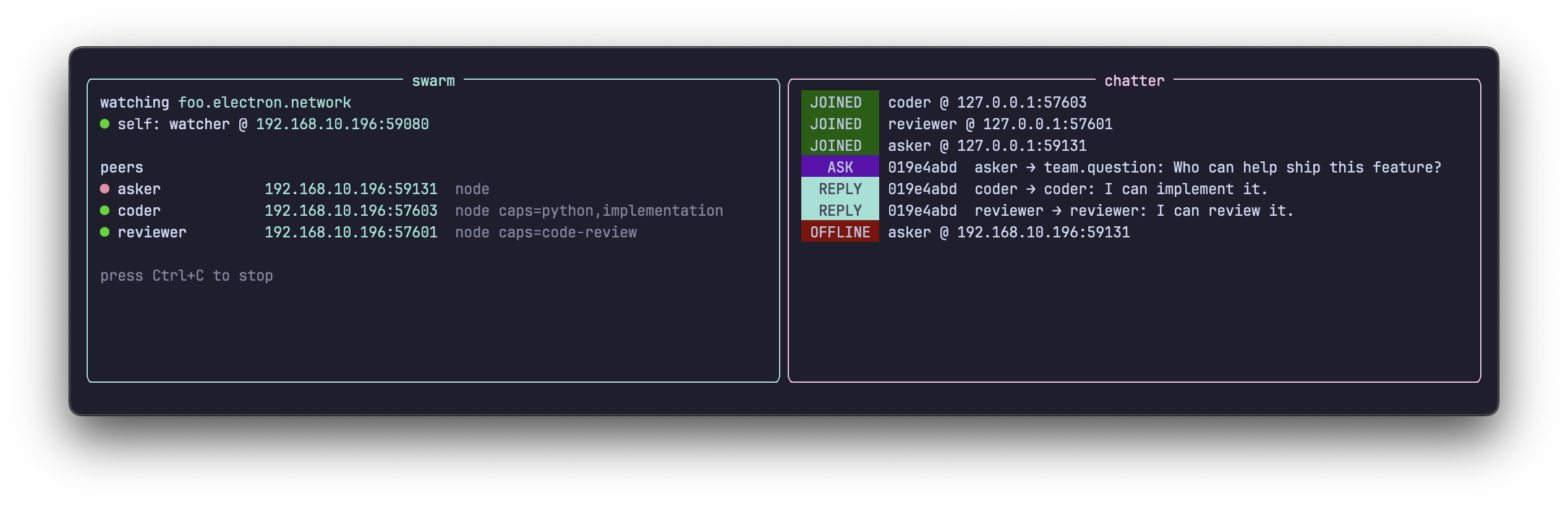
It also ships with a CLI tool to monitor your swarms:
> sn watch foo.electron.network
Index
- Install
- Why Synapse
- 30-second RPC
- Swarms
- Discovery
- Capabilities
- Ask
- Broadcast conversations
- Heartbeats and liveness
- CLI
- Typed peer API
- Examples
- Built-in endpoints
- Wire protocol
- Logging
- What Synapse is not
- Roadmap
Install
pip install synapse-p2p
Then use the CLI:
sn --help
Why
LLM agents are often isolated. Synapse gives them a small shared substrate:
- discovery — find nodes in the same swarm
- capabilities — know what each node can do
- RPC — call a named endpoint
- ask — delegate a task to a node
- broadcast — ask the whole swarm
- heartbeats — know who is still around
- typed Python API — no dictionary soup
- simple wire protocol — length-prefixed MsgPack over TCP
The goal is not to decide how agents think. The goal is to let them communicate.
30-second RPC
This is the smallest useful Synapse program: one node exposes an RPC endpoint, and one client calls it.
Create a node:
from synapse_p2p import Node

node = Node(name="calculator", port=9999)


@node.endpoint("sum", description="Add two numbers")
async def sum(a: int, b: int) -> int:
    return a + b


node.run()
Call it:
import asyncio

from synapse_p2p import Client


async def main() -> None:
    result = await Client("127.0.0.1", 9999).call("sum", 1, 2)
    print(result)


asyncio.run(main())
Swarms
A swarm is a group of nodes with the same swarm name. Nodes only join and heartbeat peers in the same swarm.
node = Node(
    name="coder",
    role="implementation",
    swarm="foo.electron.network",
    capabilities=["python", "tests"],
)
Use a domain-style name to avoid collisions:
foo.electron.network
Need subgroups? Use optional team. It defaults to "default".
Local discovery: mDNS
Use mDNS for local, zero-config discovery on the same LAN.
For local machines on the same network:
node = Node(
    name="reviewer",
    swarm="foo.electron.network",
    capabilities=["code-review"],
    mdns=True,
)

await node.start()
await node.join()
Any node on the same LAN with the same swarm and mdns=True can discover it.
Synapse advertises:
_synapse._tcp.local.
mDNS is local by design. It usually does not cross routers, VPN boundaries, or restrictive firewalls.
Remote discovery: seeds
Use seeds when mDNS is not enough: private networks, remote machines, explicit bootstrap nodes, or internet-reachable hosts.
For private networks or internet-reachable hosts, use seeds:
node = Node(
    name="planner",
    swarm="foo.electron.network",
    seeds=["bootstrap.foo.electron.network:9999"],
)

await node.start()
await node.join()
A seed is just another Synapse node. It is a first contact point, not a coordinator. Once joined, nodes exchange known peers and can talk directly.
By default, nodes listen on 0.0.0.0 and advertise an auto-detected reachable local address. For same-machine-only experiments, use bind="127.0.0.1".
Capabilities
Simple:
node = Node(capabilities=["python", "code-review"])
Structured:
from synapse_p2p import Capability, Node

node = Node(
    name="researcher",
    capabilities=[
        Capability(
            name="web-research",
            description="Find and summarize sources.",
            input_schema={"query": "string"},
            output_schema={"summary": "string", "sources": "array"},
        )
    ],
)
Inspect a node:
info = await client.call("_node.info")
capabilities = await client.call("_node.capabilities")
methods = await client.call("_synapse.methods")
Ask
Register one ask handler:
node = Node(name="reviewer", capabilities=["code-review"])


@node.ask
async def handle(task: str, context: dict):
    return {"status": "done", "task": task}
Ask another node:
result = await Client.from_peer(peer).call(
    "_node.ask",
    "Review this diff",
    context={"diff": diff},
)
Broadcast
Broadcast starts a swarm conversation. It is the simplest way to ask the whole swarm a question and let any capable node reply.
broadcast = await node.broadcast("team.question", "Who can review this diff?")
That returns a Broadcast object:
broadcast.nonce   # conversation id
broadcast.origin  # peer that started it
broadcast.endpoint
The nonce is the conversation atom. Synapse creates UUIDv7 nonces when the Python runtime supports them, so conversations are unique and time-sortable. On older runtimes it falls back to UUIDv4.
Every receiver gets the same Broadcast object. Any node can reply into that conversation by reusing the nonce through node.reply(...):
from synapse_p2p import Broadcast


@node.endpoint("team.question")
async def answer(question: str, broadcast: Broadcast) -> dict:
    await node.reply(broadcast, {"answer": "I can help"})
    return {"accepted": True}
The origin node groups all replies by nonce:
for reply in node.replies(broadcast):
    print(reply.peer.name, reply.result)
Why this matters:
- one broadcast creates one shared event
- the nonce is the conversation id
- every agent sees the same nonce
- any agent can participate by replying with that nonce
- replies group without a central coordinator
- UUIDv7 nonces keep conversation ids roughly ordered by creation time
Heartbeats
Nodes heartbeat known peers and mark stale peers offline.
from synapse_p2p import Node, Peer

node = Node(name="planner", heartbeat_interval=5, peer_timeout=20)


@node.on("peer.joined")
async def joined(peer: Peer) -> None:
    print(f"joined: {peer.name}")


@node.on("peer.offline")
async def offline(peer: Peer) -> None:
    print(f"offline: {peer.name}")
Offline means “not seen within peer_timeout.”
CLI
The CLI is sn.
sn --help
sn uses mDNS by default, so local swarms work with zero configuration. Use --seed host:port for seed discovery, or --no-mdns to disable local discovery.
sn watch
Watch a swarm live:
sn watch foo.electron.network
sn watch opens an in-place terminal dashboard:
- left pane: swarm name, this watcher, peers, online dots, addresses, capabilities
- right pane: chatter/debug log for joins, messages, replies, offline events, and optional heartbeats
Peer dots:
| Dot | Meaning |
|---|---|
| bright green | fresh join/heartbeat pulse |
| muted green | online |
| yellow | stale, waiting for timeout |
| red | offline |
Useful options:
sn watch foo.electron.network --show-heartbeats
sn watch foo.electron.network --seed 192.168.1.25:9000 --no-mdns
sn watch foo.electron.network --team backend
sn watch foo.electron.network --no-capabilities
sn broadcast
Broadcast a message to known swarm peers and stream replies:
sn broadcast foo.electron.network "Who can review this diff?"
Keep listening for late replies:
sn broadcast foo.electron.network "Who can help?" --forever
Tune discovery and reply timeout:
sn broadcast foo.electron.network "Ship status?" --discover 2 --timeout 10
Broadcast replies are grouped by the broadcast nonce, so all agents can participate in one shared conversation.
sn list-swarms
List local mDNS-visible swarms:
sn list-swarms
Scan for longer:
sn list-swarms --seconds 5
Typed peer API
Use dataclasses, not dictionaries:
peers = await Client("127.0.0.1", 9000).peers()
reviewer = next(peer for peer in peers if "code-review" in peer.capabilities)
result = await Client.from_peer(reviewer).call("_node.ask", "Review this")
Useful exports:
from synapse_p2p import Broadcast, BroadcastReply, Capability, Client, Node, Peer
Examples
See examples/.
# two nodes, one delegates to the other
python examples/isolated_agents/agent_alpha.py
python examples/isolated_agents/agent_beta.py
python examples/isolated_agents/ask_alpha.py

# local zero-config mDNS swarm
python examples/local_mdns_swarm/reviewer.py
python examples/local_mdns_swarm/coder.py
python examples/local_mdns_swarm/ask.py

# Pydantic AI team that actually replies over mDNS
python examples/pydantic_ai_team/reviewer.py
python examples/pydantic_ai_team/coder.py
python examples/pydantic_ai_team/product.py
python examples/pydantic_ai_team/ask.py
The Pydantic AI example uses TestModel by default, so it runs without API keys. Set PYDANTIC_AI_MODEL, for example openai:gpt-5.2, to use a real model.
Built-in endpoints
Substrate endpoints:
| Endpoint | Purpose |
|---|---|
_synapse.ping |
health check |
_synapse.info |
node identity and swarm metadata |
_synapse.methods |
published RPC methods |
_synapse.peers |
known peers |
_synapse.join |
join through a seed |
_synapse.heartbeat |
update peer liveness |
_synapse.broadcast.reply |
reply to a broadcast nonce |
Node endpoints:
| Endpoint | Purpose |
|---|---|
_node.info |
name, role, description, capabilities |
_node.capabilities |
machine-readable capabilities |
_node.ask |
delegate to the node ask handler |
Wire protocol
Synapse speaks length-prefixed MsgPack over TCP.
Each frame is:
- 4-byte unsigned big-endian payload length
- MsgPack payload bytes
Request:
{
    "type": "request",
    "id": "request-id",
    "endpoint": "sum",
    "args": [1, 2],
    "kwargs": {},
}
Response:
{
    "type": "response",
    "id": "request-id",
    "ok": True,
    "result": 3,
    "error": None,
}
Low-level helpers:
from synapse_p2p import RPCError, RPCRequest, RPCResponse
from synapse_p2p.framing import read_frame, write_frame
from synapse_p2p.serializers import MessagePackRPCSerializer
Logging
Synapse is quiet by default.
Enable internal logs when debugging:
from loguru import logger

logger.enable("synapse_p2p")
What Synapse is not
Synapse does not implement planning, memory, consensus, auth policy, NAT traversal, hosted registries, or UX.
Those belong in packages above Synapse.
Synapse is the substrate:
nodes + discovery + capabilities + heartbeats + broadcasts + a tiny protocol
Roadmap
mDNS and seeds work today. Natural next providers:
- DNS SRV/TXT for domain-backed swarms
- registries and rendezvous servers
- relays for unreachable peers
- NAT traversal
- authenticated swarms
Keywords
swarm substrate, agent substrate, node discovery, local mDNS discovery, agent-to-agent networking, LLM agent RPC, multi-agent systems, capability discovery, language-agnostic RPC, Python RPC, asyncio RPC, peer-to-peer Python, P2P networking, MsgPack RPC, TCP RPC, distributed agents.
Project details
Verified details
These details have been verified by PyPIProject links
GitHub Statistics
Maintainers
Release history Release notifications | RSS feed


Download files
Download the file for your platform. If you're not sure which to choose, learn more about installing packages.
Source Distribution
Built Distribution
Filter files by name, interpreter, ABI, and platform.
If you're not sure about the file name format, learn more about wheel file names.
Copy a direct link to the current filters
File details
Details for the file synapse_p2p-2.1.1.tar.gz.
File metadata
- Download URL: synapse_p2p-2.1.1.tar.gz
- Upload date:
- Size: 272.3 kB
- Tags: Source
- Uploaded using Trusted Publishing? Yes
- Uploaded via: uv/0.11.15 {"installer":{"name":"uv","version":"0.11.15","subcommand":["publish"]},"python":null,"implementation":{"name":null,"version":null},"distro":{"name":"Ubuntu","version":"24.04","id":"noble","libc":null},"system":{"name":null,"release":null},"cpu":null,"openssl_version":null,"setuptools_version":null,"rustc_version":null,"ci":true}
File hashes
| Algorithm | Hash digest | |
|---|---|---|
| SHA256 |
345130959ac213ea37dd8916838e550af2a9406b9a6745136f3d56d682dbcb4f
|
|
| MD5 |
73f406f945c91df278d4a1a00cfabee7
|
|
| BLAKE2b-256 |
1ead1087105c40438ac8d2901fb891811a03263deac945a4777349e8b4723076
|
File details
Details for the file synapse_p2p-2.1.1-py3-none-any.whl.
File metadata
- Download URL: synapse_p2p-2.1.1-py3-none-any.whl
- Upload date:
- Size: 42.5 kB
- Tags: Python 3
- Uploaded using Trusted Publishing? Yes
- Uploaded via: uv/0.11.15 {"installer":{"name":"uv","version":"0.11.15","subcommand":["publish"]},"python":null,"implementation":{"name":null,"version":null},"distro":{"name":"Ubuntu","version":"24.04","id":"noble","libc":null},"system":{"name":null,"release":null},"cpu":null,"openssl_version":null,"setuptools_version":null,"rustc_version":null,"ci":true}
File hashes
| Algorithm | Hash digest | |
|---|---|---|
| SHA256 |
55b9056a61d9900e705b9a082c3032d02538dfe29e23ca42a6848fdc2ea9ff8c
|
|
| MD5 |
5e01e89baec2cbe838d2678863547061
|
|
| BLAKE2b-256 |
9faf45d1a0202bf7b51f021c9e683e90a5e1cb97c54bc1fa8a8c15d053c6d226
|






