

vinoWhisper




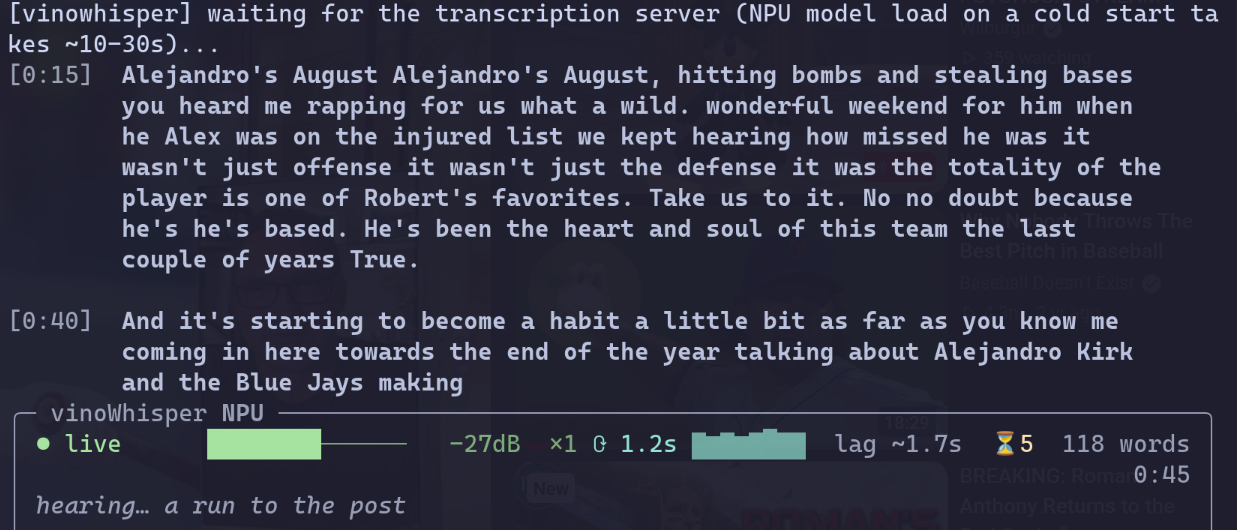
Live captions for anything playing on your Linux laptop, running on the NPU that came with it. No cloud, no API key, no account, no audio leaving the machine. Point it at whatever is playing and it captions in your terminal, or in a floating box above everything else on screen. The same box does dictation too: hold a key, talk, and let go to type what you said. There is nothing to configure: start it and it goes.
pip install vinowhisper && vinowhisper-setup && vinowhisper-caption
Why this exists
To be upfront about the bias: I did not build this because local speech-to-text is hard to find. I built it because my laptop has an Intel NPU rated at 16 TOPS that was doing absolutely nothing, and captioning a video is the rare workload that suits it: continuous, latency-sensitive, and small enough to fit.
So the pitch is not "another Whisper wrapper." The transcription runs on a chip
that is otherwise idle, so it costs you no CPU, no GPU, no fan, and no network.
openvino-genai's WhisperPipeline with device="NPU" does the work, the same
idea as vinoAuthFace, different
feature.
Measured on this laptop (Wildcat Lake, stepping A0), whisper-small.en on the NPU, 2026-09-12:
Per 12s window (the default), generate() |
0.70s mean, 0.85s p90 |
| Captions behind the audio | ~1.5s at best |
| First streamed token | 0.204s |
| Idle cost after you stop | zero, the server exits itself |
The Intel iGPU does the same window in 0.95s and the CPU in 2.30s, so both fallbacks are usable, just laggier.
What makes it different from a shell script around Whisper
- Words are never rewritten once printed. A word is committed only when two
overlapping windows agree on it (LocalAgreement-2), so the transcript lives in
your terminal's own scrollback. The dimmed
hearing…line is what is still waiting on a second opinion. Latency - It scales to zero. The NPU model load costs 10-30s, so a server holds it. The first client starts that server on a private Unix socket and it exits itself after 5 minutes idle. Architecture
- The model download is verified. The Hugging Face source is pinned to a
commit and sha256-checked per file, and the export is hashed against
vinowhisper/model_digests.jsonbefore anything loads it. SECURITY.md - A missing NPU degrades instead of bricking. Selection walks NPU, GPU, CPU,
and a fallback is never silent: server log,
/health,vinowhisper-doctor, and a red border on the status bar. Hardware - It tells you how to fix it. Nearly every error prints the command that resolves it, in your distro's package names.
- The overlay is optional, and native.
vinowhisper-trayis a 6.3MB Rust binary that floats a caption box above every window, fullscreen video included. It links nothing but libc and adds nothing to the Python install. - Dictation, in the same overlay. Hold Meta+H, talk, let go, and it types what you said into the focused window. Optionally a small model on the NPU tidies it first, and only by deleting ("um", stammers, "scratch that"). It never adds or rewords a word. Overlay and dictation
Install
curl -fsSL https://github.com/karanshukla/vinoWhisper/releases/latest/download/install.sh | bash
That verifies the release's wheel, installs it with uv
and hands over to vinowhisper-setup, which prints every command before running
it and asks first.
| I want | Run |
|---|---|
| The overlay and dictation | vinowhisper-setup --gui |
| pip instead of the installer | pip install vinowhisper && vinowhisper-setup (Python 3.11-3.13) |
| A Flatpak | flatpak install --user vinowhisper-x86_64.flatpak from the release. Not run on a desktop yet: what has been checked |
| To upgrade | Check for updates in Settings → About, or vinowhisper-upgrade |
| To remove it | vinowhisper-upgrade --uninstall. Models go, sessions and settings stay |
pip gets you the commands. It cannot get you an NPU driver or a model export,
which is what vinowhisper-setup is for either way.
Installing has what each of these does.
What you need
| OS | Linux. Developed on Fedora 45 / KDE Plasma 6 / Wayland. See Supported distros |
| Audio | PipeWire (pw-record) or PulseAudio (parec), picked automatically |
| Accelerator | Intel NPU for the numbers above. An Intel GPU or the CPU runs, slower. AMD NPUs are detected and not usable (no OpenVINO plugin) |
| Python | 3.11 to 3.13. 3.14 cannot export the model |
| Disk | ~1.5GB for the model export |
| Overlay (optional) | A Wayland compositor with wlr-layer-shell: KDE Plasma 6, Sway, Hyprland, niri, COSMIC. Not GNOME |
The NPU needs a userspace driver half that no distro packages completely, and
vinowhisper-doctor will tell you exactly which half is missing.
docs/hardware.md
covers every way it fails to appear.
Supported distros
vinowhisper-setup and vinowhisper-doctor read /etc/os-release and print
install commands in your distro's own package names. Eight families are covered:
Fedora, Debian, Arch, openSUSE, Gentoo, Void, Alpine and NixOS, plus their
derivatives and the image-based ones (Fedora Atomic, openSUSE Aeon). Only
Fedora's have been used for real.
The table, with the NPU driver per family
Commands
vinowhisper-caption                       # caption system audio
vinowhisper-caption --source mic          # caption yourself
vinowhisper-caption --list-targets        # capture one app instead of the whole sink
vinowhisper-caption --debug               # per-cycle timings, levels, raw transcript
vinowhisper-caption --record ~/sess       # save the session for replay
vinowhisper-caption --plain > out.txt     # no status bar (implied when piping)
vinowhisper-caption --json                # one event per line, what the overlay reads

vinowhisper-transcribe lecture.mp3        # a file into a saved session, no playback

vinowhisper-setup --language fr           # French (de, es, auto): sets up the multilingual model
vinowhisper-setup --language auto --task translate   # foreign speech, captioned in English

vinowhisper-tray                           # the floating overlay and tray icon
vinowhisper-tray toggle                    # show/hide it; Meta+Alt+C does the same
vinowhisper-tray dictate                   # start/finish dictating; hold Meta+H does the same
vinowhisper-tray --install --autostart     # launcher entry, and the tray at login
                                          #   (or tick "Start at login" in the tray)

vinowhisper-setup                         # guided install; re-runnable, idempotent
vinowhisper-setup --dry-run               # print the plan, change nothing
vinowhisper-server --stop                 # unload the model now; the next use starts it again
vinowhisper-setup --gui                   # just the optional overlay and dictation
vinowhisper-setup --ovfetch               # just ovfetch, NPU driver data for the doctor
vinowhisper-upgrade --uninstall           # remove it, models included; sessions and settings stay

vinowhisper-doctor                        # devices, model, digests, audio, live levels
vinowhisper-doctor --json                 # the same, for a bug report
vinowhisper-doctor --no-probe             # skip the 2s-per-target level capture

vinowhisper-replay ~/sess --restitch      # re-run the merge logic offline
vinowhisper-replay ~/sess --sweep 8,12,20 # measure what --window actually costs
Docs
| Installing | What the installer does, the OpenVINO version floor and why, digest pinning, pinning the window on top |
| Terminal captions | Scrollback, paragraphs, the level meter, and plain output |
| Overlay and dictation | The floating box, tray icon and shortcuts, dictation and how its text is typed, which desktops it works on, and why it is Rust |
| Saved sessions | The .vwsession file, summaries, and transcribing a recording |
| Speech models | Whisper and Canary 1B v2, other languages and translation |
| Hardware | Device selection, the two model exports, and every way the NPU fails to appear |
| Audio capture | PipeWire vs PulseAudio, distro coverage, and what actually silences a capture (it is not the mute button) |
| Latency | Why captions trail the audio, the one knob that changes it, and why the wording drifts |
| Debugging | --record, offline replay, and what vinowhisper-doctor measures |
| Architecture | Socket activation and scale-to-zero, and how to stop it |
| Development | Tests without the hardware, the build config, CI and releases |
Other languages
French, German and Spanish work offline with Whisper's multilingual
whisper-small, and --task translate captions them in English. It is opt-in
(vinowhisper-setup --language fr) and not benchmarked on the NPU.
Speech models has the
details, and Canary 1B v2 as a second model.
Honest limits
Worth saying before you install it, because the numbers above are all from one machine:
- Every benchmark here is n=1, on one laptop, with early-silicon NPU drivers. The GPU and CPU fallbacks have run on this laptop's Xe3 iGPU and Core 5 320 and nowhere else, and 2 of 15 GPU model loads segfaulted inside OpenVINO's GPU plugin.
- Captions trail the audio by roughly twice the cycle time. That is inherent to a two-cycle commit policy, not a bug to be tuned away. docs/latency.md explains the one knob that moves it.
- Wording drifts between cycles, because each window is re-decoded with more right-context than the last. The stitcher hides most of it and not all.
- The overlay needs wlr-layer-shell. Tested on KDE Plasma 6.7 on hardware, and on headless Sway 1.9 in a VM with a stub in place of the model. GNOME does not offer the protocol, so there the overlay refuses to start and the terminal UI is the way in. Hyprland, niri and COSMIC should work and are untested. Compositors without a shortcuts portal bind the tray's commands instead (examples).
- Dictation types into whatever has focus. Wayland does not say what that is, so it cannot check. It types through the remote-desktop portal, which KDE and GNOME have and Sway, niri and COSMIC do not, so dictation does not type there. docs/tray.md has the details.
- Only Fedora's package names have been used for real. The other seven families come from their package indexes. If one is wrong for yours, that is expected, and it is the fastest thing in this repo to fix. The PulseAudio capture backend has never run against a real PulseAudio server either.
- The NPU export needs
transformers<5.4. 5.4.0 and up produce a model that compiles and then fails atgenerate()(bisected 2026-09-04). Thevinowhisper[export]extra holds the pin. That version carries two open transformers CVEs, and both need you to export a malicious model repo, which the defaultopenai/whisper-small.enis not. docs/install.md has the bisect table.
More
- CONTRIBUTING.md and docs/development.md
- SECURITY.md: what stays on the machine, and the local server's trust boundary
- CHANGELOG.md
If you run this on hardware that isn't a Wildcat Lake laptop, I want the
report, working or not. An
issue with
vinowhisper-doctor --json pasted into it is worth more than any benchmark I
can run here.
MIT licensed.
1 maintainer

Metadata
1 maintainer
Release files for vinowhisper 1.8.0
For a detailed explanation of source distributions (sdists) and built distributions (wheels), please see the package formats documentation.
Source distribution (sdist)
| File | Size | Uploaded | Provenance | Actions |
|---|---|---|---|---|
| vinowhisper-1.8.0.tar.gz | 309.5 kB | Without provenance | Details for vinowhisper-1.8.0.tar.gz |
Built distribution (wheel)
| File | Interpreter | ABI | Platform | Actions Reset |
|---|---|---|---|---|
| vinowhisper-1.8.0-py3-none-any.whl | Python 3 | none | any | Details for vinowhisper-1.8.0-py3-none-any.whl |
Total release size: 482.4 kB
Release files / vinowhisper-1.8.0.tar.gz
| Download URL | vinowhisper-1.8.0.tar.gz |
|---|---|
| Size | 309.5 kB |
| Tags | Source |
|
SHA-256 checksum How to use checksums |
771db2b1a85a04ff9a611dd3eb6f3d9db2b83a7f7aae508d67bc96f4cd1d40ce
|
|
BLAKE2b-256 checksum How to use checksums |
762cb70d653a5acb26b699a16a6d89ee72fa366476aa113b4f59d61e22dfb79a
|
| Upload date | |
|
Uploaded using Trusted Publishing? What is trusted publishing? |
Yes |
| Uploaded via |
uv/0.13.8 {"installer":{"name":"uv","version":"0.13.8","subcommand":["publish"]},"python":null,"implementation":{"name":null,"version":null},"distro":{"name":"Ubuntu","version":"26.04","id":"resolute","libc":null},"system":{"name":null,"release":null},"cpu":null,"openssl_version":null,"setuptools_version":null,"rustc_version":null,"ci":true}
|
Release files / vinowhisper-1.8.0-py3-none-any.whl
| Download URL | vinowhisper-1.8.0-py3-none-any.whl |
|---|---|
| Size | 172.9 kB |
| Tags | Python 3 |
|
SHA-256 checksum How to use checksums |
4c875abeb18c21b6a01d454330c08ecdf014b25bf9acd18cb704d4c6c655658b
|
|
BLAKE2b-256 checksum How to use checksums |
b46384c66f19c52a62da20e62143428a8ac4ce2c13365b93849f6bd02422351b
|
| Upload date | |
|
Uploaded using Trusted Publishing? What is trusted publishing? |
Yes |
| Uploaded via |
uv/0.13.8 {"installer":{"name":"uv","version":"0.13.8","subcommand":["publish"]},"python":null,"implementation":{"name":null,"version":null},"distro":{"name":"Ubuntu","version":"26.04","id":"resolute","libc":null},"system":{"name":null,"release":null},"cpu":null,"openssl_version":null,"setuptools_version":null,"rustc_version":null,"ci":true}
|
Security for vinowhisper 1.8.0
Provenance
Provenance describes where a file came from. On PyPI, provenance is shared via attestations, which provide a verifiable record of the build or publishing details. View details, limitations and caveats.
No provenance found
None of the files in this release were uploaded with provenance metadata.
A note on package security
PyPI is a repository for distributing packages, not a service for auditing them. While third-party security researchers and our staff do their best to detect and remove malicious packages, PyPI cannot guarantee the quality, security or suitability of any given package.
To learn more about protecting yourself from malicious actors, visit our package security documentation.














