
xleda is a Microsoft Excel powered EDA tool for Python data
Verified details
These details have been verified by PyPIProject links
GitHub Statistics
Maintainers

Project description






A Microsoft Excel powered EDA tool for Python data.
-
Produces Microsoft Excel workbooks from pandas dataframes that are highly optimized to both perform and document the activity of Exploratory Data Analysis .
-
Visually explore your data, navigate with your keyboard, take field or record notes, create lists of fields/records for editing, round-trip your edits/analysis back into python, share your workbook with other contributors.
-
There are some amazing EDA tools for Python. You shouldn't have to start from scratch to include Microsoft Excel among them.
-
xleda provides a good start to a robust EDA.

An xleda workbook made with diamond data.
Requirements/Compatibility
-
Requires the full version of Microsoft Excel to create workbooks.
-
Once created, xleda workbooks should work in anything that reads Microsoft Excel workbooks.
-
It has been developed and tested on Windows.
-
It should also work on MacOS though this has not yet been tested.
Installation
-
Install with
uv add xleda
or
pip install xleda
Quick Start
-
Use wb() to quickly create an xleda workbook of a dataframe.
-
See the configuration section below for how to name the workbook, set a theme, add plots etc.
 from xleda import wb
 import seaborn as sns

 # < your dataframe goes here >
 df = sns.load_dataset("titanic")

 # Creates xleda.xlsm in the current directory
 wb(df)
Basic xleda Components
Field Metadata
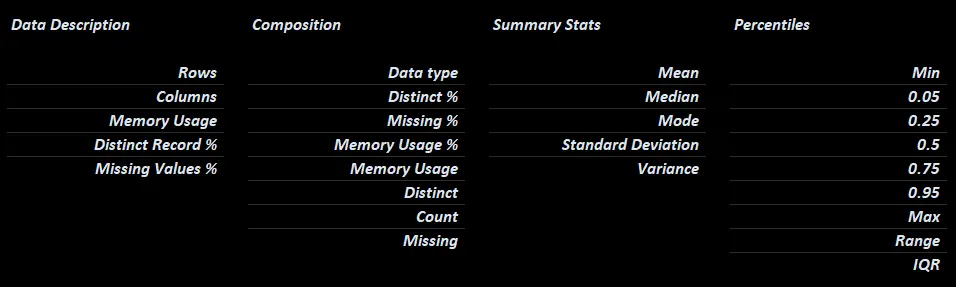
Included Field Metadata
Overview
- The
Overviewworksheet rotates the field metadata 90 degrees so that you can sort/filter fields by their name, metadata, or your notes/definitions/etc.

Sorting fields from MLB data by memory usage.
Per Field Charts
Two charts are produced for each column in your dataframe.
- A composition table showing the top 5 values per column and their percentages.
- A histogram/KDE showing min/max, distribution, and mean
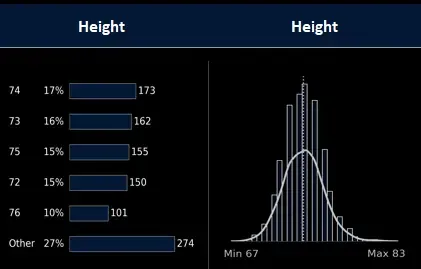
Default charts for MLB player height.
Source Data Table
-
A copy of your source data is included as an Excel table so you can visually inspect it, sort/filter it, etc.
-
Includes a way to make lists of individual records.
-
Includes a
HasBlankfield for filtering records with that have blank values. -
Includes a way to round-trip your source data back into Python so that you can use Excel to replace values, delete records/columns/etc.
-
More on how to use these features below.

Source Data Table for MLB player data.
Pivot
- A bare-bones pivot table configured to drill down into where blank values are.
- The first 10 fields of the source data are added by default.

Bare-bones pivot table for Titanic survivor data.
xleda.wb() Configuration
input_df | Dataframe | Mandatory
- A pandas dataframe of any size
name | str | Optional
- Name of the dataset/file name of the created workbook
- Defaults to
xleda
theme_color | str | Optional
- Sets the primary color of the charts and the color of the headings in the workbook to a hex color of your choice.
theme_color="random"sets a random theme - Defaults to a neutral color
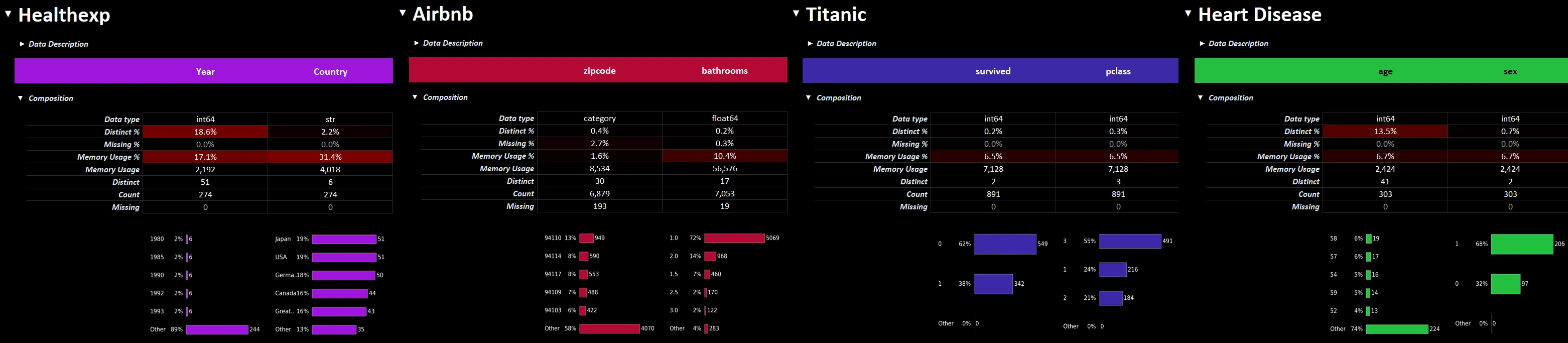
theme_color affects the workbooks and default charts.
add_plots | dict | Optional
-
add_plots={'plotname': Figure, ...}will add additional worksheets with plots of your choosing. -
No styling/sizing of additional plots is performed by xleda.
-
The example below adds two additional plot worksheets, one from seaborn and another from missingno. The workbook can be found here.
 from xleda import wb

 import matplotlib.pyplot as plt
 import seaborn as sns
 import missingno as msno


 # < your dataframe goes here >
 df = penguins = sns.load_dataset("penguins")


 # Style the additional plots | optional
 plt.style.use("dark_background")


 # Create additional plots
 pair_plots = sns.pairplot(df, hue="species").figure
 null_matrix = msno.matrix(df).get_figure()


 # Resize the null matrix  | optional
 null_matrix.set_size_inches(9.35, 4.5)


 # Creates an xleda workbook named Penguins.xlsm with two extra plot sheets
 wb(input_df=df,
    name="Penguins",
    theme_color="#4C4C4C",
    add_plots={'Pair Plots': pair_plots,
               'Null Matrix': null_matrix})
wb_path | Path | Optional
-
Sets the target folder for the xleda workbook.
-
Uses a pathlib Path object.
-
Defaults to current working directory
 from xleda import wb
 from pathlib import Path


 # Creates "c:\my_target_folder\Penguins.xlsm"
 wb(input_df=df,
    name="Penguins",
    wb_path=Path(r"c:\my_target_folder"))
overwrite | bool | Optional
- Whether to overwrite existing workbooks of the same name.
- Existing workbooks are sent to Trash/Recycle Bin
- Defaults to False
large_report | bool | Optional
- Raises the default dataframe size limits of 25,000 rows/50 columns to Excel's limits of 1,000,000 rows and 16,000 columns.
- The closer your are to this limit, the more RAM and patience you'll need to produce a workbook.
- See additional details in the performance section below.
- Defaults to False
no_vba | bool | Optional
- Creates the workbook as an xlsx file without VBA.
- Defaults to False
open_wb | bool | Optional
- Opens the workbook after creating.
- Setting this to
Falseis useful when creating multiple workbooks - Defaults to True.
export | bool | Optional
- Performs an export from an xleda workbook instead of creating one.
- Replaces the
export_analysismethod. - See details below.
- Defaults to False.
Usage Notes
Performance
-
On an average machine, xleda creates workbooks for most data sets less than 20 seconds.
-
Performance is largely dependent on how powerful of a machine you have and how large your dataframe is.
-
There is a detailed output provided when creating an xleda workbook that does a pretty good job of letting you know what it's doing.
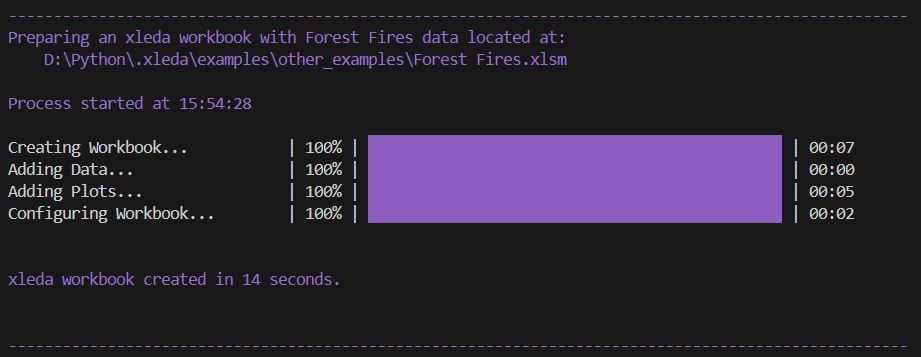
Console output of a Planets workbook
Limits with Large Data Sets
-
To ensure workbooks are created quickly, defaults limit data to the first 50 columns and a random sample of 25,000 records.
-
You can optionally override this to Excel's limits (see
large_report=Trueabove) -
You'll see a warning banner if you hit a limit.

-
One of the more complex data sets tested was a 600 column/1,200 row dataframe.
-
It took ~5 minutes to create, in part because nearly all values are large unique numbers in all 600 columns.
-
It is still snappy to use even though it has 1,200 charts on a single worksheet.
-
That example is here.
-
Field/Record Lists
-
The
Field Listssection helps you create lists of the fields in your data.- e.g. lists of fields to rename, delete, standard scale, encode, impute, investigate, etc.
-
Anything not marked as
Falsewill be included in each list. -
You can rename any list to
Anything You Wantand the list will be renamed toanything_you_want. -
The
Record Listfield added to your source data works the same way except it creates a list of records instead of a list of fields. More on that below. -
The Compiled Lists section formats your lists as python lists for easy copy/pasting.

Easily create lists of fields in your data.
Columns Added to Source Data
-
Although the source data is unchanged before it goes into Excel, there are some columns added to support an EDA workflow.
-
HasBlank: If any field in a record has a missing value, this will show 1 otherwise 0 -
Record Hash: Uses a built-in pandas feature hash_pandas_object to uniquely identify records. If two records share all column values they also share aRecord Hash. -
Record List: Used to create a list ofRecord Hashvalues. LikeField Listsabove, anything not marked false gets added to a list. -
index: This is a copy of the index from the provided dataframe as a column.
 # .....After editing your workbook and assuming you marked
 # records to delete in the record list column

 # exports your source dataframe with the added record list column
 export_dict = wb(df, export=True).export_dict
 df = export_dict['source_data']

 # Uses the record list to delete records
 delete_records = df = export_dict['lists']['record_list']
 df = df[not df['Record Hash'].isin(delete_records)]
-
Accessing Metadata in Python
Default Metadata
- Metadata from all
xleda.wb()objects is collected into a dictionary accessible throughxleda.wb().export_dict
 # Creates "Titanic.xlsm" and exports the metadata dictionary
 export_dict = wb(input_df=df,
            		 name="Titanic").export_dict

 # Returns the field metadata df used in the Field Analysis worksheet
 export_dict['field_metadata']
-
The following metadata is available without using
export=Truefield_metadata: A basic metadata dataframe, combining information from pandas info/describe/quantile.overview_metadata: A transposed copy of the field_metadata.source_data: A copy of your unaltered source data that includesRecord Hash/Record List/HasBlank/indexcolumns.
Expanded Metadata
-
Using
xleda.wb(export=True)reads an xleda workbook instead of creating one. -
It expands the available metadata within
xleda.wb().export_dictto include:-
description: Dataframe description if you've added one -
definitions: Any field definitions you've added. -
notes: Any field notes you've added -
lists: Any lists showing in the compiled lists section -
altered_source_data: Reads the Excel table namedtbl_SourceDatafrom the workbook and will include any manual edits you've made such as removing records, renaming fields, replacing values, etc. **** Note that data types will likely change in the round-trip translation.
-
Completed Example
-
The xleda workbook pictured here is used in for the export code example below .
-
It can be found here..
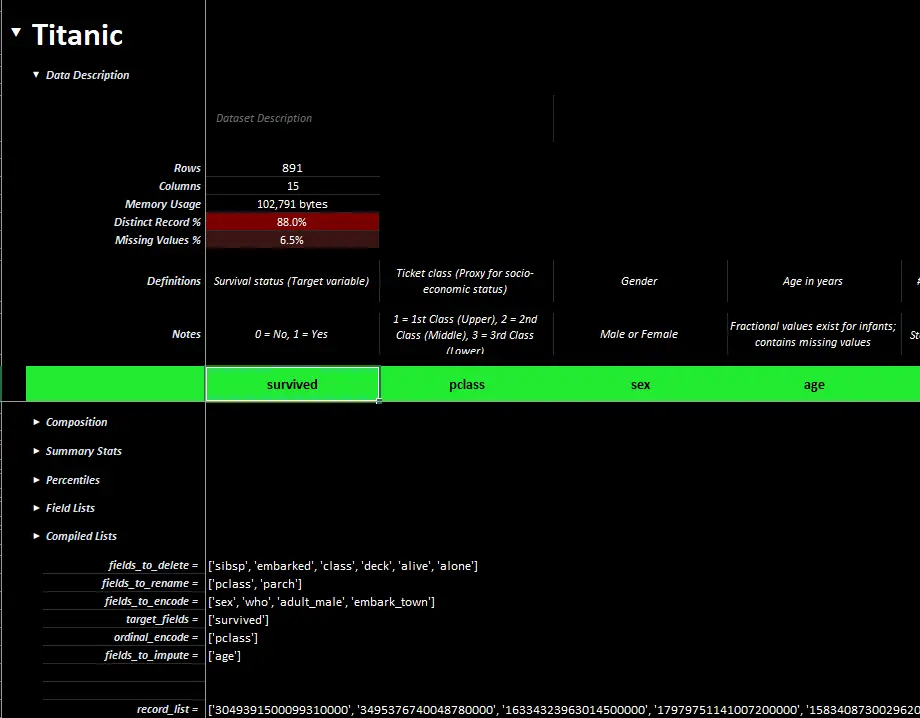
A completed xleda workbook of Titanic passenger showing definitions, notes, lists, etc.
Example Export Dictionary
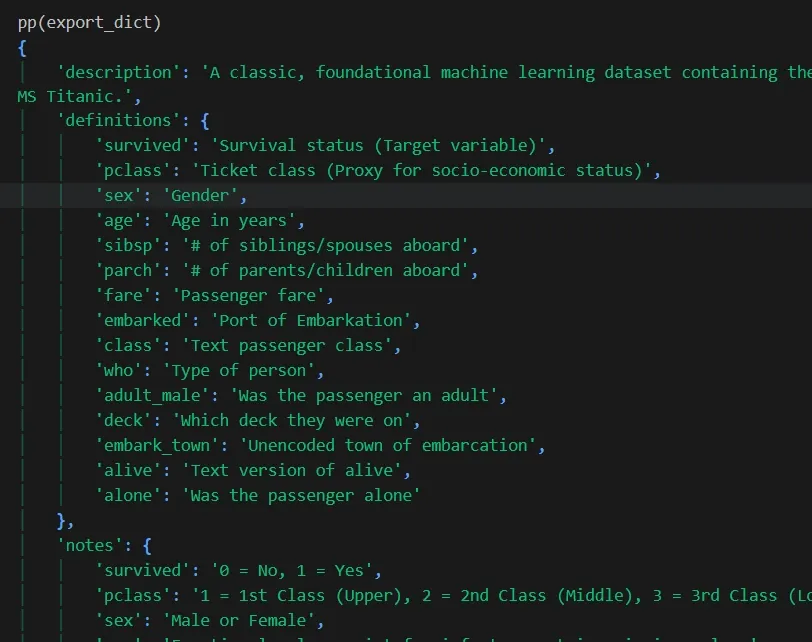
An example export dictionary from a completed field analysis on Titanic passenger data.
Example Export Code
-
This example exports everything from an xleda workbook named "Titanic (Completed).xlsx" in the current directory.
-
Either download this one or create your own.
 from xleda import wb

 # Performs a full export from "Titanic (Completed).xlsx"
 export_dict = wb(input_df=df,
 				 name="Titanic (Completed)",
 				 no_vba=True,
 				 export=True).export_dict


 # Returns dict_keys(['description', 'definitions', 'notes',
 # 'lists', 'field_metadata', 'overview_metadata', 'source_data',
 # 'altered_source_data'])
 print(export_dict.keys())
VBA Code
-
If you can't or don't want to enable VBA, you may want to use
no_vba=Truewhich creates an xlsx file that contains no VBA. -
The small amount of VBA code in the template does two optional things.
-
Makes the sections expand/collapse when you select them as pictured above.
-
Adds two UDFs, PythonList and PythonDict, that format cell values as lists/dicts.
-

Use row groupings to navigate if you can't use VBA.
Extensible
-
xleda is only meant to give a good start to EDA.
-
If it accomplishes one thing it will be to give you a way to quickly get Python data into Excel so that you can make sense of it...without making you do everything from scratch.
-
Where you go from there is up to you.
-
Because it's an ordinary workbook, you can use any tool that works with Microsoft Excel workbooks to do more.
-
xlwings is recommended if you do.
Built With
- This was primarily built with Python, xlwings, Pandas, and of course, Microsoft Excel.
Roadmap
- Add a barebones pivot that is ready to configure
- Make xleda even more accessible by simplifying the API and making it easier to remember.
- Create a way to quickly view dataframe data that is editable, shareable, and presentation ready.
- Add a way to include extra plots for a dataset.
- Add a way to include extra supporting table worksheets.
- Add a way to use on desktop files e.g. by right-clicking csv/parquet files/other tabular data files.
- Add a basic version for even quicker dataframe inspection.
- Add a way to include multiple xleda analyses in a single workbook.
- Test on MacOS
- Investigate starting from Excel data.
- Your idea here.
Changelog
[!NOTE]Version 0.8.6 - New simplified API, simplified export, general polish Simplified basic usage to make it quicker to use and easier to memorize.
- Changed the default entry point to
xleda.wb()fromxleda.FieldAnalysis().xleda.wb()now creates and automatically opens workbooks.- The only argument needed to create a workbook is now a dataframe.
wb(df)- Workbook name now defaults to
xledaif no name is given.- Protected backwards compatibility while providing guidance to use the new API.
- Subclassed the new API to create plugs for the old one.
Simplified export functionality
- Changed
export_analysisfunctionality from a class method to a class argumentwb(df, export=True).- All wb() objects now include a export_dict metadata collection that is accessible using dot notation.
- Added field_metadata, and overview_metadata to export_dict.
- using wb(export=True) adds the metadata exported from workbooks to export_dict.
- Added file exists checks for
export=Truewith messaging that the export will be limited if the file isn't found.Template updates
- Recreated the template, moved formatting to cell styles for simplicity/consistency in maintenance where appropriate.
- Pivot was removed and Blanks was renamed Pivot.
% of Recordsfield was added to the new Pivot- Added dataframe index to source data by default.
- Added dataframe level metadata to the Data Description section.
- Added two UDFs to the template, PythonList/PythonDict to create Python formatted strings from cell values
- Adjusted the named range to support being able to delete almost any column without affecting lists or navigation.
- General polish.
Other updates
- Default limits were reduced to 25,000 rows/50 columns
- Good deal of refactoring to support new entry point, minimize errors, reduce redundancy.
- Removed clipboard usage in all except one place which is formatting instead of data.
- Added
open_wbargument to prevent automatically opening the workbook. Useful if creating many workbooks.- Replaced rich progress bars with TQDM for better support in notebooks/vs code notebook/console environments.
- When using overwrite=True, overwritten files now go to the recycle bin/trash. Console output includes messaging about these files.
- Clarified/organized readme to support the new API/template.
- Added production logging metrics so you can see how the time required to create a workbook was utilized.
- This is useful if you're trying to find a good size to subsample to.
- You can find it at
wb().performancefor now.
Project details
Verified details
These details have been verified by PyPIProject links
GitHub Statistics
Maintainers
Release history Release notifications | RSS feed


Download files
Download the file for your platform. If you're not sure which to choose, learn more about installing packages.
Source Distribution
Built Distribution
Filter files by name, interpreter, ABI, and platform.
If you're not sure about the file name format, learn more about wheel file names.
Copy a direct link to the current filters
File details
Details for the file xleda-0.8.6.tar.gz.
File metadata
- Download URL: xleda-0.8.6.tar.gz
- Upload date:
- Size: 68.2 kB
- Tags: Source
- Uploaded using Trusted Publishing? Yes
- Uploaded via: uv/0.11.17 {"installer":{"name":"uv","version":"0.11.17","subcommand":["publish"]},"python":null,"implementation":{"name":null,"version":null},"distro":{"name":"Ubuntu","version":"24.04","id":"noble","libc":null},"system":{"name":null,"release":null},"cpu":null,"openssl_version":null,"setuptools_version":null,"rustc_version":null,"ci":true}
File hashes
| Algorithm | Hash digest | |
|---|---|---|
| SHA256 |
7fc1447656517f89a1fc9266ca3e303633eef154ebb88b49bc4ee91bac6c4138
|
|
| MD5 |
82a14e76fce90ae907150f84b62f09bc
|
|
| BLAKE2b-256 |
9765cfd543dbda1852cff5495237843c3da06664bdb0655f1b6c7af07fd562bd
|
File details
Details for the file xleda-0.8.6-py3-none-any.whl.
File metadata
- Download URL: xleda-0.8.6-py3-none-any.whl
- Upload date:
- Size: 68.1 kB
- Tags: Python 3
- Uploaded using Trusted Publishing? Yes
- Uploaded via: uv/0.11.17 {"installer":{"name":"uv","version":"0.11.17","subcommand":["publish"]},"python":null,"implementation":{"name":null,"version":null},"distro":{"name":"Ubuntu","version":"24.04","id":"noble","libc":null},"system":{"name":null,"release":null},"cpu":null,"openssl_version":null,"setuptools_version":null,"rustc_version":null,"ci":true}
File hashes
| Algorithm | Hash digest | |
|---|---|---|
| SHA256 |
d37e325be35fb4a8736a2be1f3c944cafb4cb79339184f4d163e9532019c2bd1
|
|
| MD5 |
8aef950aa99a1e7a5b36cabbad30a89f
|
|
| BLAKE2b-256 |
f1b969dc5e9bcd7d6d974cb2eac14165a2d0b7117a7619a66423ac2f3fa197b1
|






