
Open Data Stack


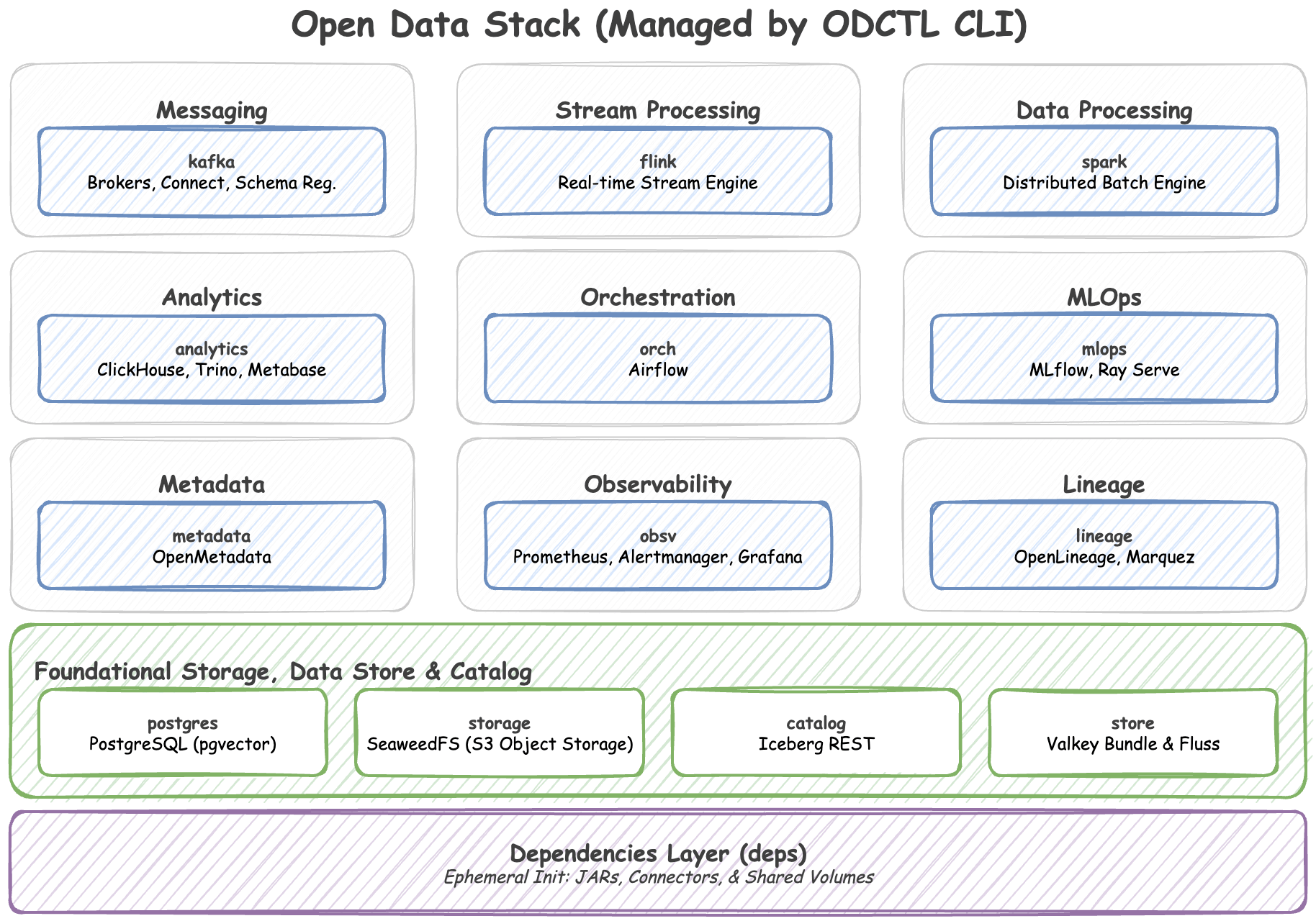
A curated collection of open-source technologies and an accompanying CLI (odctl) for experimenting with modern data architecture and MLOps locally.
To see why it exists, read Why odctl.
Provisioning a local data environment with distributed systems can be highly complex. The Open Data Stack streamlines this process by resolving dependency conflicts, network routing configurations, and integration challenges across tools like Kafka, Spark, Flink, Iceberg, and Airflow. It provides a cohesive, Docker-based blueprint that operates seamlessly out of the box.
Documentation: jaehyeon.me/odctl. It covers every profile with its ports, images and memory limits, the CLI reference, guides and troubleshooting.
Installation
odctl needs Docker running, with 8 to 16 GB of memory, and Python 3.10 or later. Install it into its own environment:
uv tool install odctl
# or
pipx install odctl
odctl follows semantic versioning from 1.0, so a project can pin odctl>=1.0,<2.
Quick Start
odctl init                    # copy the compose files and settings into ./.odctl
odctl list                    # show the profiles
odctl up kafka-lite flink-lite spark-lite
odctl down --all
odctl up starts the profiles each one depends on first, here PostgreSQL, SeaweedFS (S3) and the Iceberg REST catalog. See Getting started for more.

Why not plain Docker Compose?
odctl runs Docker Compose underneath, and a Compose file of your own is enough for one small project. odctl helps when you have several projects: the compose files live in one tested place instead of drifting apart in copies, the services are already connected to each other, and commands such as odctl ps and odctl explain show what is running and on which ports. Why not plain Docker Compose? explains it in more detail.
Related reading
Blog posts about odctl and the projects built on it are tagged odctl on jaehyeon.me.
Projects that use odctl:
- benchtop: hands-on data engineering and machine learning demos that run locally, each on the odctl stack.
- desflow (docs): a SimPy library for simulations that stream to Kafka, PostgreSQL, Redis and Iceberg; its examples and integration tests run their infrastructure with odctl.
- agentic-analytics-system: conversational analytics over an Iceberg lakehouse, with Trino, Iceberg and object storage started by odctl.
Development
Pull requests are welcome. To work on the CLI:
- Clone the repository and install uv.
- Install the dependencies and the project in development mode:
uv sync - Install the pre-commit hooks, which run the formatting and type checks:
uvx pre-commit install
- Run the tests:
uv run pytest tests/
- Build the documentation site, then serve it while you edit. It is served at
http://127.0.0.1:8000/odctl/:uv run mkdocs build --strict uv run mkdocs serve
The profile pages and the CLI reference are generated by scripts/gen_pages.py during the build, so edit registry.yml, the compose files or the commands rather than those pages.
License
This project is licensed under the Apache License 2.0. See the LICENSE file for details.
1 maintainer

Metadata
1 maintainer
Release files for odctl 1.2.0
For a detailed explanation of source distributions (sdists) and built distributions (wheels), please see the package formats documentation.
Source distribution (sdist)
| File | Size | Uploaded | Provenance | |
|---|---|---|---|---|
| odctl-1.2.0.tar.gz | 896.3 kB | With provenance | Details |
Built distribution (wheel)
| File | Interpreter | ABI | Platform | Reset |
|---|---|---|---|---|
| odctl-1.2.0-py3-none-any.whl | Python 3 | none | any | Details |
Total release size: 1.1 MB
Release files / odctl-1.2.0.tar.gz
| Download URL | odctl-1.2.0.tar.gz |
|---|---|
| Size | 896.3 kB |
| Tags | Source |
|
SHA-256 checksum How to use checksums |
a73d12c98c647ac6ad90eef943e0e666939a2edf8169bea6cf89037cfb0bb624
|
|
BLAKE2b-256 checksum How to use checksums |
f085a36e44fb7fd4a12a8870f6b9f0a9b8f25b2b878ae10c1d6c8f002caa6d07
|
| Upload date | |
|
Uploaded using Trusted Publishing? What is trusted publishing? |
Yes |
| Uploaded via |
twine/7.0.0 CPython/3.13.16
|
Provenance
Provenance describes where a file came from. On PyPI, provenance is shared via attestations, which provide a verifiable record of the build or publishing details. View details, limitations and caveats.


PyPI Publish Attestation
PyPI verified that this artifact, at this checksum, originated from the publisher listed below.
Signed by GitHub Actions, verified by PyPI on Oct 23, 2026.
Transparency logRelease files / odctl-1.2.0-py3-none-any.whl
| Download URL | odctl-1.2.0-py3-none-any.whl |
|---|---|
| Size | 171.4 kB |
| Tags | Python 3 |
|
SHA-256 checksum How to use checksums |
9e30c0afbfa5ddd61523ce8c872a7e7cf12e53d8eec11a583af30964c6505810
|
|
BLAKE2b-256 checksum How to use checksums |
7a34644713d439c66888123235c3724abfbac42f55fd4267d9f65712bca50bc1
|
| Upload date | |
|
Uploaded using Trusted Publishing? What is trusted publishing? |
Yes |
| Uploaded via |
twine/7.0.0 CPython/3.13.16
|
Provenance
Provenance describes where a file came from. On PyPI, provenance is shared via attestations, which provide a verifiable record of the build or publishing details. View details, limitations and caveats.
PyPI Publish Attestation
PyPI verified that this artifact, at this checksum, originated from the publisher listed below.
Signed by GitHub Actions, verified by PyPI on Oct 23, 2026.
Transparency logSecurity for odctl 1.2.0
Provenance
Provenance describes where a file came from. On PyPI, provenance is shared via attestations, which provide a verifiable record of the build or publishing details. View details, limitations and caveats.
Full provenance
All 2 files in this release have been uploaded with provenance metadata.
Attestation for odctl-1.2.0.tar.gz
PyPI Publish Attestation
PyPI verified that this artifact, at this checksum, originated from the publisher listed below.
Signed by GitHub Actions, verified by PyPI on Oct 23, 2026.
Transparency logA note on package security
PyPI is a repository for distributing packages, not a service for auditing them. While third-party security researchers and our staff do their best to detect and remove malicious packages, PyPI cannot guarantee the quality, security or suitability of any given package.
To learn more about protecting yourself from malicious actors, visit our package security documentation.














