
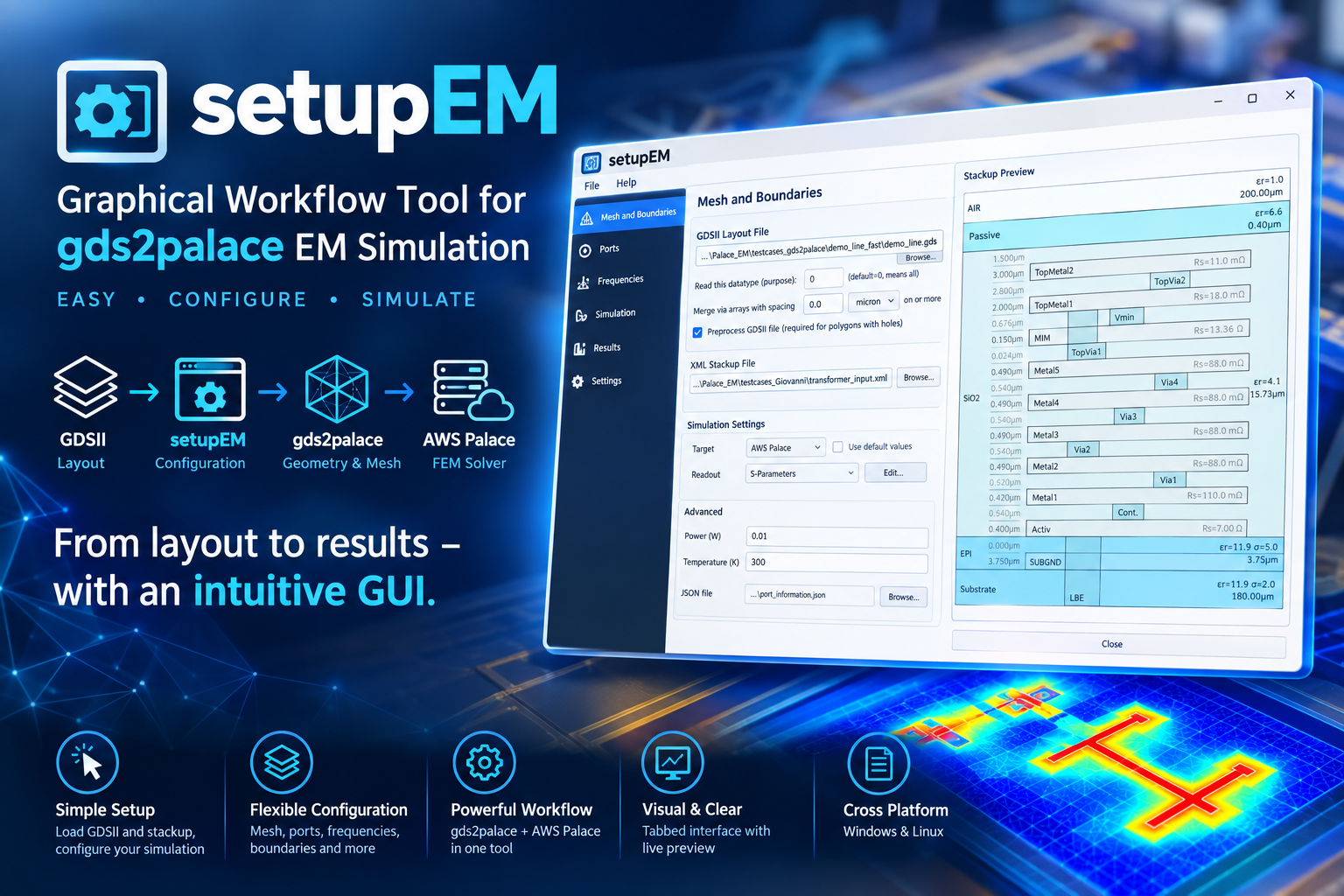
Python GUI for gds2palace
Install
pip install setupEM
Full documentation, installation guide, and usage walkthrough: https://github.com/VolkerMuehlhaus/setupEM
Recent changes
What's New - October 19, 2026
Stackup Editor, ADS Momentum (*.ltd) import: metals with an EXPAND thickness operation now make the dielectric next to them thicker, as in ADS, instead of reaching into the dielectric below. Before, a thick EXPAND DOWN metal (e.g. MET1/MET2 in a GaAs stackup) overlapped the layers underneath it, and a via could end up with zero height. Files where long lines are wrapped or END_... markers follow the last entry on the same line now import too; before, they failed with "No usable dielectric slabs".
What's New - October 18, 2026
Touchstone files with different port impedances: the option line of the combined .sNp file now has one Z0 per port, in port order. Before, ports with the same Z0 as port 1 were left out.
What's New - October 17, 2026
Conductor model replaces Conductor meshing on the Mesh and Boundaries tab (Palace only), with a third choice: Surface impedance (default, as before), Solve inside (volume mesh) and the new Solve inside + skin layers, which adds thin layers along the conductor faces for accurate Q and loss at high frequency. Generated model scripts now use settings['conductor_model'] instead of settings['filled_metals']. Older projects and model scripts with filled_metals still load. setupEM now requires gds2palace 0.9.0 or later; pip install --upgrade setupEM updates it.
Full history: CHANGES.md
Note: the setupEM PyPI package itself requires:
- gds2palace>=0.9.0
- gds_prepare_for_EM>=1.3.0
- PySide6
- shiboken6
- scipy
- requests
- scikit-rf
- matplotlib
- numpy
- gdspy
- meshio
- pyvista
- pyvistaqt
(Other Python modules mentioned above are only needed to run standalone helper scripts in this repository, not to use the installed package.)
1 maintainer

Metadata
1 maintainer
Release files for setupEM 0.14.1
For a detailed explanation of source distributions (sdists) and built distributions (wheels), please see the package formats documentation.
Source distribution (sdist)
| File | Size | Uploaded | Provenance | Actions |
|---|---|---|---|---|
| setupem-0.14.1.tar.gz | 343.9 kB | Without provenance | Details for setupem-0.14.1.tar.gz |
Built distribution (wheel)
| File | Interpreter | ABI | Platform | Actions Reset |
|---|---|---|---|---|
| setupem-0.14.1-py3-none-any.whl | Python 3 | none | any | Details for setupem-0.14.1-py3-none-any.whl |
Total release size: 695.4 kB
Release files / setupem-0.14.1.tar.gz
| Download URL | setupem-0.14.1.tar.gz |
|---|---|
| Size | 343.9 kB |
| Tags | Source |
|
SHA-256 checksum How to use checksums |
9ee0f3167ca11536d84bb2580671712010ba6821a5f3a35e1bc61b0f38e13507
|
|
BLAKE2b-256 checksum How to use checksums |
8ccdcebdd1db7aa73c751c9457c6c154cc8ce2af6dd3ef133afb06a97be01dba
|
| Upload date | |
|
Uploaded using Trusted Publishing? What is trusted publishing? |
No |
| Uploaded via |
twine/7.0.0 CPython/3.13.14
|
Release files / setupem-0.14.1-py3-none-any.whl
| Download URL | setupem-0.14.1-py3-none-any.whl |
|---|---|
| Size | 351.5 kB |
| Tags | Python 3 |
|
SHA-256 checksum How to use checksums |
f8703cf97350d57e37392285926c341f52813dfc1d817272d31bd5f571c421b0
|
|
BLAKE2b-256 checksum How to use checksums |
06ac1a9c20750ff64d9b7b29b2a0cad1a8bf4cfe5638f47a274ae65ac88eeced
|
| Upload date | |
|
Uploaded using Trusted Publishing? What is trusted publishing? |
No |
| Uploaded via |
twine/7.0.0 CPython/3.13.14
|
Security for setupEM 0.14.1
Provenance
Provenance describes where a file came from. On PyPI, provenance is shared via attestations, which provide a verifiable record of the build or publishing details. View details, limitations and caveats.
No provenance found
None of the files in this release were uploaded with provenance metadata.
A note on package security
PyPI is a repository for distributing packages, not a service for auditing them. While third-party security researchers and our staff do their best to detect and remove malicious packages, PyPI cannot guarantee the quality, security or suitability of any given package.
To learn more about protecting yourself from malicious actors, visit our package security documentation.














