
AniWorld Downloader v5
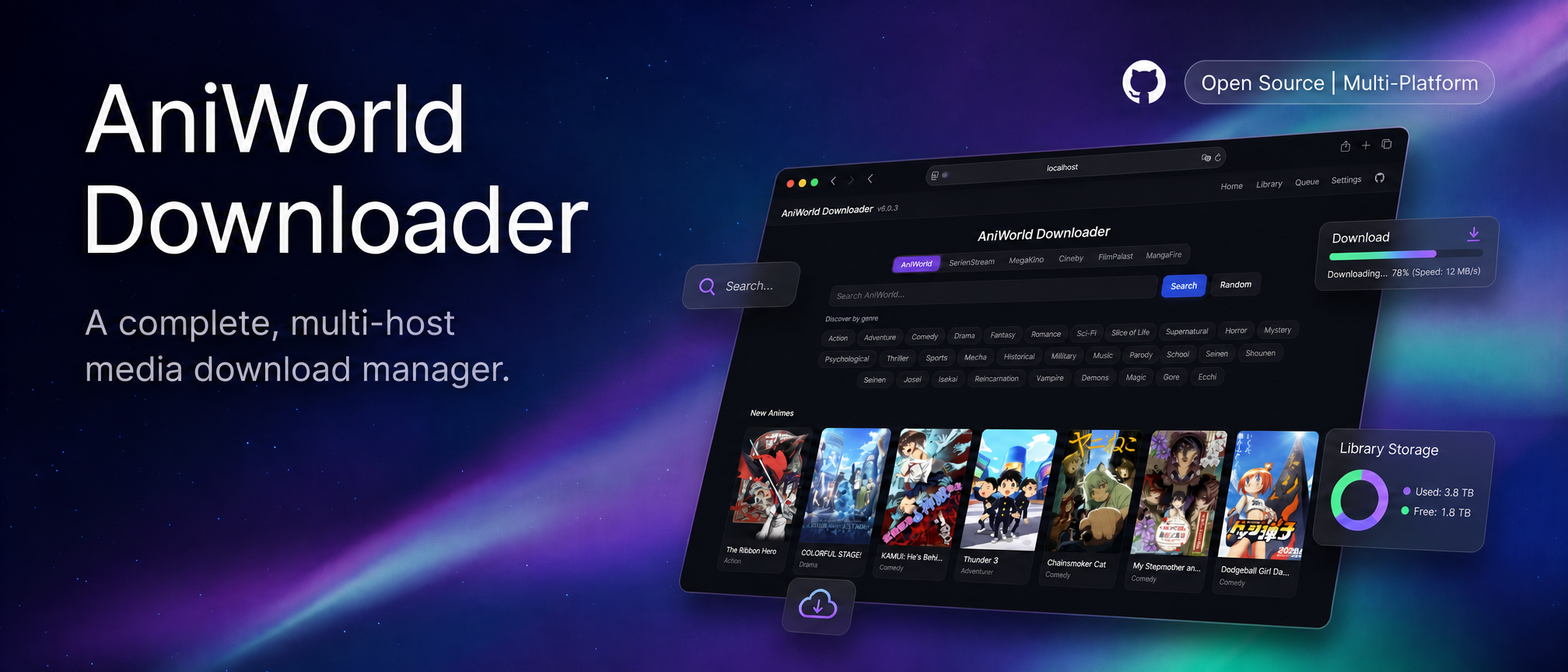









Find, download, and watch anime, movies, and series, or save manga chapters to read later. AniWorld Downloader brings supported sites together in a browser-based Web UI, with an interactive terminal menu and a CLI for scripts and automation.
It runs on Windows, macOS, and Linux, with Docker and standalone builds available too. Free and open source, with no ads, tracking, or paid-only features.
Getting started · Supported sites · Docker · Documentation · Python examples
https://github.com/user-attachments/assets/d65c4a5c-827a-45d7-a904-78977fd9aef4
Quick Start
With Python 3.11 or newer installed:
python -m pip install -U aniworld
aniworld -w
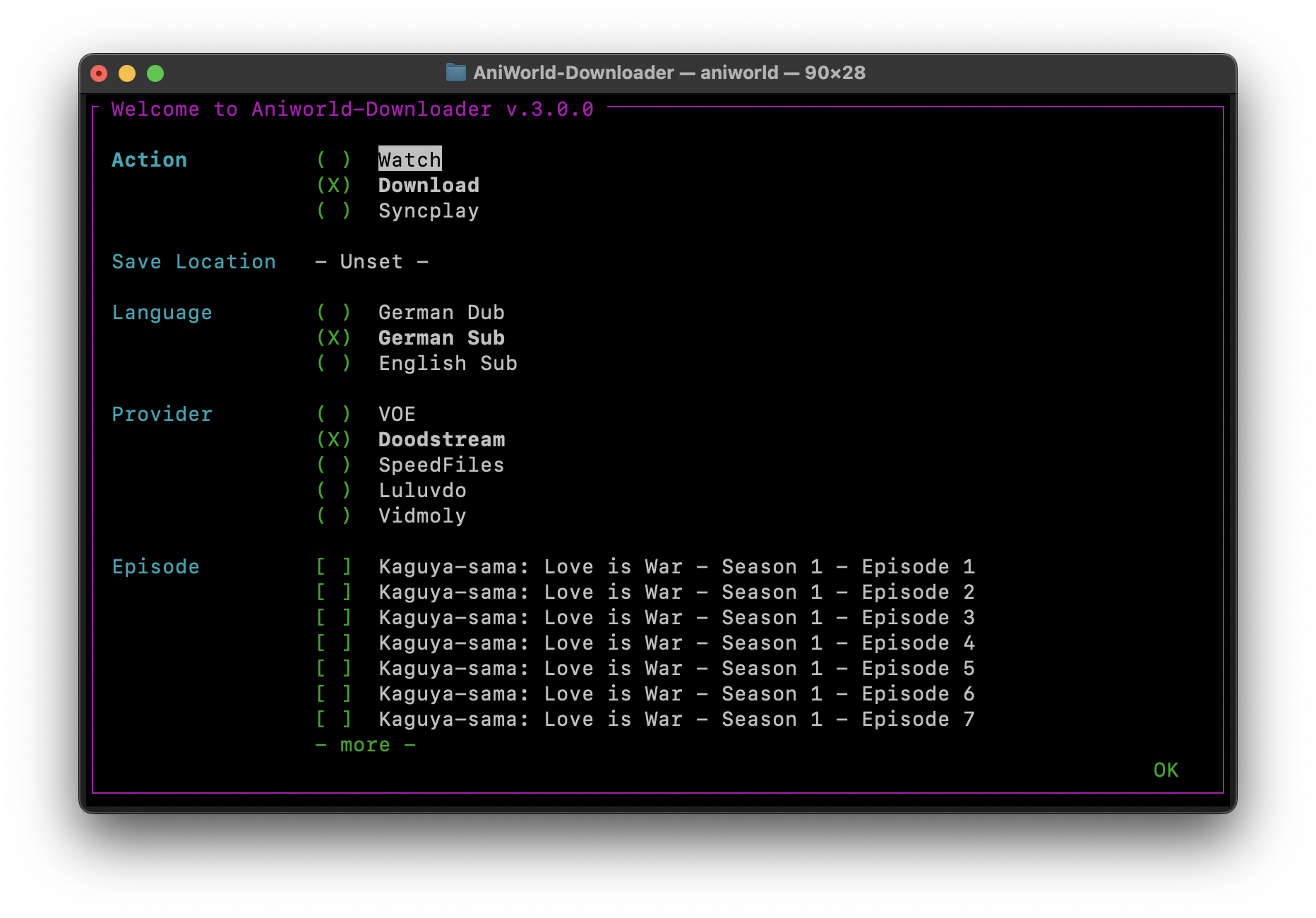
Open localhost:8080 to use the Web UI. To start the interactive terminal menu instead:
aniworld
To install the latest development version from the models branch:
pip install --upgrade git+https://github.com/phoenixthrush/AniWorld-Downloader.git@models
Video downloads need FFmpeg. Playback uses mpv, IINA, or Syncplay, depending on the action you choose. Portable dependencies can be installed automatically on Windows; macOS and Linux use system packages.
Prefer another installation method? Use Docker or download a standalone build from GitHub Releases. See the documentation for platform-specific setup and troubleshooting.
Features
- Download individual episodes, whole seasons or series, movies, and manga chapters.
- Search supported sites, track your download queue, and browse your library in the Web UI.
- Keep up with new episodes using Auto-Sync and release scheduling.
- Choose available audio and subtitle languages, with fallback to other stream hosters.
- Customize folders, filenames, and output formats, including MKV/MP4 for video and JPG/CBZ for manga.
- Watch through external players, with AniSkip and Anime4K support where applicable.
The Web UI also supports local accounts, optional OIDC SSO, custom CSS, and background shaders. A JSON API and optional Discord request bot let you connect it to other tools. Features and language availability vary by site.
For CAPTCHA browser visibility, manual solving, timeouts, and debug logs, see CAPTCHA configuration.
Supported Sites
AniWorld and SerienStream are the main focus of the project.
All registered source backends are listed below. Availability notes use sampled stream/image checks from 09/2026, not complete downloads or playback tests. Availability can vary by title, region, and stream hoster.
| Site | Content | Status | Notes |
|---|---|---|---|
| AniWorld | Anime and anime movies | Working | |
| SerienStream | Series | CAPTCHA verification required | |
| MegaKino | Movies and series | Working | |
| Filmo | Movies | Working | |
| Moflix | Movies and series | Working | |
| MangaFire | Manga | Working | JPG and CBZ downloads |
| FilmPalast | Movies | Working | |
| Hanime | Adult animation | Working | Disabled by default |
| HentaiTV | Adult animation | Implemented; live availability unverified | CLI/Python only |
| AnimeIDHentai | Adult animation | Implemented; live availability unverified | CLI/Python only |
| HentaiHaven | Adult animation | Implemented; live availability unverified | CLI/Python only |
| Kinox | Movies and series | Unverified: manual captcha required | Disabled by default |
| BurningSeries | Series | Broken: embed resolution failed | Disabled by default |
"Disabled by default" refers to Web UI visibility; direct CLI URLs remain accepted. Hanime (hanime.tv) has an optional Web UI tab, enabled with ANIWORLD_ENABLE_HTV=1. HentaiTV (hentai.tv), AnimeIDHentai (animeidhentai.com), and HentaiHaven (hentaihaven.xxx) support direct CLI URLs and Python use. See adult-site usage for examples.
Stream Hosters
Sites list the titles; stream hosters provide the video links. The checks below use the same 09/2026 snapshot.
| Hoster | Status |
|---|---|
| VOE | Working |
| Filemoon | Working |
| Doodstream | Working |
| MegaKino | Working |
| Gupload | Working |
| MoflixClick | Working |
| Vidara | Working |
| Vidmoly | Broken: no embed HTML returned |
| Vidoza | Unverified: Shut down? |
If a hoster fails, the downloader can try others in your configured fallback order, provided the title offers them in the selected language. It does not automatically switch languages. VOE previews are broken; Filemoon, Doodstream, and MegaKino previews are not implemented.
CLI Usage
Replace SUPPORTED_URL with an episode, season, series, movie, or chapter URL from a supported site:
aniworld "SUPPORTED_URL"
To choose a language and provider without opening the menu:
aniworld --no-menu --language "German Dub" --provider VOE "https://aniworld.to/anime/stream/example/staffel-1/episode-1"
For all options, more examples, or your installed version:
aniworld --help
aniworld --examples
aniworld --version
Docker
Save docker-compose.yaml in a folder on your machine. From that folder, create the download directory and start the app:
mkdir -p Downloads
docker compose up -d
Open localhost:8080 when the container is ready. The image includes FFmpeg and Chromium for captcha handling.
- Downloads are saved to
./Downloadson your machine. - The
aniworld-datavolume keeps the database,.env, and custom themes across container recreation. - Use
docker compose logs -fto view logs anddocker compose downto stop the app.
To update the image and restart:
docker compose pull
docker compose up -d
The Compose file includes configuration examples. Set persistent options in its environment: block, or load a host .env file using env_file. Settings marked resets after restart in the Web UI only affect the running process.
Configuration and Integrations
Configuration lives in ~/.aniworld/.env by default. Set ANIWORLD_INSTALL_FOLDER to change the app data directory. See src/aniworld/.env.example for available settings and defaults.
Many settings can be changed in the Web UI. Those marked resets after restart must also be set in your .env or deployment environment to persist. Saved themes, database records, and Discord bot settings are stored separately and survive restarts when the app data is retained.
Optional integrations: the standard installation includes the Web UI and terminal dependencies. Install an extra for OIDC login or Discord requests:
python -m pip install "aniworld[sso]"
python -m pip install "aniworld[discord]"
Use "aniworld[all]" to install both. The Docker image already includes them.
API: search, manage the queue, and access library and settings operations through JSON endpoints. Create a key in Settings → API Keys, then send it with your requests:
curl -H "X-API-Key: YOUR_API_KEY" http://localhost:8080/api/queue
Keys have read, read-and-download, or full-access permissions. They cannot manage other API keys. The settings page includes an endpoint reference with examples.
Appearance: use Settings → Appearance for custom CSS and background shaders. The themes/ directory contains a light theme and a documented CSS template. To recover from a theme that hides controls, open /settings?nocss=1.
Python: all public site models are available from aniworld or aniworld.models. Search and genre functions share aniworld.search; see Genre Search for supported filters and site limits. The examples/ directory demonstrates models, metadata, downloads, and genre queries.
Contributing
Bug reports, fixes, provider updates, and documentation improvements are welcome. Please check existing issues first. For a bug report, include your operating system, installation method, app and Python versions, the command or steps you used, and relevant logs.
To work on the current development branch:
git clone --branch models https://github.com/phoenixthrush/AniWorld-Downloader.git
cd AniWorld-Downloader
python -m pip install -e ".[all,test]"
pytest
Automated tests run without contacting live sites. Separate tests/test_providers_*.py scripts check live providers. CI also runs Ruff checks. Keep pull requests focused and explain what changed and how you tested it.
Contributors
Thank you to everyone who reports issues, shares ideas, and contributes code.

Credits
AniWorld Downloader uses mpv, IINA, Syncplay, Anime4K, AniSkip, flag-icons, new-domain-check, and fake-useragent.
Other Cool Projects
- Jellyfin-AniWorld-Downloader by SiroxCW — browse and download AniWorld content from Jellyfin.
- AniSeerr by Yezun-hikari — connect Seerr requests to AniWorld Downloader.
- AniBridge by Zzackllack — connect supported catalogues to automation tools through FastAPI.
- AniLoader by WimWamWom — a standalone web-based fork.
Support and Community
For help, check the documentation, open a GitHub issue, or join us on Discord. You can also reach me at contact@phoenixthrush.com.
If the project has been useful, a star, a contribution, or a donation is always appreciated. Thanks for being part of it. <3
Legal Disclaimer
AniWorld Downloader is a client-side tool. It does not host, upload, store, or distribute media on behalf of third-party sites.
You are responsible for how you use it and for following the laws and terms that apply where you live. The project is provided "as is". Its maintainers are not responsible for third-party content, external links, or the availability, accuracy, legality, or reliability of outside services.
Questions about content hosted by another service should be directed to that service.
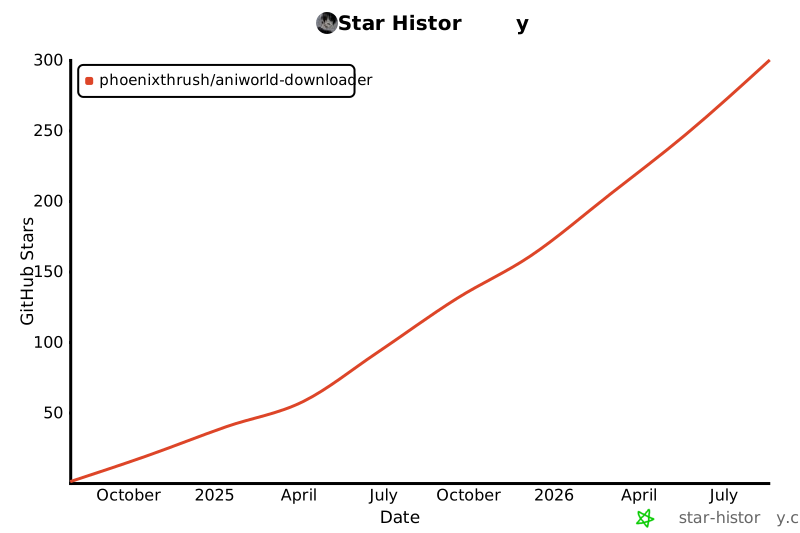
Star History
License
AniWorld Downloader is available under the MIT License.
1 maintainer

Metadata
1 maintainer
Release files for aniworld 5.2.0
For a detailed explanation of source distributions (sdists) and built distributions (wheels), please see the package formats documentation.
Source distribution (sdist)
| File | Size | Uploaded | |
|---|---|---|---|
| aniworld-5.2.0.tar.gz | 1.6 MB | Details |
Built distribution (wheel)
| File | Interpreter | ABI | Platform | Reset |
|---|---|---|---|---|
| aniworld-5.2.0-py3-none-any.whl | Python 3 | none | any | Details |
Total release size: 3.2 MB
Release files / aniworld-5.2.0.tar.gz
| Download URL | aniworld-5.2.0.tar.gz |
|---|---|
| Size | 1.6 MB |
| Tags | Source |
|
SHA-256 checksum How to use checksums |
522da661758e8473b8c2aad4af23292108b2fd659447cd45355b0a314f1ff03c
|
|
BLAKE2b-256 checksum How to use checksums |
bdce20cb26e5c296103c619c34b22790f17e91093587c006ad068b1251856b34
|
| Upload date | |
|
Uploaded using Trusted Publishing? What is trusted publishing? |
Yes |
| Uploaded via |
twine/7.0.0 CPython/3.13.14
|
Provenance
Provenance describes where a file came from. On PyPI, provenance is shared via attestations, which provide a verifiable record of the build or publishing details. View details, limitations and caveats.


PyPI Publish Attestation
PyPI verified that this artifact, at this checksum, originated from the publisher listed below.
Signed by GitHub Actions, verified by PyPI on Oct 2, 2026.
Transparency logRelease files / aniworld-5.2.0-py3-none-any.whl
| Download URL | aniworld-5.2.0-py3-none-any.whl |
|---|---|
| Size | 1.6 MB |
| Tags | Python 3 |
|
SHA-256 checksum How to use checksums |
0885485dec6b14025453af8967be9afdd884cd31f4dc40b47909b767eb086c32
|
|
BLAKE2b-256 checksum How to use checksums |
8790fac471ffde8e49debad8c5dd0698380a40d698055ab6be1bc739a020aea4
|
| Upload date | |
|
Uploaded using Trusted Publishing? What is trusted publishing? |
Yes |
| Uploaded via |
twine/7.0.0 CPython/3.13.14
|
Provenance
Provenance describes where a file came from. On PyPI, provenance is shared via attestations, which provide a verifiable record of the build or publishing details. View details, limitations and caveats.
PyPI Publish Attestation
PyPI verified that this artifact, at this checksum, originated from the publisher listed below.
Signed by GitHub Actions, verified by PyPI on Oct 2, 2026.
Transparency log













