
Muff
This is a fork of Ruff.
The only difference between Muff and Ruff is the Python formatter's level of indentation in function arguments.
Ruff indents 4 spaces for function arguments:
def my_function(
    my_function_arg_1,
    my_function_arg_2,
    my_function_arg_3,
    my_function_arg_4,
):
    pass
And Muff adds an extra level of indentation:
def my_function(
        my_function_arg_1,
        my_function_arg_2,
        my_function_arg_3,
        my_function_arg_4,
):
    pass
(The actual code diff between Muff and Ruff is here.)
This greatly improves readability, especially when syntax highlighting isn't available (such as in stack traces).
In fact, PEP-8 recommends this style, saying that "Add 4 spaces (an extra level of indentation) to distinguish arguments from the rest."
Currently (November 2025) there is a 2-year-old open issue in Ruff to request this formatting style. There are no known timeline for this issue, which is why I created this fork.
If/when that issue gets implemented and merged, I will deprecate this fork.
How to use muff
Via command line:
muff format --line-length 79 --config "format.quote-style='single'" --config "format.docstring-code-format=true" <FILE_PATH>
Via config file:
muff format --config=muff.toml <FILE_PATH>
Note: muff will try to find ruff.toml (rather than muff.toml)
if you don't specify the config file.
Below is the original README of Ruff:
Ruff





An extremely fast Python linter and code formatter, written in Rust.
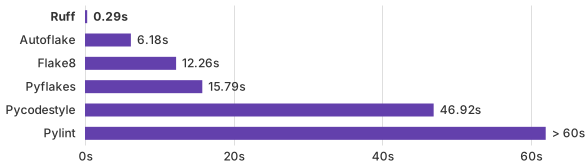
Linting the CPython codebase from scratch.
- ⚡️ 10-100x faster than existing linters (like Flake8) and formatters (like Black)
- 🐍 Installable via
pip - 🛠️
pyproject.tomlsupport - 🤝 Python 3.14 compatibility
- ⚖️ Drop-in parity with Flake8, isort, and Black
- 📦 Built-in caching, to avoid re-analyzing unchanged files
- 🔧 Fix support, for automatic error correction (e.g., automatically remove unused imports)
- 📏 Over 900 built-in rules, with native re-implementations of popular Flake8 plugins, like flake8-bugbear
- ⌨️ First-party editor integrations for VS Code and more
- 🌎 Monorepo-friendly, with hierarchical and cascading configuration
Ruff aims to be orders of magnitude faster than alternative tools while integrating more functionality behind a single, common interface.
Ruff can be used to replace Flake8 (plus dozens of plugins), Black, isort, pydocstyle, pyupgrade, autoflake, and more, all while executing tens or hundreds of times faster than any individual tool.
Ruff is extremely actively developed and used in major open-source projects like:
...and many more.
Ruff is backed by Astral, the creators of uv and ty.
Read the launch post, or the original project announcement.
Testimonials
Sebastián Ramírez, creator of FastAPI:
Ruff is so fast that sometimes I add an intentional bug in the code just to confirm it's actually running and checking the code.
Nick Schrock, founder of Elementl, co-creator of GraphQL:
Why is Ruff a gamechanger? Primarily because it is nearly 1000x faster. Literally. Not a typo. On our largest module (dagster itself, 250k LOC) pylint takes about 2.5 minutes, parallelized across 4 cores on my M1. Running ruff against our entire codebase takes .4 seconds.
Bryan Van de Ven, co-creator of Bokeh, original author of Conda:
Ruff is ~150-200x faster than flake8 on my machine, scanning the whole repo takes ~0.2s instead of ~20s. This is an enormous quality of life improvement for local dev. It's fast enough that I added it as an actual commit hook, which is terrific.
Timothy Crosley, creator of isort:
Just switched my first project to Ruff. Only one downside so far: it's so fast I couldn't believe it was working till I intentionally introduced some errors.
Tim Abbott, lead developer of Zulip (also here):
This is just ridiculously fast...
ruffis amazing.
Table of Contents
For more, see the documentation.
Getting Started
For more, see the documentation.
Installation
Ruff is available as ruff on PyPI.
Invoke Ruff directly with uvx:
uvx ruff check   # Lint all files in the current directory.
uvx ruff format  # Format all files in the current directory.
Or install Ruff with uv (recommended), pip, or pipx:
# With uv.
uv tool install ruff@latest  # Install Ruff globally.
uv add --dev ruff            # Or add Ruff to your project.

# With pip.
pip install ruff

# With pipx.
pipx install ruff
Starting with version 0.5.0, Ruff can be installed with our standalone installers:
# On macOS and Linux.
curl -LsSf https://astral.sh/ruff/install.sh | sh

# On Windows.
powershell -c "irm https://astral.sh/ruff/install.ps1 | iex"

# For a specific version.
curl -LsSf https://astral.sh/ruff/0.15.20/install.sh | sh
powershell -c "irm https://astral.sh/ruff/0.15.20/install.ps1 | iex"
You can also install Ruff via Homebrew, Conda, and with a variety of other package managers.
Usage
To run Ruff as a linter, try any of the following:
ruff check                          # Lint all files in the current directory (and any subdirectories).
ruff check path/to/code/            # Lint all files in `/path/to/code` (and any subdirectories).
ruff check path/to/code/*.py        # Lint all `.py` files in `/path/to/code`.
ruff check path/to/code/to/file.py  # Lint `file.py`.
ruff check @arguments.txt           # Lint using an input file, treating its contents as newline-delimited command-line arguments.
Or, to run Ruff as a formatter:
ruff format                          # Format all files in the current directory (and any subdirectories).
ruff format path/to/code/            # Format all files in `/path/to/code` (and any subdirectories).
ruff format path/to/code/*.py        # Format all `.py` files in `/path/to/code`.
ruff format path/to/code/to/file.py  # Format `file.py`.
ruff format @arguments.txt           # Format using an input file, treating its contents as newline-delimited command-line arguments.
Ruff can also be used as a pre-commit hook via ruff-pre-commit:
- repo: https://github.com/astral-sh/ruff-pre-commit
  # Ruff version.
  rev: v0.15.20
  hooks:
    # Run the linter.
    - id: ruff-check
      args: [ --fix ]
    # Run the formatter.
    - id: ruff-format
Ruff can also be used as a VS Code extension or with various other editors.
Ruff can also be used as a GitHub Action via
ruff-action:
name: Ruff
on: [ push, pull_request ]
jobs:
  ruff:
    runs-on: ubuntu-latest
    steps:
      - uses: actions/checkout@v4
      - uses: astral-sh/ruff-action@v3
Configuration
Ruff can be configured through a pyproject.toml, ruff.toml, or .ruff.toml file (see:
Configuration, or Settings
for a complete list of all configuration options).
If left unspecified, Ruff's default configuration is equivalent to the following ruff.toml file:
# Exclude a variety of commonly ignored directories.
exclude = [
    ".bzr",
    ".direnv",
    ".eggs",
    ".git",
    ".git-rewrite",
    ".hg",
    ".ipynb_checkpoints",
    ".mypy_cache",
    ".nox",
    ".pants.d",
    ".pyenv",
    ".pytest_cache",
    ".pytype",
    ".ruff_cache",
    ".svn",
    ".tox",
    ".venv",
    ".vscode",
    "__pypackages__",
    "_build",
    "buck-out",
    "build",
    "dist",
    "node_modules",
    "site-packages",
    "venv",
]

# Same as Black.
line-length = 88
indent-width = 4

# Assume Python 3.10
target-version = "py310"

[lint]
# Enable Pyflakes (`F`) and a subset of the pycodestyle (`E`) codes by default.
select = ["E4", "E7", "E9", "F"]
ignore = []

# Allow fix for all enabled rules (when `--fix`) is provided.
fixable = ["ALL"]
unfixable = []

# Allow unused variables when underscore-prefixed.
dummy-variable-rgx = "^(_+|(_+[a-zA-Z0-9_]*[a-zA-Z0-9]+?))$"

[format]
# Like Black, use double quotes for strings.
quote-style = "double"

# Like Black, indent with spaces, rather than tabs.
indent-style = "space"

# Like Black, respect magic trailing commas.
skip-magic-trailing-comma = false

# Like Black, automatically detect the appropriate line ending.
line-ending = "auto"
Note that, in a pyproject.toml, each section header should be prefixed with tool.ruff. For
example, [lint] should be replaced with [tool.ruff.lint].
Some configuration options can be provided via dedicated command-line arguments, such as those related to rule enablement and disablement, file discovery, and logging level:
ruff check --select F401 --select F403 --quiet
The remaining configuration options can be provided through a catch-all --config argument:
ruff check --config "lint.per-file-ignores = {'some_file.py' = ['F841']}"
To opt in to the latest lint rules, formatter style changes, interface updates, and more, enable
preview mode by setting preview = true in your configuration
file or passing --preview on the command line. Preview mode enables a collection of unstable
features that may change prior to stabilization.
See ruff help for more on Ruff's top-level commands, or ruff help check and ruff help format
for more on the linting and formatting commands, respectively.
Rules
Ruff supports over 900 lint rules, many of which are inspired by popular tools like Flake8, isort, pyupgrade, and others. Regardless of the rule's origin, Ruff re-implements every rule in Rust as a first-party feature.
By default, Ruff enables Flake8's F rules, along with a subset of the E rules, omitting any
stylistic rules that overlap with the use of a formatter, like ruff format or
Black.
If you're just getting started with Ruff, the default rule set is a great place to start: it catches a wide variety of common errors (like unused imports) with zero configuration.
In preview, Ruff enables an expanded set of default rules
that includes rules from the B, UP, and RUF categories, as well as many more. If you give the
new defaults a try, feel free to leave feedback in the GitHub
discussion, where you can also find the new
rule set listed in full.
Beyond the defaults, Ruff re-implements some of the most popular Flake8 plugins and related code quality tools, including:
- autoflake
- eradicate
- flake8-2020
- flake8-annotations
- flake8-async
- flake8-bandit (#1646)
- flake8-blind-except
- flake8-boolean-trap
- flake8-bugbear
- flake8-builtins
- flake8-commas
- flake8-comprehensions
- flake8-copyright
- flake8-datetimez
- flake8-debugger
- flake8-django
- flake8-docstrings
- flake8-eradicate
- flake8-errmsg
- flake8-executable
- flake8-future-annotations
- flake8-gettext
- flake8-implicit-str-concat
- flake8-import-conventions
- flake8-logging
- flake8-logging-format
- flake8-no-pep420
- flake8-pie
- flake8-print
- flake8-pyi
- flake8-pytest-style
- flake8-quotes
- flake8-raise
- flake8-return
- flake8-self
- flake8-simplify
- flake8-slots
- flake8-super
- flake8-tidy-imports
- flake8-todos
- flake8-type-checking
- flake8-use-pathlib
- flynt (#2102)
- isort
- mccabe
- pandas-vet
- pep8-naming
- pydocstyle
- pygrep-hooks
- pylint-airflow
- pyupgrade
- tryceratops
- yesqa
For a complete enumeration of the supported rules, see Rules.
Contributing
Contributions are welcome and highly appreciated. To get started, check out the contributing guidelines.
You can also join us on Discord.
Support
Having trouble? Check out the existing issues on GitHub, or feel free to open a new one.
You can also ask for help on Discord.
Acknowledgements
Ruff's linter draws on both the APIs and implementation details of many other tools in the Python ecosystem, especially Flake8, Pyflakes, pycodestyle, pydocstyle, pyupgrade, and isort.
In some cases, Ruff includes a "direct" Rust port of the corresponding tool. We're grateful to the maintainers of these tools for their work, and for all the value they've provided to the Python community.
Ruff's formatter is built on a fork of Rome's rome_formatter,
and again draws on both API and implementation details from Rome,
Prettier, and Black.
Ruff's import resolver is based on the import resolution algorithm from Pyright.
Ruff is also influenced by a number of tools outside the Python ecosystem, like Clippy and ESLint.
Ruff is the beneficiary of a large number of contributors.
Ruff is released under the MIT license.
Who's Using Ruff?
Ruff is used by a number of major open-source projects and companies, including:
- Albumentations
- Amazon (AWS SAM)
- Anki
- Anthropic (Python SDK)
- Apache Airflow
- AstraZeneca (Magnus)
- Babel
- Benchling (Refac)
- Bokeh
- Capital One (datacompy)
- CrowdCent (NumerBlox)
- Cryptography (PyCA)
- CERN (Indico)
- DVC
- Dagger
- Dagster
- Databricks (MLflow)
- Dify
- FastAPI
- Godot
- Gradio
- Great Expectations
- HTTPX
- Hatch
- Home Assistant
- Hugging Face (Transformers, Datasets, Diffusers)
- IBM (Qiskit)
- ING Bank (popmon, probatus)
- Ibis
- ivy
- JAX
- Jupyter
- Kraken Tech
- LangChain
- Litestar
- LlamaIndex
- Matrix (Synapse)
- MegaLinter
- Meltano (Meltano CLI, Singer SDK)
- Microsoft (Semantic Kernel, ONNX Runtime, LightGBM)
- Modern Treasury (Python SDK)
- Mozilla (Firefox)
- Mypy
- Nautobot
- Netflix (Dispatch)
- Neon
- Nokia
- NoneBot
- NumPyro
- ONNX
- OpenBB
- Open Wine Components
- PDM
- PaddlePaddle
- Pandas
- Pillow
- Poetry
- Polars
- PostHog
- Prefect (Python SDK, Marvin)
- PyInstaller
- PyMC
- PyMC-Marketing
- pytest
- PyTorch
- Pydantic
- Pylint
- PyScripter
- PyVista
- Reflex
- River
- Rippling
- Robyn
- Saleor
- Scale AI (Launch SDK)
- SciPy
- Snowflake (SnowCLI)
- Sphinx
- Stable Baselines3
- Starlette
- Streamlit
- The Algorithms
- Vega-Altair
- Weblate
- WordPress (Openverse)
- ZenML
- Zulip
- build (PyPA)
- cibuildwheel (PyPA)
- delta-rs
- featuretools
- meson-python
- nox
- pip
Show Your Support
If you're using Ruff, consider adding the Ruff badge to your project's README.md:
[](https://github.com/astral-sh/ruff)
...or README.rst:
.. image:: https://img.shields.io/endpoint?url=https://raw.githubusercontent.com/astral-sh/ruff/main/assets/badge/v2.json
    :target: https://github.com/astral-sh/ruff
    :alt: Ruff
...or, as HTML:
<a href="https://github.com/astral-sh/ruff"><img src="https://img.shields.io/endpoint?url=https://raw.githubusercontent.com/astral-sh/ruff/main/assets/badge/v2.json" alt="Ruff" style="max-width:100%;"></a>
License
This repository is licensed under the MIT License

1 maintainer

Metadata
1 maintainer
Release files for muff 0.15.20
For a detailed explanation of source distributions (sdists) and built distributions (wheels), please see the package formats documentation.
Source distribution (sdist)
| File | Size | Uploaded | |
|---|---|---|---|
| muff-0.15.20.tar.gz | 4.8 MB | Details |
Built distributions (wheels)
| File | Reset | |||
|---|---|---|---|---|
| muff-0.15.20-py3-none-win_amd64.whl | Python 3 | none | Windows x86-64 | Details |
| muff-0.15.20-py3-none-manylinux_2_17_x86_64.manylinux2014_x86_64.whl | Python 3 | none | Linux glibc 2.17+ x86-64 | Details |
| muff-0.15.20-py3-none-manylinux_2_17_aarch64.manylinux2014_aarch64.whl | Python 3 | none | Linux glibc 2.17+ ARM64 | Details |
| muff-0.15.20-py3-none-macosx_11_0_arm64.whl | Python 3 | none | macOS 11.0+ ARM64 | Details |
Total release size: 93.1 MB
Release files / muff-0.15.20.tar.gz
| Download URL | muff-0.15.20.tar.gz |
|---|---|
| Size | 4.8 MB |
| Tags | Source |
|
SHA-256 checksum How to use checksums |
0e16f7d33694bf73a5bc7e3f47d2200146f941ea644664f5c6b3f026879f9448
|
|
BLAKE2b-256 checksum How to use checksums |
133c8ccc98077ea1d45c9b4ce91e0cf8975c94d29905ce1413442ea4685142ef
|
| Upload date | |
|
Uploaded using Trusted Publishing? What is trusted publishing? |
No |
| Uploaded via |
uv/0.8.11
|
Release files / muff-0.15.20-py3-none-win_amd64.whl
| Download URL | muff-0.15.20-py3-none-win_amd64.whl |
|---|---|
| Size | 22.2 MB |
| Tags | Python 3 Windows x86-64 |
|
SHA-256 checksum How to use checksums |
c00621c5e480562ffd324489cb5fbd4f94239e42a77df6c22acdcab953d62289
|
|
BLAKE2b-256 checksum How to use checksums |
eb2e0d2df48865e4dbcb6c00736bdddf179df8e609eeb04c3bc8ea61192b3a63
|
| Upload date | |
|
Uploaded using Trusted Publishing? What is trusted publishing? |
No |
| Uploaded via |
uv/0.8.11
|
Release files / muff-0.15.20-py3-none-manylinux_2_17_x86_64.manylinux2014_x86_64.whl
| Download URL | muff-0.15.20-py3-none-manylinux_2_17_x86_64.manylinux2014_x86_64.whl |
|---|---|
| Size | 23.0 MB |
| Tags | Linux glibc 2.17+ x86-64 Python 3 |
|
SHA-256 checksum How to use checksums |
d4e0b6e174f5eafef829388f72de7219688890e866b16fcc819444a7b6969858
|
|
BLAKE2b-256 checksum How to use checksums |
2536b6970e23d6608c46d71f1d3e391b05a736ef12c13e3a6268717c187394e6
|
| Upload date | |
|
Uploaded using Trusted Publishing? What is trusted publishing? |
No |
| Uploaded via |
uv/0.8.11
|
Release files / muff-0.15.20-py3-none-manylinux_2_17_aarch64.manylinux2014_aarch64.whl
| Download URL | muff-0.15.20-py3-none-manylinux_2_17_aarch64.manylinux2014_aarch64.whl |
|---|---|
| Size | 21.9 MB |
| Tags | Linux glibc 2.17+ ARM64 Python 3 |
|
SHA-256 checksum How to use checksums |
b0fb467c42db305db46d193a127e4201e3e81b95776fedd956b74a0a0cc3af97
|
|
BLAKE2b-256 checksum How to use checksums |
94b6b584ea8909279f8546b016a5b234cb2aa07d8a96b4d5c69085d469029ac8
|
| Upload date | |
|
Uploaded using Trusted Publishing? What is trusted publishing? |
No |
| Uploaded via |
uv/0.8.11
|
Release files / muff-0.15.20-py3-none-macosx_11_0_arm64.whl
| Download URL | muff-0.15.20-py3-none-macosx_11_0_arm64.whl |
|---|---|
| Size | 21.2 MB |
| Tags | Python 3 macOS 11.0+ ARM64 |
|
SHA-256 checksum How to use checksums |
bdf931fd35d892646cc96c891a48b6194a6f0a109b308de57fcc5c0f3b0036ab
|
|
BLAKE2b-256 checksum How to use checksums |
60169f4cf84f4fed3fb19cad8cd501e67d2b20d6b27a06f6c7402532f1696e6e
|
| Upload date | |
|
Uploaded using Trusted Publishing? What is trusted publishing? |
No |
| Uploaded via |
uv/0.8.11
|














