

myGeeKy
Find fellow GitHub geeks who match your CV and repos — and are likely to follow you back.




myGeeKy never follows anyone for you. There's no follow/unfollow code in this project at all (see Safety) — every suggestion is ranked, explained, and only ever a suggestion. You look, you click, you follow people yourself, by hand, on github.com.
Why this exists: I don't have Facebook. I only want to follow people I can genuinely learn from — and who might learn something from me too. myGeeKy is a GitHub-friendly alternative for people like me: we want real friends, and we're wary of fake ones.
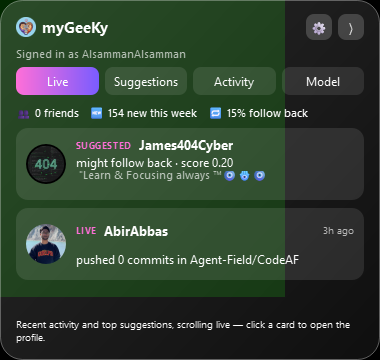
The actual panel — translucent, docked to the screen edge, showing real activity from people you follow.
How it works
GitHub's Markdown renderer strips <script> tags (security), so it can't
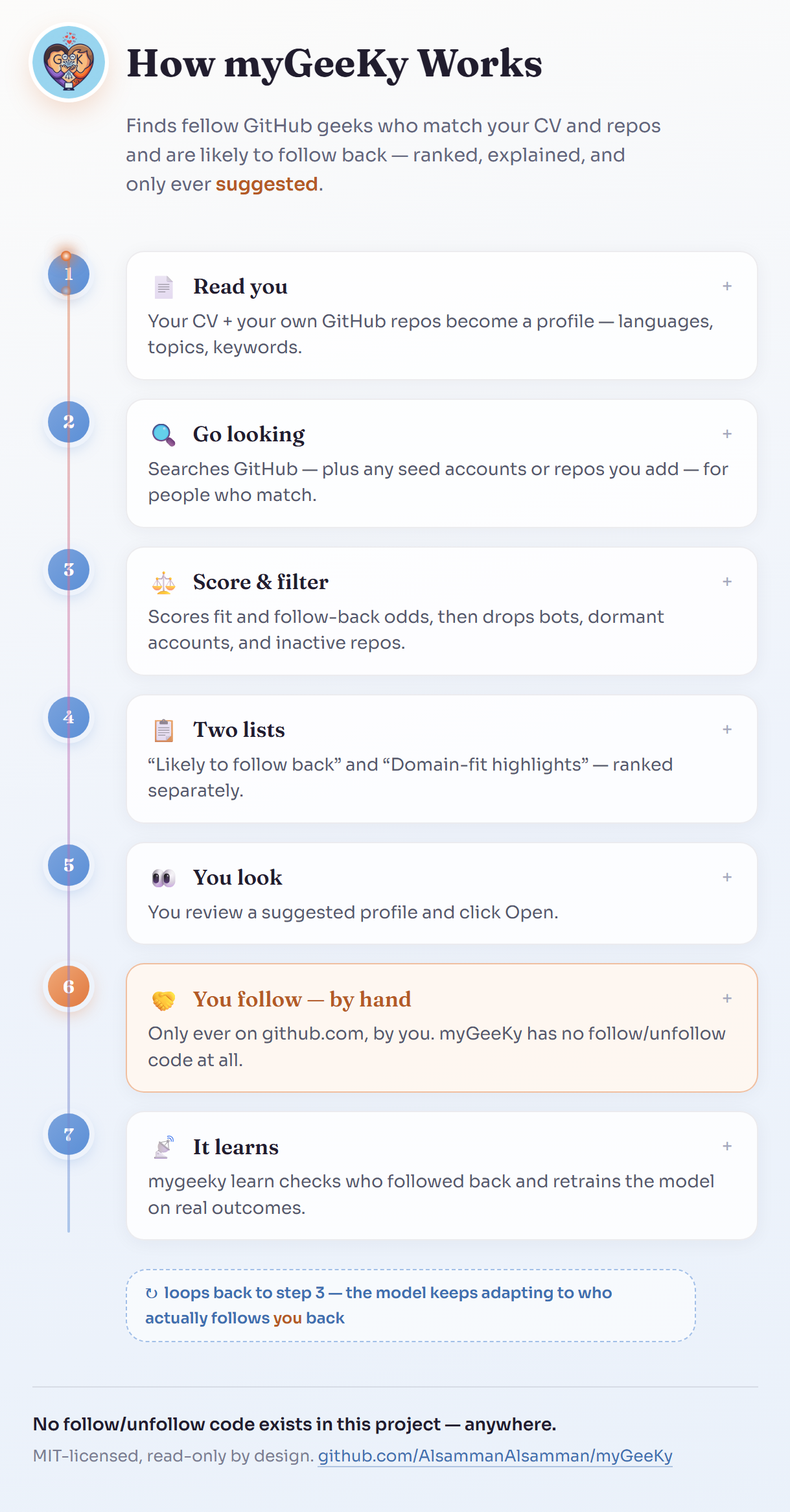
run a live JS diagram inline — the image below is a preview of a real,
animated, click-to-expand HTML/JS page that ships in this repo at
docs/flowchart.html:
▶ Open the live interactive version
— real vanilla JS (click any step to expand it), served straight off this
repo via githack, no build step, no server.
(If that link is ever slow/unavailable: clone the repo and open
docs/flowchart.html directly in a browser — it's fully self-contained,
zero dependencies.)
The pink "You follow — by hand" step is the only place a follow ever happens — myGeeKy has no follow/unfollow code anywhere in the project; see Safety.
What it does
- Understands you — reads your CV (txt/md/pdf) plus your own GitHub repos (languages, topics, descriptions) to build a profile of what you're into, and auto-derives a weighted "domain vocabulary" from that corpus (not a hardcoded field-specific wordlist).
- Collects candidates from multiple sources, not just a plain search:
GitHub user search (language/location/follower filters), followers of
well-known accounts in your field (
seed_accounts), stargazers of relevant repos (seed_repos), stargazers of your own repos, and optionally second-degree contacts (people followed by people you already follow). Candidates corroborated by more than one source get a small ranking boost. - Filters out noise before scoring: accounts following more than
max_followingpeople (a growth-hacking/mass-follow pattern, not genuine engagement), dormant/throwaway-looking accounts, organizations, and — for the top-ranked candidates — a real per-repo activity check (a maintained repo pushed to recently, or a freshly-created one; a profile'supdated_atalone can just reflect a bio edit). - Scores each surviving candidate on:
- content similarity to your CV/repos (TF-IDF + cosine similarity)
- how likely they are to follow back (their own following/follower ratio)
- how active their account is
- once you've used it a while: a learned model (see below)
- Suggests two ranked lists, not one — printed, or returned as JSON.
Nothing is followed automatically:
- Likely to follow back — the blended score above.
- Domain-fit highlights — ranked purely by match to your CV/repos, independent of follow-back likelihood. A senior domain expert who follows almost no one on GitHub is exactly who the follow-back score would otherwise bury, and is often the best actual match.
- Learns from real outcomes, not just from waiting:
mygeeky bootstrapseeds the model immediately from accounts you already follow (checks, read-only, who already follows you back) — so you get real training data on day one instead of waiting weeks.mygeeky learn(meant to run weekly) looks at who you actually followed since the last check, checks whether they followed back, and retrains a logistic-regression model on the growing set of outcomes — reporting cross-validated AUC so you can see how trustworthy it is, and excluding mass-follow outliers from training.
Install
pip install mygeeky
(For PDF CVs: pip install "mygeeky[pdf]".)
Quick start
mygeeky init      # asks for your GitHub username, CV, and the kind of people you're looking for
mygeeky run       # get your first batch of suggestions
mygeeky init asks a short set of questions — all optional, all editable
later:
- Your GitHub username
- Your CV (a file path, pasted text, or skip)
- Languages / topics / keywords / locations you're looking for
- Optional extra candidate sources: well-known accounts in your field, relevant repos
- Follower-count range,
max_following, minimum repo count, how many suggestions per run
Then it offers to store a GitHub token (see Safety — this is
handled very deliberately), and — if a token is set up — offers to run
mygeeky bootstrap immediately so you're not starting the learning model
from zero.
Everyday use
mygeeky run                 # search + rank + suggest (two lists: followback + domain-fit)
mygeeky run --json          # same, as JSON (for scripts / AI agents)
mygeeky suggestions         # re-print the last run's results without re-querying GitHub
mygeeky bootstrap           # seed the model from accounts you already follow (run once, early)
mygeeky learn               # check who you followed since last time, learn from who followed back
mygeeky pipeline            # learn, then run — this is what the weekly schedule calls
mygeeky gui                 # launch the live glass panel (needs `pip install "mygeeky[gui]"`)
Running it weekly
myGeeKy doesn't run in the background by itself — you decide when it's allowed to touch your OS's task scheduler:
mygeeky schedule show          # print the exact command/cron line for your OS (does nothing)
mygeeky schedule install --yes # actually register it (Windows Task Scheduler / cron)
mygeeky schedule remove        # undo it
The scheduled job runs mygeeky pipeline — i.e. it checks and learns
from what you did last week, then produces new suggestions. It still never
follows anyone.
Live glass panel (optional GUI)
pip install "mygeeky[gui]"
mygeeky gui          # (or the standalone `mygeeky-gui` command)
A small, translucent, always-on-top panel docked to the edge of your
screen (Windows and Linux), built with PySide6/Qt
— native widgets, not a webview. (An earlier version used pywebview; its
WebView2-on-Windows transparency turned out to be a confirmed, currently
inconsistent upstream bug that even its maintainer can't reproduce reliably
across machines — see pywebview#1611.
Qt's WA_TranslucentBackground is the mature, well-supported way apps
actually get real per-pixel window transparency on Windows.) Click the
folded tab to expand it; click the arrow to fold it back to a slim strip.
- Suggestions tab — both lists from
mygeeky run(avatar, bio, score), each with an Open → button that opens their GitHub profile in your browser. That's the only thing a click ever does — myGeeKy still never follows anyone; a "Refresh" button re-runs a real search on demand (it never does this on a timer, to avoid hammering GitHub's rate limits). - Activity tab — a live feed of what people you follow are actually
doing (pushes, merged PRs, new repos, releases, stars...), from GitHub's
own events API. Refreshes automatically, but no more often than
gui_activity_refresh_minutes(default 5) — and that refresh is a single cheap API call, not a full search. - Model tab — a chart of your learned model's cross-validated AUC and
training-set size over time, so you can watch it actually improve as you
run
mygeeky bootstrap/learn.
⚙ Settings — click the small gear icon in the header to open a compact panel with:
- Theme, switchable live (no restart needed): Midnight Glass (dark, cool-toned, the default), Frosted White (light, warm, iOS-control-center-like), and Vibrant Aurora (saturated, colorful, leans into the geeky/hearts branding).
- Transparency, a slider from 35% to 100% window opacity, applied live as you drag.
Both choices are saved (gui_theme, gui_opacity) and remembered next time
you open the panel.
Config: gui_dock_side ("right"/"left"), gui_expanded_width,
gui_folded_width, gui_panel_height_fraction, gui_activity_refresh_minutes,
gui_activity_limit, gui_theme ("midnight"/"frosted"/"aurora"),
gui_opacity (0.35-1.0) — same mygeeky config set mechanism as
everything else.
No LLM/AI is used anywhere in the GUI (or the rest of myGeeKy) — the suggestions, activity feed, and model chart are all built from the same TF-IDF/logistic-regression pipeline the CLI uses, so there's no API cost and nothing to configure to make it work. (There's deliberately no way to plug in a Claude subscription either — that kind of auth is scoped to Claude Code itself and isn't something a third-party tool can piggyback on; if you ever want AI-written explanations, that'd be a separate opt-in using your own API key or a local model, not something myGeeKy needs.)
Rendering note: the panel is genuinely transparent (real per-pixel alpha, confirmed on Windows 11), but it's a flat translucency, not a blurred "frosted glass" effect — Windows' native DWM Acrylic/Mica backdrop was tried and turned out to conflict with Qt's own transparency on tested hardware, reliably making the window opaque instead, so it isn't wired up. On Linux, real transparency depends on your compositor/window manager the same way it does for any Qt app.
All parameters (adjustable, or leave at the defaults)
mygeeky config show
mygeeky config set max_followers 3000
mygeeky config set languages "Python, Rust, Go"
mygeeky config reset
Full parameter table — every key, what it does, and its default
| Key | Meaning | Default |
|---|---|---|
languages |
languages you're looking for | [] (any) |
topics |
topics/interests you're looking for | [] (any) |
keywords |
extra free-text interests fed into matching | [] |
locations |
optional location filter | [] (any) |
min_followers / max_followers |
candidate follower-count range | 0 / 20000 |
max_following |
reject candidates following more than this (growth-hacking signal) | 500 |
min_public_repos |
minimum public repos a candidate must have | 2 |
require_followers_or_following / min_followers_gate / min_following_gate |
drop dormant/throwaway accounts with neither | true / 5 / 5 |
exclude_organizations |
skip org accounts | true |
exclude_already_following |
skip people you already follow | true |
exclude_users |
usernames to never suggest | [] |
seed_accounts |
candidates = followers of these well-known accounts | [] |
seed_repos |
candidates = stargazers of these owner/repo repos |
[] |
include_own_stargazers |
candidates = people who starred your own repos | true |
include_second_degree / second_degree_sample |
candidates = who a sample of your followees follow (expensive) | false / 15 |
source_max_pages |
pages fetched per candidate source | 3 |
activity_check_top_n |
how many top-ranked candidates get the real per-repo activity check | 150 |
max_repo_push_age_days / recent_upload_days / min_maintain_span_days |
real activity QC thresholds | 365 / 120 / 60 |
domain_vocab_size / domain_highlight_count |
size of the auto-derived domain vocabulary / highlight list | 25 / 15 |
search_pages |
GitHub search pages scanned per query | 3 |
max_candidates_per_run |
cap on candidates evaluated per run | 60 |
max_suggestions_returned |
cap on follow-back suggestions shown per run | 15 |
similarity_threshold |
minimum blended score to be suggested | 0.08 |
content_similarity_weight / follow_back_ratio_weight / activity_weight |
heuristic scoring weights | 0.5 / 0.3 / 0.2 |
rate_limit_sleep_seconds / search_pause_seconds |
pacing for normal vs. GitHub's tighter search-API rate limit | 1.5 / 2.1 |
min_training_samples |
labeled examples needed before the ML model kicks in | 8 |
ml_blend_weight |
how much the learned model influences the final score once trained | 0.5 |
training_mass_follow_outlier |
exclude training examples from accounts following more than this | 3000 |
gui_dock_side |
which screen edge the live panel docks to ("right"/"left") |
"right" |
gui_expanded_width / gui_folded_width |
panel width in pixels, expanded vs. folded | 380 / 48 |
gui_panel_height_fraction |
panel height as a fraction of the screen height | 0.25 |
gui_activity_refresh_minutes |
minimum minutes between automatic activity-feed refreshes | 5 |
gui_activity_limit |
how many recent activity events to show | 30 |
gui_theme |
glass style ("midnight"/"frosted"/"aurora") |
"midnight" |
gui_opacity |
whole-window transparency, adjustable via the ⚙ settings panel | 1.0 |
Safety
- No follow/unfollow code exists in this project.
github_client.pyonly implements read endpoints (GET). There is no method that callsPUT /user/following/*, so myGeeKy cannot follow anyone even by accident, regardless of what token scope you provide. - Your GitHub token is never written to a file. It's requested with
hidden input (
getpass) and stored only in your OS's encrypted secret store via thekeyringpackage (Windows Credential Locker / macOS Keychain / Linux Secret Service).mygeeky auth statusshows where it's coming from — never the value. An environment variable (MYGEEKY_GITHUB_TOKEN) is supported as an explicit, opt-in fallback for CI/agent contexts. - Minimal token scope. myGeeKy only reads public profile/repo/follower data — create your token with no scopes at all, or a fine-grained token limited to read-only public repositories/followers. Never grant it write or admin scopes.
- All local state (config, CV text, suggestion history, the learned model) lives under your OS's standard config/data directories, not inside this project folder, so nothing personal ever ends up in a repo or a published package by accident.
- The GUI follows the same rule.
open_profile()(the only thing a click in the panel can trigger) refuses to open anything that isn't ahttps://github.com/...URL, and there's no other code path from the panel to the network beyond the read-only suggestion/activity fetches described above.
Using myGeeKy from an AI agent / script
Every result-producing command supports --json:
mygeeky run --json
Example output shape
{
  "followback": [
    {
      "username": "example-geek",
      "profile_url": "https://github.com/example-geek",
      "score": 0.4123,
      "score_breakdown": {"heuristic": 0.41, "ml_proba": null, "blended": 0.41},
      "features": {
        "content_similarity": 0.31,
        "follow_back_ratio": 0.9,
        "activity_recency": 1.0,
        "shared_languages": 0.5,
        "shared_topics": 0.33
      },
      "domain_fit": 0.62,
      "followers": 120,
      "following": 140,
      "public_repos": 34,
      "bio": "...",
      "sources": ["search:language:Python followers:0..20000 ...", "starred_your_repo:you/tool"],
      "n_sources": 2,
      "timestamp": "2026-09-17T12:00:00+00:00",
      "list": "followback"
    }
  ],
  "domain_highlights": [
    { "...": "same shape, ranked by domain_fit instead of score", "list": "domain" }
  ]
}
An agent can read this list and present it to you — it should never be wired up to auto-follow anyone; that defeats the entire point of this tool.
How the "learning" works
Bootstrapping, retraining, and how to read the AUC
Bootstrapping (day one): mygeeky bootstrap looks at accounts you
already follow, checks (read-only) whether each one follows you back,
and logs (features, followed_back) as a training example immediately —
so the model has real data from the start instead of an empty cold start
that only grows by however many people you manually follow each week.
Ongoing (weekly): mygeeky learn compares your current GitHub
following list against a snapshot taken at the last check. Anyone new is a
person you chose to follow. It checks whether they followed back and
logs the same kind of training example.
In both cases: once there are at least min_training_samples examples
with both outcomes represented (excluding accounts following more than
training_mass_follow_outlier, a growth-hacking outlier that would
distort the model), a scikit-learn LogisticRegression model is trained
and its prediction is blended into future scores (ml_blend_weight
controls how much). myGeeKy reports the model's cross-validated AUC each
time it retrains, so you can judge how trustworthy it is rather than take
it on faith — with a small training set, treat it as directional, not
precise. This is intentionally simple and transparent rather than a black
box — you can inspect score_breakdown on every suggestion to see the
heuristic and learned components separately.
Two lists, on purpose
mygeeky run produces a followback list (ranked by the blended
score above) and a domain_highlights list (ranked purely by
domain_fit, an auto-derived match to your CV/repo vocabulary,
independent of follow-back likelihood). These optimize for different
things: some of the best domain-specific matches — senior researchers,
niche maintainers — follow almost no one on GitHub, so the reciprocation
model correctly scores them low even though they may be the best actual
fit. Both lists go through the same activity-QC and bot/dormant filters.
License
MIT — see LICENSE.
1 maintainer

Release files for mygeeky 0.1.1
For a detailed explanation of source distributions (sdists) and built distributions (wheels), please see the package formats documentation.
Source distribution (sdist)
| File | Size | Uploaded | |
|---|---|---|---|
| mygeeky-0.1.1.tar.gz | 435.9 kB | Details |
Built distribution (wheel)
| File | Interpreter | ABI | Platform | Reset |
|---|---|---|---|---|
| mygeeky-0.1.1-py3-none-any.whl | Python 3 | none | any | Details |
Total release size: 860.7 kB
Release files / mygeeky-0.1.1.tar.gz
| Download URL | mygeeky-0.1.1.tar.gz |
|---|---|
| Size | 435.9 kB |
| Tags | Source |
|
SHA-256 checksum How to use checksums |
00a5d1b6a74e9949ed0a8763698b2f53b381f96e426a015df0b4b9878d62ac0f
|
|
BLAKE2b-256 checksum How to use checksums |
5e329dfb491c591cc50309a472522ea743615e415db9fe57b3b58d90da46c5f5
|
| Upload date | |
|
Uploaded using Trusted Publishing? What is trusted publishing? |
No |
| Uploaded via |
twine/7.0.0 CPython/3.12.10
|
Release files / mygeeky-0.1.1-py3-none-any.whl
| Download URL | mygeeky-0.1.1-py3-none-any.whl |
|---|---|
| Size | 424.7 kB |
| Tags | Python 3 |
|
SHA-256 checksum How to use checksums |
d5a7b3055343d26633a76acac0f8fd07d7f269305d2594d74a356e2d295ea0ce
|
|
BLAKE2b-256 checksum How to use checksums |
972208a4422c2269bf1ae90ad3a9a34b146f37618e3c920e1b02dd21ccdee856
|
| Upload date | |
|
Uploaded using Trusted Publishing? What is trusted publishing? |
No |
| Uploaded via |
twine/7.0.0 CPython/3.12.10
|














