

OpenFocus
Every pixel, its sharpest frame.
Ten fusion algorithms, five alignment choices and a source-locked retouch workspace for macro, microscopy and industrial stacks. 16-bit end to end, a headless CLI, and a UI in twelve languages.








Download · Docs · Changelog · DOI
English · 简体中文 · 日本語 · Español · Deutsch · Français · Русский · 한국어 · Português · Italiano · Nederlands · Polski

📢 News
Earlier releases are in the Changelog.
📸 If you publish images created with OpenFocus, please consider adding a note such as:
Created with OpenFocus — https://github.com/Xinzhe99/OpenFocus
This is not mandatory, but highly appreciated.
Features


Also in the box:
- Focus-stack workflow — stack browser, sharpness curve, quick preview, ROI render, and per-method settings remembered across restarts.
- Microscopy-ready — 16-bit end to end, µm/px from TIFF metadata, dust-map flat-field correction, multi-page TIFF Z-stacks, textured OBJ export.
- Color profiles — single-image PNG, TIFF, JPEG and WebP exports retain a shared RGB ICC profile when every source frame has the same profile. Mixed or untagged stacks have no profile attached; pixels are not color-converted.
- Transparent PNG — stacks with matching rectangular constant-opacity masks can be fused at full size and saved as PNG. See the manual for restrictions.
- Headless CLI — the same pipeline as
openfocus, with batch mode,--dry-run,--resumeand JSON output for scripting. - Agent-drivable — a token-protected local channel drives the live GUI (typed pipeline commands plus generic widget/menu/mouse/keyboard control), with a skill, a 14-check smoke runner and a full menu-action sweep.
- Projects and recovery —
.ofprojsessions, crash auto-recovery, undo/redo across stack edits and annotations. - Twelve UI languages — English, 中文, 日本語, Español, Deutsch, Français,
Русский, 한국어, Português, Italiano, Nederlands, Polski. Auto-detected from
the system locale; a new language is one
locales/<code>.pyfile. - Light on memory — the neural stack is loaded only when the neural method is used, so a classical-method session idles around 110 MB instead of 260 MB.
⬇️ Install
Download the latest Windows or macOS build from the OpenFocus website. The same files and older versions are also available on GitHub Releases.
| Platform | File | Type |
|---|---|---|
| Windows 10/11 (64-bit) | OpenFocus-*-setup.exe |
Installer (recommended) |
| Windows 10/11 (64-bit) | OpenFocus-*-windows-x64.zip |
Portable (unzip and run) |
| macOS Apple Silicon (M1–M4) | OpenFocus-*-macos.dmg |
Disk image (drag to Applications) |
| macOS Apple Silicon (M1–M4) | OpenFocus-*-macos-arm64.zip |
Portable (unzip) |
Windows signing varies by release; check the release notes. macOS builds are not notarized, and either platform may show a security prompt on first launch. On Windows, choose SmartScreen → "More info" → "Run anyway" (the first start may take 30–60 s). On macOS, run xattr -cr /Applications/OpenFocus.app for an app installed from the DMG, or xattr -cr ~/Applications/OpenFocus.app for a terminal installation; alternatively open the app once and allow it in System Settings → Privacy & Security → Open Anyway.
To install from a terminal, preview the macOS or Linux command first, then run
it without --dry-run. On Linux this installs the headless CLI; macOS builds
require Apple Silicon and are installed into ~/Applications.
curl -fsSL https://openfocus.top/install.sh | sh -s -- --dry-run
curl -fsSL https://openfocus.top/install.sh | sh
On Windows, run the installer from PowerShell:
irm https://openfocus.top/install.ps1 | iex
The direct Windows setup download is also available with
curl -fL https://openfocus.top/download/latest/windows-setup -o OpenFocus-setup.exe.
Code signing policy
When enabled, free code signing on Windows is provided by SignPath.io, certificate by SignPath Foundation. Check the release notes for each build's signing status.
- Committers and reviewers: the project's repository maintainers with write access (GitHub repository).
- Approvers: repository owner @Xinzhe99.
- Privacy: OpenFocus collects no telemetry and uploads no user data. The only automatic network request is the daily GitHub Releases update check; see the Privacy Policy.
🤖 Agent integration
The desktop app starts a token-protected local agent channel automatically.
Use openfocus ctl for typed commands or generic UI actions against the live
window. Agents can load stacks, render, export, open and fill dialogs,
answer file pickers, send mouse/keyboard events and take screenshots.
The pip install openfocus package is headless. To use its ctl command
with a separately running desktop app, also install PyQt6 (pip install PyQt6).
The wheel cannot launch the desktop app; use the desktop build or a checkout.
- Skill:
skills/openfocus-control/SKILL.md - Protocol and command reference:
docs/AGENT_CONTROL_SPEC.md - End-to-end runner:
python tools/agent_gui_smoke.py --launch - Every-action sweep:
python tools/agent_action_sweep.py --launch
💻 Command Line Usage
Or install the CLI on Windows, macOS and Linux — the same pipeline, no GUI stack:
pip install openfocus
openfocus -i ./stack_folder -o ./result/fused.png
See the CLI manual.
Community & Support
- Docs — User Manual (twelve languages) · Changelog · Performance · Fusion methods
- Citation — CITATION.cff; every release is archived on Zenodo (DOI)
- Feedback — open an issue for bugs, ideas and algorithm work
- Credits — each fusion/registration algorithm keeps its original research licence; StackMFF V3 lives at Xinzhe99/StackMFF-V3
License
The OpenFocus application is released under the MIT License.
StackMFF series exception. The StackMFF fusion algorithms — currently StackMFF V3 and any future state-of-the-art editions — remain the property of the OpenFocus project, which retains all rights to the StackMFF series. You may use them as part of OpenFocus for your own images and internal work. Copying, porting or migrating these algorithms into another open-source project requires prior written permission.
Developing
Run from a checkout:
conda create -n openfocus python=3.10
conda activate openfocus
pip install -r requirements.txt
python main.py
Packaging with PyInstaller: docs/BUILD_COMMANDS.md.
Adding a fusion or registration algorithm: CONTRIBUTING.md. The extensibility specification defines the shared registration, parameter, execution and persistence contracts.
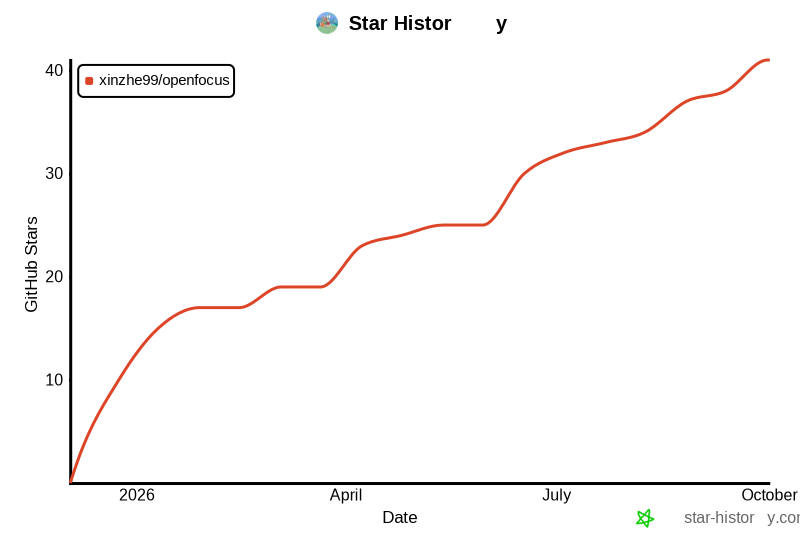
⭐ Star History
1 maintainer

Metadata
1 maintainer
Release files for openfocus 1.75.0
For a detailed explanation of source distributions (sdists) and built distributions (wheels), please see the package formats documentation.
Source distribution (sdist)
| File | Size | Uploaded | Provenance | Actions |
|---|---|---|---|---|
| openfocus-1.75.0.tar.gz | 24.2 MB | Without provenance | Details for openfocus-1.75.0.tar.gz |
Built distribution (wheel)
| File | Interpreter | ABI | Platform | Actions Reset |
|---|---|---|---|---|
| openfocus-1.75.0-py3-none-any.whl | Python 3 | none | any | Details for openfocus-1.75.0-py3-none-any.whl |
Total release size: 48.1 MB
Release files / openfocus-1.75.0.tar.gz
| Download URL | openfocus-1.75.0.tar.gz |
|---|---|
| Size | 24.2 MB |
| Tags | Source |
|
SHA-256 checksum How to use checksums |
f10d9f1586aea5165e72d543d9caee2f63f974e18040fe3c5051634d003df5c0
|
|
BLAKE2b-256 checksum How to use checksums |
94d221ed2de0f8acaa45f86a959393703217e5e36e1ec710d18d6e5544468380
|
| Upload date | |
|
Uploaded using Trusted Publishing? What is trusted publishing? |
No |
| Uploaded via |
twine/7.0.0 CPython/3.14.4
|
Release files / openfocus-1.75.0-py3-none-any.whl
| Download URL | openfocus-1.75.0-py3-none-any.whl |
|---|---|
| Size | 23.9 MB |
| Tags | Python 3 |
|
SHA-256 checksum How to use checksums |
b7c6601c20b197e211f5f626dcd2d1152001f708ca6287e9d3b5ef47f8c7864f
|
|
BLAKE2b-256 checksum How to use checksums |
447995fb015bcb482cb75aaa1a0bfb431ba534a52872c8f1eabfc6ddc8966da0
|
| Upload date | |
|
Uploaded using Trusted Publishing? What is trusted publishing? |
No |
| Uploaded via |
twine/7.0.0 CPython/3.14.4
|
Security for openfocus 1.75.0
Provenance
Provenance describes where a file came from. On PyPI, provenance is shared via attestations, which provide a verifiable record of the build or publishing details. View details, limitations and caveats.
No provenance found
None of the files in this release were uploaded with provenance metadata.
A note on package security
PyPI is a repository for distributing packages, not a service for auditing them. While third-party security researchers and our staff do their best to detect and remove malicious packages, PyPI cannot guarantee the quality, security or suitability of any given package.
To learn more about protecting yourself from malicious actors, visit our package security documentation.














